
Archive of Unknown Universes' Presents Alternate Versions of History
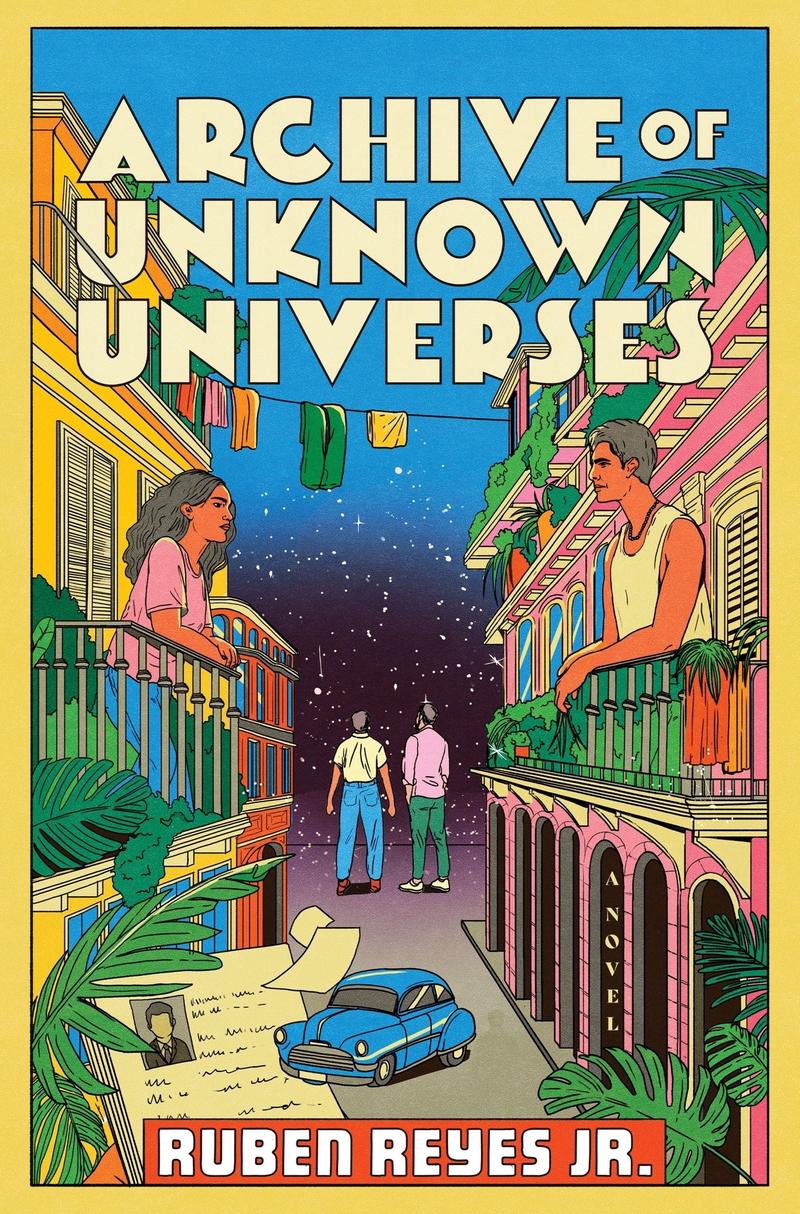
Alison Stewart: This is All Of It on WNYC. I'm Alison Stewart. This year, we're celebrating Hispanic Heritage Month with conversations with debut novelists. Today, we'll hear about a new novel titled Archive of Unknown Universes. The story follows two families in alternate timelines of the Salvadoran Civil War. Set in 2018, a machine called The Defractor allows users to sift through alternative versions of themselves, witnessing lives that they could have lived. In the novel, we're introduced to Ana Flores and her boyfriend, Luis Guzmán, two Harvard students on a joint research trip to Havana, Cuba, and San Salvador, the capital of El Salvador.
Ana uses the machine to explore what-ifs about her relationship and Luis's family secrets. One in particular is the relationship between two men, Neto and Rafael, 1970s revolutionaries who love story is snuffed out by a brutal of war and homophobia. The Washington Post states, "In his debut novel, the brilliant young writer, Ruben Reyes Jr., turns that art of speculation into a riveting saga of answers."
His story collection, There Is a Rio Grande in Heaven, was a finalist for the Story Prize and long listed for the PEN/Faulkner Award for Fiction, and his debut novel is Archive of Unknown Universes. This Thursday, he has an event to celebrate the release of the novel at the World's Borough Bookstore in Jackson Heights, Queens. It's happening at 7:00 PM. He is in studio now. Ruben, welcome.
Ruben Reyes Jr.: Hi. I'm thrilled to be here. Thanks for having me.
Alison Stewart: Your latest novel, Archive of Unknown Universes, follows these two families in alternative timelines of the Salvadoran Civil War. You're also the child of true Salvadoran immigrants. What was something that you wanted to explore about the war's effects on Salvadorans in this novel?
Ruben Reyes Jr.: I was really interested in the intergenerational effects of war. Before I actually started writing the novel, probably a whole two years before I read this incredible academic article by a sociologist named Leisy Abrego, who basically argues that because the Salvadoran Civil War and the US's influence in it was denied by the government, by other actors, Salvadoran children and immigrants grew up without knowing that history. She has a line along the lines of because it was officially denied, people began to deny it in their own lives. This novel is a way of trying to break those silences, and in some ways reflects my own journey of learning more about the Salvadoran Civil War.
Alison Stewart: It's really interesting. Early in the book you write, and this set it up so beautifully, you wrote, "Ana's research goals were simple, to prove that diaspora existed before 1980, that Salvadorans shaped the world before the war, before their global displacement. Growing up, only people who migrated from El Salvador, like her mother, knew where it was. The country felt unimportant, too small to matter, a cultural irrelevance. Her research was going to disprove what she spent a lifetime believing."
That's such a beautiful, beautiful sentence. What are some of the universal themes that come up that we share all as humans? That's a very specific theme, but what are the universal themes that come up in the book?
Ruben Reyes Jr.: I think the heart of this book is really the love stories that are here. I grew up reading love stories, loving love stories. I love romcoms. I love sad dramas about unhappy couples. I love it all. In my first book, I wrote some relationships, but it was often in service of other questions. In this book, I wanted to tackle the question of love, and specifically, whether people are made for each other really explicitly. We have two couples that I think approach that question in opposite ways. We have Neto and Rafael, who, without giving too much away, feel like they're destined to be together, and then we have Ana and Luis, who are choosing each other every day.
Alison Stewart: Tell us about The Defractor.
Ruben Reyes Jr.: Yes.
Alison Stewart: How does it work?
Ruben Reyes Jr.: Well, if you are a student at a university, because that's the rule that I created in the novel, you can go check it out from the desk, attach it to your temple, and ask it a guiding question, and then the device will show you, either visually or textually, other versions of the life you could have been living.
Alison Stewart: Now, you're only supposed to use it for research, though.
Ruben Reyes Jr.: Yes, but some people break the rules. The temptation is a little too strong. It's this device that people come to for advice, for guidance, even though that's not its official purpose.
Alison Stewart: First of all, but you place it in 2018, not 2028 or 2058. Why did you put this technology available seven years ago?
Ruben Reyes Jr.: I think it was a little bit of write what you know. These students are at Harvard at the time that I was at Harvard, at a time when I was starting to ask these big questions about my family history, about myself, about how to be an adult, all themes that run throughout. The device was-- helps the plot along in many ways. It was also an interesting way of getting to the universal question of what-if, which is one I asked myself back then. Still ask myself now, and I'm sure will ask myself a decade from now.
Alison Stewart: There are ongoing ethical issues about The Defractor. What are they?
Ruben Reyes Jr.: Some people are worried about its misuse, this idea that people will become over-reliant on it. In the world of the novel, the Catholic Church, which has a big impact especially on Ana's life, has officially said that people shouldn't use The Defractor. I think there was an idea that if we turn to guidance from technology, where do we end up? Which is a question I think about all the time, especially today.
Alison Stewart: It's funny. Ana goes to The Defractor, and she-- it's after Alanis Morissette is the voice she uses. What is she searching for?
Ruben Reyes Jr.: Really specifically, she's looking for answers. In the first chapter, I feel comfortable saying this because in the first chapter, but she finds this portrait, this idea of a man she doesn't know, hiding amongst her mother's things. She really wants to know, who is this man? The underlying thing is that she wants to know what her mother went through the Salvadoran Civil War.
Like I mentioned earlier, a lot of immigrants who lived through that kind of trauma are unable to talk about it. It's too hard to look back at that moment in one's life. Ana knows her mother is an immigrant, knows that there was a war, but doesn't know much more. The novel is partially about her trying to break these silences in her past.
Alison Stewart: While she's using The Defractor, Ana's boyfriend, this other world, her boyfriend is a student named Luis Guzmán, but the technology shows her in life with another man.
Ruben Reyes Jr.: Yes, a mystery man who is also very handsome.
Alison Stewart: Oh, by the way. [chuckles]
Ruben Reyes Jr.: It's a very important detail.
Alison Stewart: What is that sight of her with another man? What does it make her feel?
Ruben Reyes Jr.: She feels really confused. I think when she sees that, she sees or projects maybe what she's not getting out of her current relationship, which I think is really just, again, another one of these universal things of the grass is always greener, whether it's where you're living or who you're dating or any number of things.
Alison Stewart: A new novel takes place in a world where one machine allows users to easily sift through alternative timelines. Author Ruben Reyes Jr. joins us to discuss his book, Archive of the Unknown Universe. He has an event to celebrate the release this Thursday, September 25th, at the World's Borough Bookstore in Jackson Heights, Queens. You're going to read a little bit of the book for us. Set this up for us.
Ruben Reyes Jr.: Yes. As I mentioned earlier, there is this sweeping love story set in the late '70s between two men. I'm going to read just a couple of paragraphs that I think captures both their love story and the political context happening around them. "1979. They track their love in deaths. When Neto visits Managua for the first time, the government murders 11 students at a protest in broad daylight. Rafael lands in Ilopango in 1977, and just 25 miles away, a nightmare descends on Aguilares. A church is shot up and three Jesuit priests are kidnapped, then disappeared.
"Every couple of months, with every letter Neto and Rafael send, a new death squad pops up. Finally, when they're in Havana in 1978, no one they know dies. They take it as a blessing, a good omen at last. Death, Rafael prays, will not trail them this time. He waits outside the airport until a red truck appears, the passenger door forced open. He half expects a rifle pointed right at his chest, but no, it's far less deadly than facing a gunman, but just as thrilling. There he is, full of life, aglow, with a grin Rafael knows well, Neto."
Alison Stewart: That's Ruben Reyes reading from his book, Archive of the Unknown Universes. Let's talk about writing about multiverses. As a writer, first of all, how did you keep track of all the different realities?
Ruben Reyes Jr.: Oh my gosh, that was one of the major challenges of this book. The structure specifically is something I worked on pretty much to the last minute till I had to go to the printer.
Alison Stewart: Really?
Ruben Reyes Jr.: Yes, pretty close to it. My editor was really helpful in that way, but there were no cards, there were timelines I had written down. I also had to set limitations on myself. When you're writing about multiverses, that goes out infinitely. I could have written 10 different timelines, but I chose to focus basically on 3. Yes, it was tricky, and it was a big challenge, but I think it really came together towards the end.
Alison Stewart: As you said, you go in so many different directions talking about multiverses. How often did you start exploring one reality, and then, "No, I'm going to something else"?
Ruben Reyes Jr.: Eventually, I wanted to focus on how the relationships or the timelines played off of each other.
Alison Stewart: Interesting.
Ruben Reyes Jr.: Ana is a consistent between two alternate versions of 2018, but I wanted her to have really different relationships, different struggles, even though she was the same character in them. Once I had that constriction of these two timelines are in conversation with each other, it was a little bit easier to navigate.
Alison Stewart: You jump from 2018 back to 1978, from the United States to Cuba to El Salvador to Nicaragua. Why was it important to you to try to establish a place of time and sense for the reader when you have so many different places that you were taking us?
Ruben Reyes Jr.: I think the first thing is that as a writer, you want a reader to be in scene as much as possible. You don't want to confuse them because it's really hard to get to the character and to the plot if someone's confused about the basics. It was really important that I take a wide span because, as you mentioned earlier in the quote, I was really interested in this idea of Salvadorans as a global people. Some people know that the Salvadoran Civil War is what displaced a lot of us, but there was a lot of movement before the war officially kicked off. There was a lot of movement within Latin America and even some to the States even in smaller numbers. I think the book tries to honor that with the scope.
Alison Stewart: There's an alternate timeline in which the rebels in the civil war were successful, transforming the nations that citizens fought for or fled. Tell us about the rebels in your book.
Ruben Reyes Jr.: They're based on historical figures. In 2018, I actually got a grant from Harvard, thank you, to go to El Salvador and do some independent research.
Alison Stewart: Oh, that must be so interesting.
Ruben Reyes Jr.: Yes. I actually met people who were involved in the guerrilla, and through a family connection that I really didn't know I had. Basically, my godfather's brother was involved in the conflict. I spent some time not really knowing what I was looking for, but just gathering stories. A lot of those details formed the basis of these characters.
Alison Stewart: What changed for you as the result of all of that research?
Ruben Reyes Jr.: It made me really think about the people at the heart of this history. I think when we talk about civil conflict or history or these big political movements, in the present, we look back and we're like, "Here are the big factors, the context, and here's how it played out." In the moment, people don't have that perspective yet, and they're just people living through it. They're people trying to put food on the table, people who are falling in love despite the war going on around them. I think that trip, and especially doing those oral histories, helped me remember to put the characters at the heart of this book.
Alison Stewart: Who was the toughest character for you to write?
Ruben Reyes Jr.: Oh my God. Such a good question. I think Luis was probably the hardest. I think it's because Luis shares a lot of similarities to me, and I often find that writing the character that is most like you can be hard because knowing yourself honestly and with perspective is a really hard thing to do as a fiction writer.
Alison Stewart: In a Substack post last year, you wrote, "Death is almost impossible to write about. I wrote pages and pages about what a life might be like after narrowly escaping death under a repressive government." In a big picture, why was death so difficult to write about?
Ruben Reyes Jr.: In my experience of grief, it is the kind of thing that escapes language, both because it's so particular to you and the relationship of the loved one you've lost, but also because it just feels all-encompassing. It's one of the many emotions, to me, maybe the most difficult emotion to write. When I was writing this novel, I was reflecting on my own relationship with grief and grieving, but I also wanted to try to imagine or understand what it feels like to live in a country that's going through grief on a-- 75,000 people died during the Salvadoran Civil War. I still don't know if I'll be able to ever really write into that grief, but this novel is an attempt to at least start to do that.
Alison Stewart: What was your thought process for bringing this novel to a close? You won't give it away, but how did you know?
Ruben Reyes Jr.: It's a great question. I think pretty early on in the drafting process, I realized that these guerrilla soldiers who were in love, Neto and Rafael, were such a central part of the novel. I love all the characters, and I love everything that's in this novel, but I think there's something about their relationship that is really passionate and just moving to me even as I was writing it. Without saying too much more, I'll say that it ends with them. I think pretty early on, I knew that they were the beating heart in some ways.
Alison Stewart: This is your debut novel. When did you start to work on it? What was challenging about writing a novel? You'd written love stories before, different stories, but what was challenging about the novel? When did you start it, and what was challenging?
Ruben Reyes Jr.: I started it in earnest in 2018 when I was in an MFA program. Up to that point, I was really idealistic, I think. I love short stories. I still do. I told myself, "I've read a lot of novels that are a little bit too long and could have been short stories. I don't want to fall into that trap." When I had this idea of the multiverse of the Salvadoran Civil War, of multiple timelines, I was like, "That's not a short story. There's just too much to handle." That's when in earnest, I tried allowing myself to be like, "Okay, I can write a novel. This is an idea that deserves a novel."
I think the scope is really the hardest thing. You can barrel through drafting a short story because it's between 5,000 and 8,000 words. When you're looking to write something that's 70,000 words or more, you can't approach in the same way. It was definitely a challenge. I learned a lot from it, and hopefully, I'll write another someday, but we'll see how that goes.
Alison Stewart: People who are listening and thinking, "I really want to write a fiction novel," what advice would you give to writers who are considering becoming authors?
Ruben Reyes Jr.: I think the number one tip that a lot of writers give, that I think is true, is to read and to read widely. Read the kinds of books that you think your book will resemble, whether that's in the genre, but also read things that are totally different. One of the greatest gifts in my life is reading poetry, because poets have such an attention to language that is really inspiring to me and helps me think about my own relationship to language. This is a novel. It's a really specific kind of novel, but it's informed by all the different genres that I've read. I tell writers, even if you don't think you like that genre, give it a shot because you might learn something from it.
Alison Stewart: We've been speaking to author Ruben Reyes Jr. about his debut novel, Archive of the Unknown. This Thursday is an event to celebrate the release of his new novel at the World's Borough bookshop in Jackson Heights, Queens. It's happening at 7:00 PM. Thank you so much for coming in.
Ruben Reyes Jr.: Thank you so much for having me.
Alison Stewart: Tomorrow marks the opening of a sweeping new exhibit at the Whitney Museum, titled Sixties Surreal. It displays the work of more than 100 American artists from 1958 to 1972. We'll talk about it. I'm Alison Stewart. I appreciate you listening, and I appreciate you. I will be back here sometime.