Ahead of Mardi Gras, Julie Benko Performs Live from 'Euphonic Gumbo'
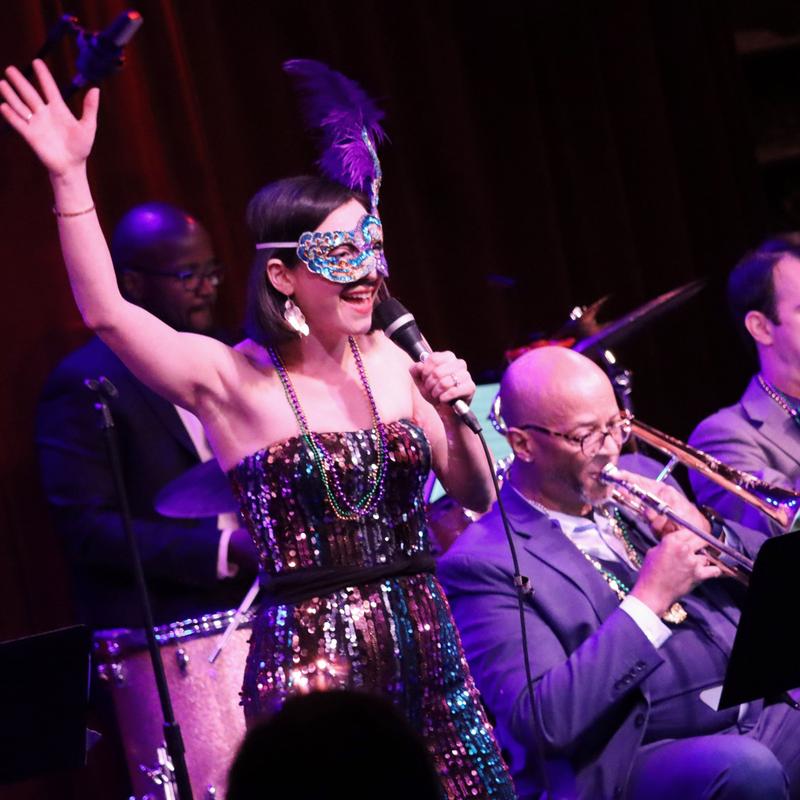
Alison Stewart: This is All Of It on WNYC. I'm Alison Stewart. Mardi Gras, next Tuesday. If you're looking for a way to get in the spirit, look no further than my next guest's forthcoming album, Euphonic Gumbo, and a concert to boot. Julie Benko is a singer and Broadway actor. You may know her from her time in the recent Broadway revival of Funny Girl or in her current role as Emma Goldman in Ragtime. She's also a fan of New Orleans jazz, and on Monday, she'll be at Birdland Jazz Club for an album release party, backed by her band, who are also here with me in studio for a special preview. Welcome, everybody.
Julie Benko: Thank you. Hi.
Alison Stewart: Everybody's got their beads. They're ready to go. Julie, will you start us off with a song?
Julie Benko: Absolutely. Jason, shall we go?
Jason Yeager: Yes. One, two. One, two. One, two, three.
Julie Benko: Hello, everybody. This is Julie Benko. I hope you'll celebrate Mardi Gras with me and Euphonic Gumbo.
[MUSIC - Julie Benko and Band: Down in New Orleans Melody]
Alison Stewart: That was Down in New Orleans Melody with Julie Benko and her band. They're here to preview her album, Euphonic Gumbo, which is out next week. Hi, Julie.
Julie Benko: Hi, Alison.
Alison Stewart: Would you introduce us to everybody in the studio?
Julie Benko: Absolutely. We have Ronen Itzik on the drums over there, Ron Wilson on trombone, who was in the pit of Funny Girl with me, actually.
Ron Wilkins: Wilkins.
Julie Benko: Ron Wilkins. Oh, God. We go way back.
Alison Stewart: Go way back.
Julie Benko: On live. Oh, boy. Andy Warren on trumpets, Kenny Pexton on clarinet and saxophone, Michael O'Brien on the bass. Over here on piano and organ, Jason Yeager, who is also my husband and the father of my child. I had to add the last part, the father of my child.
Alison Stewart: Yes. When did you become in love with New Orleans jazz?
Julie Benko: We went down to New Orleans for-- Jason teaches at Berklee College of Music in Boston. We went down about 10 years ago for the JEN, the Jazz Education Network. We had never been there before, and we just completely fell in love. There's music on every street corner. We just kept going back. We got the bug, and we would stay out all night on Frenchman Street and exploring everywhere we could find. Always putting on about 10 pounds every visit.
[laughter]
Alison Stewart: When did you decide to sing New Orleans jazz?
Julie Benko: It was a couple of years later, and we were doing a lot of research. I was doing research because I was so fascinated by Storyville, in particular, the legal red light district that existed prior to World War I there, where Louis Armstrong came up playing and Jelly Roll Morton. I started to write a play about Storyville and set in Storyville. As I was doing this, I was finding all of these songs and all of this repertoire that had been a part of New Orleans history for so long. Then one Mardi Gras came around, and Jason and I just did a little duo gig at a restaurant near our old apartment in Harlem.
Then the following year, after Funny Girl had happened, and we were starting to play bigger clubs, Birdland invited us to do a show, and it was February, and we said, "Well, you know what? Maybe we'll make this a bigger affair." That was three years ago. We've done it for three years. This Monday will be the fourth annual Mardi Gras extravaganza at Birdland, and we finally recorded the record.
Alison Stewart: Jason, what is it that you like about playing New Orleans jazz music?
Jason Yeager: The thing I like best about it is that it's unbridled joy, and it celebrates community and collective creativity. I love many styles of jazz, and I've played in many different contexts that give me a lot of joy and fulfillment. This style of music has a special quality of privileging expression and community, and the ensemble, as opposed to individual virtuosity or instrumental prowess. It's really not about that, it's about the song and the feeling and the community.
It's so because this music was born in New Orleans, jazz music was born in New Orleans. The traditions that come out of that place are so special, and it's not just one tradition. I think a lot of folks in my community, in the jazz community, assume that it's all Louis Armstrong, Hot Fives and Hot Sevens, which is a touchstone for us. It's so much more. It's R&B, it's zydeco, it's Creole folk music. It's many different things. That's what I love about it, the community nature.
Alison Stewart: Julie, when you think about New Orleans jazz and you think about musical theater, what do they have in common?
Julie Benko: What Jason mentioned, the collective. I think anytime you're making theater, it's by nature this communal experience. You're doing it together. You rely on each other, you're listening. Everybody is structured, but there's play within structure. I also think there's a theatricality to New Orleans music. You think about the parades this time of year, the costumes, the beads, the floats, the characters that everyone's playing. It really feels like-- I mean, it's a masquerade. Everybody is really playing a character. I think it's a natural fit for somebody like me to go, "Oh, wow, I can't believe it took me so long to find this place. I so belong here in this make-believe place that you step into."
Alison Stewart: Thanks for the beads, by the way.
Julie Benko: You're welcome. I don't know if you can hear them on the radio or not. Tell us about the title of the album.
Julie Benko: Euphonic Gumbo came to me-- I was writing this play, which is called Down the Line, which references the houses that were along Basin Street, the houses of ill repute. They would say, "Oh, the houses down the line." In the play, there's a character, Tony Jackson, who was a real pianist in Storyville. He was Jelly Roll Morton's hero. He was never recorded. He died young and never recorded. He was the undisputed king entertainer of Storyville. He was a genius.
I mean, he wrote Pretty Baby, which we do on the album. He apparently could hear any song one time and sing it back and play it back forever. He could do all sorts of styles. He lived openly as a gay man, gay Black man, in the early 1900s. Not an easy thing. Wait, what was the question? I got all on Tony Jackson.
Alison Stewart: The name of the album.
Julie Benko: The name of the album. I was writing a monologue for him, and he is explaining to one of the newcomers to the house what jasmine music means to him, which was shortened to jazz. He talks about how it takes the roux-- It's a gumbo. The roux is like the rhythm from Africa. Then the spices are these army band instruments and the blues from the fields, and all of these elements that come together and create a euphonic gumbo. That's something that's really tasty but goes down easy. Something you can just enjoy but feels like home.
Alison Stewart: I'm in studio with Julie Benko and her band. She's previewing her album, Euphonic Gumbo, which is out next week. On Monday, she'll be at Birdland Jazz Club for an album release party. Should we hear some more music?
Julie Benko: Sure.
Alison Stewart: What are we going to hear next?
Julie Benko: This is the Lakes of Pontchartrain. Lake Pontchartrain is just north of New Orleans. There are not multiple lakes, but that is the title of the song, and it's become an Irish troubadour favorite. It's an old song. The melody, they think, comes from around the War of 1812, and the lyrics come from around the time of the American Civil War, but apparently, it got brought back to Ireland. Jason and I actually performed this in Ireland over the summer in an impromptu performance, but not with the whole band. It's special to be all together.
Alison Stewart: Here's Julie Benko.
[MUSIC - Julie Benko and Band: Lakes of Pontchartrain]
Alison Stewart: That was Julie Benko and her band. We'll be back with more after a quick break. This is All Of It.
[music]
Alison Stewart: You're listening to All Of It on WNYC. I'm Alison Stewart. I am in the studio with Julie Benko and her band. She's previewing her album, Euphonic Gumbo, which is out next week. On Monday, she'll be at Birdland Jazz Club for an album release party. This can happen on Monday because Broadway is closed.
Julie Benko: Exactly. It's my one night off.
Alison Stewart: You're playing Emma Goldman in Ragtime. What has it been like to take over that role?
Julie Benko: It's been awesome. It's truly one of the most incredible shows ever written. It's so powerful. It's so resonant right now in this moment. I'm used to stepping in under very high-stakes scenarios, but truly, everyone's been so kind. It's such a great place to work. It's like the nicest theater I've ever worked in on Broadway. I have a bidet in my dressing room.
Alison Stewart: Well, well, well, well, well.
Julie Benko: I know. Learning about Emma Goldman, really doing a deep dive on her. I'm in the middle of her autobiography. It's taking me a while because it's a thousand pages long, but I'm just so inspired by the woman that she was and the work that she did. I'm really impressed by the way that she lived in the 1890s and the early 1900s, this incredible lifestyle that would even seem, in some ways, pushing the boundaries today. Also, an early advocate for birth control. She's really an amazing character.
Sometimes when I introduce myself in the prologue, everybody introduces their character, and I say Emma Goldman was a radical anarchist. A good number of the time, people start applauding, "Give Emma Goldman entrance applause." I truly think it's not Julie Benko entrance applause. They hear the name Emma Goldman, they get so excited because of what she represents at this point in history, too. It's very meaningful to step in. It's just an incredible production to be a part of.
Alison Stewart: The music is so gorgeous in Ragtime. What do you think about when you're listening to others sing their songs? Especially, oh, Joshua Henry?
Julie Benko: My jaw is usually just on the floor. We were able to watch the show from these entrances that are in the audience because of the way this theater is built. You can really watch the show from up close. I watch Wheels of a Dream pretty much every day. I'm just so blown away by him, and he just makes me cry every day.
Alison Stewart: What do you enjoy about the music in the show?
Julie Benko: It's so rooted in ragtime music, but it's its own melodies that Stephen Flaherty wrote. It really pays homage to ragtime music. People at the end of the show, they always ask me at the stage door, "What's your favorite song in the show?" I say, "I really can't choose." When I watched the show when I was coming in to learn it, I just was so struck by how-- just in act one, it's like hit after hit after hit after hit song. You have Your Daddy's Son, and New Music, and Wheels of a Dream. They all just rip your heart out and make you cry. If you come to Ragtime, bring tissues.
Alison Stewart: Definitely bring tissues.
Julie Benko: Yes.
[laughter]
Alison Stewart: All right. The show on Monday at Birdland. What can we expect?
Julie Benko: It is a party. There will be beads for everyone. There will be king cake. There will be trivia, New Orleans trivia, and prizes. Also, you will be able to buy the CD or the vinyl. We pressed vinyl on this one, so you'll be able to get that there. We'll sign it for you. You can also get that on Bandcamp. That's also available on the Internet. You can also watch this concert on a live stream on Veeps. It's available. If you can't make it to the show, you can watch it from the comfort of your own home. We're going to be doing these songs, a few other songs that we've recorded on other albums as well that have New Orleans flair and flavor.
It's going to be just a really great party. There's always a little bit of an element of surprise because whoever gets the baby in that king cake is going to be the king or queen of Mardi Gras and has to bless Birdland and bless the album. We don't know who will win these trivia questions and get their prizes, but it's just going to be a lot of different kinds of music. We also have a special guest, two special guests. John Manzari, the tap dancer who I did Funny Girl with on Broadway. He will be performing on two songs. Also, Sasha Papernik, an accordion player, will be there as a special guest to bring some accordion to the Cajun music. We have a mix. I'll be singing in French and Yiddish and English. I know Yiddish. Right.
Alison Stewart: Sounds good. I have a question for Jason.
Jason Yeager: Sure.
Alison Stewart: It's Valentine's Day weekend, this weekend. You're going to be busy with Ragtime. Get ready for the show. How did you know that your professional relationship was going to turn to a personal one?
Jason Yeager: That's interesting. We met at a Starbucks, and Julie overheard me on the phone explaining that I was a jazz pianist who worked quite often with vocalists. She took it upon herself to introduce herself to me after the phone conversation was over, and we went on a date. It turned out that Julie and I-- it wasn't the right time for us to be--
Julie Benko: I had been dumped. I was heartbroken at the moment.
Jason Yeager: It was not the right time, but we came together as friends and collaborators. It was over the course of a year that we discovered that we actually had deeper mutual feelings. After a year of that early collaboration, we got together, and we've been together ever since. It's been 12 years, and 4.5 of those of wedded bliss. Right, honey?
Julie Benko: Right. Yes, honey.
[laughter]
Alison Stewart: What's our last song we're going to hear today?
Julie Benko: It's another medley. It's Let the Good Times Roll and Tipitina. Both are homages to the great pianists of New Orleans. Professors, they call them down there. Professor Longhair and Dr. John, who, I guess, Dr. John was Professor Longhair's mentee. This is a little piano feature. Let the Good Times Roll is, of course, what we say at this time of year. Laissez les bons temps rouler.
Alison Stewart: Here's Julie Benko.
Jason Yeager: One, two. One, two, three.