
Actor Dylan O'Brien and Writer-Director James Sweeney Star in 'Twinless'
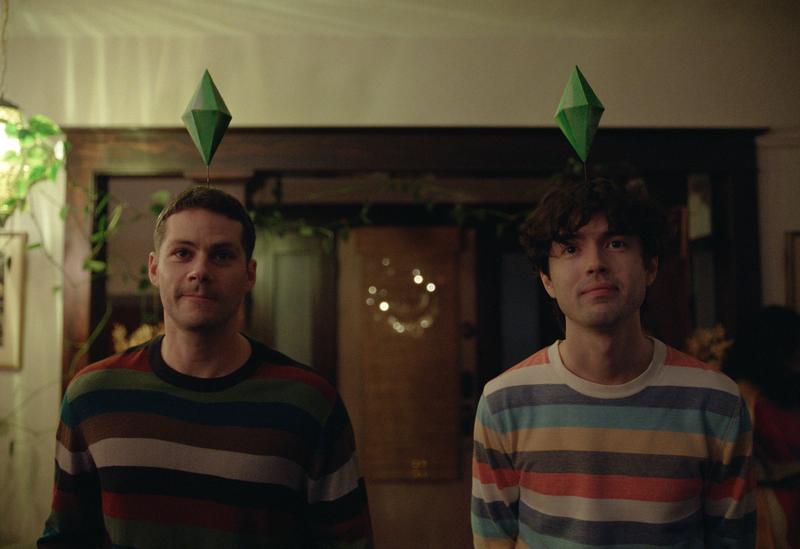
( Courtesy of Roadside Attractions )
Alison Stewart: You're listening to All of It on WNYC. I'm Alison Stewart. Dennis and Roman are unlikely friends in the new film Twinless. Roman is a quiet gym rat who loves hockey and admits he's not "the brightest tool in the shed". He meant to say brightest bulb, which he is gently told by Dennis. Dennis is a smartish, self-contained man, maybe a little lonely until he makes friends with Roman. Dennis and Roman meet in a grief support group specifically for twins who've lost a sibling. Roman's brother, Rocky, was an extroverted guy who traveled the world before he was hit by a car. Dennis shares that his twin died in an accident on his way to pick up Dennis from the airport.
Soon, Dennis and Roman, they become best friends, bonded in grief despite their differences. It turns out Dennis might have some ulterior motives for getting to know Roman, and he might know more about Rocky's death than he lets on. Twinless was written and directed by James Sweeney, who also stars as Dennis. And actor Dylan O'Brien, who plays twins Rocky and Roman. They join me now to discuss the film. We've got James on Zoom. Hi, James.
James Sweeney: Hi.
Alison Stewart: We also have Dennis in studio. Dylan in studio. Hi, Dylan.
Dylan O'Brien: Dennis O'Brien, James McSweeney. The Irish are here.
Alison Stewart: I was so pleased
Dylan O'Brien: I had to do it.
Alison Stewart: It's fine.
Dylan O'Brien: Thank you so much for having us.
Alison Stewart: I'll start correctly. James, you don't have a twin yourself. What got you interested in making movies about twins?
James Sweeney: I always wanted a twin. It was a repeated request that I gave to my parents, that was also repeatedly denied. I did date an identical twin in my 20s, and I wrote the first draft shortly after he broke up with me.
Alison Stewart: Oh, no.
James Sweeney: He's alive, to be clear. I do think the fascination with twins came from a place of seeing twins imprinted in my cultural landscape. From Mary-Kate and Ashley Olsen to Sister, Sister. I think it encapsulated the idea of the perfect best friend. Somebody who wanted to share your clothes and do all the activities you wanted to do. That was very appealing to me at the time.
Alison Stewart: I have to ask you, in the screen, there's like a man over your shoulder.
James Sweeney: Really? Yes. A mannequin.
Alison Stewart: Who is that?
Dylan O'Brien: Oh, yes, he's in his apartment.
Alison Stewart: I think so. Yes.
Dylan O'Brien: That's his mannequin.
Alison Stewart: It's his mannequin?
Dylan O'Brien: Yes.
Alison Stewart: Oh, okay. That's what I wanted to ask.
[laughter]
Alison Stewart: As long as we're making fun. Dylan, can you describe where you were when you first read the script?
Dylan O'Brien: I was at my home in Los Angeles at the time. I live here now. It's so funny. That's the first location question I've gotten so far on where I was when I first read it, but that's where I first took it in. I think I was outside. Nothing like an outdoor read. I just was immediately so taken by it. It was such a complete script. It was such a wild ride. I felt like it was so beautifully written. I really felt like I understood the humor in the voice overall, but just loved that and was really struck by the emotional through line, which for me is such a combination that I enjoy in films.
Anytime you get to be a part of something like that, it's so special. Then I watched James's first film later that night that he directed and wrote, and was in as well, and I thought it was fantastic.
Alison Stewart: Did you read it in one sitting?
Dylan O'Brien: Yes, I devoured it.
Alison Stewart: Yes?
Dylan O'Brien: Yes. Instead of the walk away.
Alison Stewart: Walk away, come back.
Dylan O'Brien: That's never a good sign.
Alison Stewart: That's not a good sign, really.
Dylan O'Brien: Right. I would think so. I couldn't put it down. I absolutely devoured it, choked it down, and then couldn't wait to see who this guy was, and we still haven't met.
[laughter]
Alison Stewart: James, what convinced you that Dylan was the right person for these two parts?
James Sweeney: I used to work in casting as my day job, so I do feel like I have an affinity for seeing the potential for actors, maybe outside of their previous work, because I think sometimes Hollywood can-- I don't think this is a surprise. Any listeners lack imagination. I am familiar with the dramatic and comedic versatility in his filmography, but really, the thing that was the yes was just meeting him and seeing what kind of person he was, because I knew this is a small independent film, and it was really our chemistry that would make or break this film.
I was looking for a partner in crime, and he turned out to be all that and more, and in retrospect, was extremely fortuitous how it all aligned.
Alison Stewart: That's interesting that you worked in casting. What did you learn in casting that you were able to put to use in this film?
James Sweeney: I think one lesson I learned is that I would see a lot of very talented actors come in who would just be wrong for a part. It was not necessarily a strong performance. That really concretized this idea that it doesn't matter how good an actor is or how maybe not good an actor you might think they are. If they are right for the part, they are right for the part. I think we have a tendency to think that talent is fixed, but I think it's really a lot more subjective than that.
Dylan O'Brien: That's so true. Mike White does this really well. Mike White casts really well. It is a science.
Alison Stewart: It's going to be getting an Emmy award this year or an Oscar. Right? Didn't they add a casting category? They should.
Dylan O'Brien: Oh, oh, oh.
James Sweeney: They do have a casting Emmy. I think that was this past weekend. I'm not sure who won.
Alison Stewart: My guests are. Fingers crossed. Dylan O'Brien, and writer and director James Sweeney. We are talking about their new movie, Twinless. What kind of research, Dylan, did you do into twins?
Dylan O'Brien: That's really interesting. It might be unpopular to say not a ton. I think the amazing thing about the themes in the story, we certainly had our own specific thoughts in terms of twin grieving. That obviously is such a unique type of loss. These support groups really do exist. It was the initial impetus for the screenplay for James. I think we definitely have our own specific feelings in terms of we've been asked if we entered any of those support groups. That was not something that I felt comfortable doing or felt would be appropriate.
In terms of the themes in this film, they're entirely universal, as well as also being obviously such a fundamentally unique experience and type of loss on this earth. I think that was what was such a intriguing part of the role to me, and the film as a whole was that, here was this kind of device used and honored truly, like this twin relationship and existence and loss by somebody who held a deep interest in that. The universal themes of humanity that came from that I thought were really beautiful and really resonated with me.
Alison Stewart: James, you're a writer, director, and actor in the film. Directors always, that's their job is to make decisions. That's a big part of direction. What is a decision that you had to make that maybe the writer wouldn't have agreed with or the actor wouldn't agree with it, but the director said, "We're doing it."
James Sweeney: Oh, interesting. Well, I actually am somebody who has a lot of decision anxiety, which is, I think, Part of what I like about directing because it forces me to make decisions. To be blunt, there is a sex scene in the film, which, as a director, I feel was very necessary, as an actor, made me a bit self-conscious.
Dylan O'Brien: That's true. Those are opposing forces.
Alison Stewart: Really.
James Sweeney: Yes.
Dylan O'Brien: Oh, yes. Yes, for sure.
Alison Stewart: Tell me more.
Dylan O'Brien: It was a very naked, physically and vulnerable thing to do, obviously. He, the filmmaker, he knew what he wanted, and he knew that it certainly wasn't gratuitous, and it was so right for the sequence and for the film and how he wanted to capture it. It was interesting watching him toe that line. [chuckles]
Alison Stewart: James, how would you describe the friendship between these two men in your film?
James Sweeney: I think these are two people who both carry a lot of shame and regret, and they are both searching for solace in their own individual ways. While they are so different, I think they are very complementary. I think we see them lift each other up at various points throughout the film. While the film overall takes some twists and turns, and I wouldn't necessarily point to this as a role model of male friendship, I do think the film explores friendship and masculinity in a very contemporary way, that I think there's a lot to dissect there.
Alison Stewart: How would you describe their friendship, Dylan?
Dylan O'Brien: I think there's a lot to what James just spoke about, but in terms of the kind of effortless comfort that they provide each other, I think that's a really intangible thing to have in a friendship, in any type of relationship. I love how blanketed we are as an audience from the initial onset of their meeting. It just flows, and they just want to be together. The effortlessness in just existing with one another, doing a mundane thing. I love the themes in that initial diner scene, them waxing poetics about that being such a signifier of an intimate relationship to each of them and something that they each miss and desire.
To me, I think that's something that always struck me from the get-go about the two of them.
Alison Stewart: We're talking about the movie Twinless. We'll have more after a quick break. This is All of It.
[music]
Alison Stewart: You're listening to All of It on WNYC. I'm Alison Stewart. My guests are actor Dylan O'Brien and writer, director, and actor James Sweeney. We are talking about their new movie, Twinless, about two unlikely friends who meet in a support group for people who have lost a twin. It is in theaters now. James, this movie is a lot about loneliness. I do want to say it's funny, though. I do have to say that it is funny, but it is a lot about loneliness and what can happen when someone is really lonely. What do you think can be so dangerous about loneliness?
James Sweeney: I think loneliness is a killer. I think that science supports that. I think what we see in this film is a place where loneliness leads to desperation. I think people who are so yearning for intimacy when that doesn't meet their expectations, it can-- love can make you do crazy things.
[laughter]
Alison Stewart: Love can make you do crazy things. Dylan, you spend most of the film as Roman. He's just a sweet guy. He's just a little dim, but he's really lovely. You also play his brother Rocky, who is gay and is much more extroverted and speaks Japanese, and he's quite extraordinary. He also has a big mustache. We should say that.
Dylan O'Brien: Thank you.
Alison Stewart: What went into the process for creating this second character? Testosterone and--
Dylan O'Brien: For creating Rocky?
Alison Stewart: Yes.
Dylan O'Brien: A lot. There was a lot of conversation with James, and we also had a great team of department heads on the ground who obviously all contribute their ideas. When we're having the hair and makeup discussions, we're having the wardrobe. I remember being a huge day for me, as it tends to be depending on the character, especially when that's a real huge part of their expression. I think for Rocky, I really wanted that to be the case, and just signifying his worldly experiences and his journey and evolution versus what we see in his brother, which is a lot more stunted, and I think contributes to the dimness that you reference.
We've been trying to find the word to describe this type of thing, too. It's so hard.
Alison Stewart: You don't want to sound awful about him.
Dylan O'Brien: Certainly. I also don't think that he's not a smart human being. It's like it's a representation of experience on this earth and evolution as a human. I think so much of the insecurity that he feels and felt his whole life in the shadow of his brother was this-- Rocky had this fearlessness about him, and he took on the world. He took on who he was inside. He wanted to experience all of it. Some people are, I think, quicker to do that than others. I think the infectious popularity that Roman would always perceive from Rocky came from something that he very much so admired in himself. You know what I mean?
Alison Stewart: James, what were you looking to draw out of Dylan in his performance as Rocky?
Dylan O'Brien: You were to pull out of me with the marionette strings.
James Sweeney: [laughs] I don't want to take too much credit because I think Dylan resonated so deeply with Rocky and Roman. I think in terms of asking a straight actor to play a queer character, the best thing I could do for Dylan was just give him permission and let him know that I trusted him and that he was in safe hands and that we were in this together. I think we talked a lot about how masculinity and performative femininity exist on a spectrum and how that can shape, depending on, I guess, the circumstances that you're in, who you behave as in public. You might code-switch if you are in private settings. I think that played into the nuances of the character.
Alison Stewart: It sounded like Dylan that you guys just did a lot of talking.
Dylan O'Brien: A lot.
Alison Stewart: I mean, in a good way.
Dylan O'Brien: Yes, we talk a lot. We do. In an absolutely great way. Communication is so paramount in this type of partnership of collaboration. It lent itself to our production, especially it being four years of occasional talking before we even got going. Then, when we got on the ground, all of these conversations were so informative for me, even though I had these guys percolating and swimming around in my brain for so long, which was an added benefit at that point. James and I can talk for hours. You learn a lot. I think we learn a lot from each other. I think we love to talk about the world and our feelings about things. It really helps.
The thing he said about permission is the greatest gift that you can receive from your filmmaker. There are so many different shapes and sizes of how people approach the directing position. A lot of people can be very handsy in your performance and constantly, almost out of insecurity, feeling like they gotta give you a note every take or else what are they doing? They got to look like they're doing something. You know what I mean? There's so much to be said for someone who has the confidence to know what they want, be so precise in terms of his filmic execution, which I really appreciate, because I know, within the confines of what the performance is being captured, that goes a long way for me.
Then, for the trust and permission, and not always-- sometimes leaving me alone, take after take. Nothing breeds confidence more than that.
Alison Stewart: It took four years for this to come to fruition. Yes?
Dylan O'Brien: Yes.
Alison Stewart: James?
James Sweeney: Since I met Dylan, [crosstalk]
Dylan O'Brien: Since I was a draft.
James Sweeney: 2015.
Alison Stewart: What was better about the film that it took four years to make?
Dylan O'Brien: That's a wonderful question.
Alison Stewart: What do you think?
James Sweeney: Hindsight's 2020. I think just our own friendship, I think, parlayed into the chemistry between the characters that you see on screen. I think just letting the themes and the script marinate. There was just a refinement process. Writing is rewriting. I don't know, I felt like all the things that went wrong turned out to be happy accidents. That is the miracle of filmmaking in and of itself. I have to-- aside for a second. I got excited when I heard your previous guest, Wyclef Jean, talk about Tasha Smith directing his music video because she is in our film. She's also an identical twin herself.
All the actors in our support group were twins, including the background talent. That was something that maybe wasn't an initial idea when I wrote the screenplay, but was something that came to the foreground in the years of what can we do to make this feel authentic? I think for me, the biggest thing I've taken away from this film is that process is everything. As hard as it was, we had a really lovely creative process.
Alison Stewart: Without giving too much away, we've been doing a good job of no spoilers, by the way, how did you decide when to reveal certain information about the main characters, James?
Dylan O'Brien: Nicely done.
Alison Stewart: In terms of the [crosstalk]
James Sweeney: That was a discreet question. Yes. The very first draft of the script was not told with a perspective shift. I will say that was a major revision that happened once I met my producer, David Permut, which was motivated by me partially wanting to balance out the film because it is such a two-hander. I think it's a bit like a Jenga puzzle. It's trying to deliver these plants and payoffs. Which was also, to be frank, the maddening thing once we got to the edit, because it was so precisely constructed that to ace the film up and excise, we had to excise 50 minutes of footage to get to our eventual runtime, which is a lot, to be honest.
The trickiest part about that because everything is connected and intentional, when you lose something on the front end, it has a connective tissue to something later, so it's a bit of a snowball effect. We had to be very careful with what information we were introducing and when, and trying to keep the audience in suspense while also keeping them surprised. It's that classic Hitchcock conundrum. We tried to have a little bit of the best of both worlds.
Alison Stewart: Dylan, have you heard from twins who have seen this movie, and what have they been sharing with you?
Dylan O'Brien: Outside of screenings, not much, but we've definitely had occasional pairs of twins at our screenings. We had several show up to the premiere, which was really cool. It's been mostly feedback that's been really positive. In terms of, I guess my capturing of the twin experience, I have gotten-- I don't know if they're just being nice, but so far it's been good in terms of at least them watching this, knowing that I'm not one myself, and being able to take in the story and live in the world and not be bumped or taken out of it by my performance. That's all I can ask for, to bring that type of humanity and authenticity so as not to distract them from the film.
Alison Stewart: The name of the movie is Twinless. It's in theaters now. It is really, really a fine movie. It's really good. It's funny, it's sad, it's weird. I recommend it. I've been speaking with actor Dylan O'Brien and writer, director, and actor James Sweeney. Thank you for giving us time today. We really appreciate it.
Dylan O'Brien: You rock. Thank you so much.
James Sweeney: Thank you so much.