
'Abbott Elementary' Star Tyler James Williams
Alison Stewart: This is All Of It. I'm Alison Stewart, live from the WNYC studios in Soho. Thank you for spending part of your day with us. I'm really grateful that you're here. On today's show, we'll speak with the stars of the Broadway play Marjorie Prime that's June Squibb, Cynthia Nixon, and Danny Burstein. If you've seen that viral Mamma Mia video, you know it's time to re-up our conversation about theater etiquette. We'll be joined by a production manager for the show who happens to be a therapist. Go figure. The Grammy award-winning local band, The Hot Plates, are here and they'll perform live in studio five. That's our plan. Let's get this started with one of the stars of Abbott Elementary. [music]
Tyler James Williams has been in the business since-- well, most of his life. As a kid, he appeared on Sesame Street and he had a real breakthrough with the cutting-edge sitcom Everybody Hates Chris. Which is why it was surreal to see him up as a grown-up man, deep-voiced and serene, but really, really funny on the hit show Abbott Elementary where he plays Mr. Gregory Eddie, a by-the-books, upright, a little bit uptight kind of guy. Abbott Elementary is terrific about talking about real-life issues like gentrification or Teach for America, or underfunding. It does so with humor and a message that's hard to forget. It shows teachers as real people talking smack in the teacher's room. Like when it was discovered that Mr. Eddie isn't into pizza.
Gregory Eddie: I can't do this. I just don't like pizza.
Mr. Johnson: What? Say that again. I don't think I heard you, son.
Barbara Howard: Sweetheart, what do you mean you don't like pizza?
Gregory Eddie: I just don't understand the concept of having a bunch of ingredients just slosh around in your mouth. It's not just pizza. I've got like four or five things that I actually like, and I just stick to those.
Jacob Hill: Do you like pie?
Gregory Eddie: Fruit should not be hot.
Barbara Howard: Okay.
Jacob Hill: Okay. What about a rack of ribs? Dry rub, no sauce?
Gregory Eddie: Yeah, it's not for me, but I do like bacon.
Ava Coleman: He's lying. He doesn't like bacon.
Mr. Johnson: How could you not like pizza, Gregory? How could you not like-- it's pizza.
Gregory Eddie: See, this is why I don't ever tell anybody, okay? Cause everyone always freaks out and acts like it's a personal attack. It's not my fault. I was born this way.
Barbara Howard: Don't you bring Lady Gaga into this.
Alison Stewart: Tyler James Williams has been nominated for an Emmy three times and won a Golden Globe for his role as Mr. Eddie in 2023. He has a few other projects in the work. Tyler, it's nice to meet you.
Tyler James Williams: It's nice to meet you.
Alison Stewart: That talking smack in the room cracks me up because my mom was a school teacher.
Tyler James Williams: Oh, was she?
Alison Stewart: Yes. She used to say that's where they let their hair down.
Tyler James Williams: Uh-huh.
Alison Stewart: That's where teachers let their hair down in the teacher's room.
Tyler James Williams: Some of my favorite scenes are in the teacher's lounge. I feel like there's two versions of the characters. There's the ones that we are in front of the kids and then the ones behind that door. It's always a great way to start an episode.
Alison Stewart: This show has been on the air for five years, but when you first saw Eddie on a script, how was he presented to you?
Tyler James Williams: When I first read the script, his voice was very clear to me. I remember I got on with Quinta not too long after I read it, and it made sense. He was a guy that I knew. He was a guy who was just trying to do his job and had aspirations. I think there was a lot of men in my family who were just trying to do their job and do a very good job at it. For that it just, it became very clear, but then as we continued on with the series, they found these little nuances, like the him not liking food thing and it filled him out so much better to the point where it wasn't just this kind of cut and dry black and white guy. There were these beautiful little idiosyncrasies that were showing up.
Alison Stewart: How did you see the development of the character over the five years? What's been interesting to you? What's been challenging for you as this character's developed?
Tyler James Williams: What's always interesting is his ability to feel uncomfortable. I don't think there's many times that Gregory is actually comfortable in whatever room he's in, especially in his own skin. That's been really fun and interesting, but I think the challenging part of it has been, I think a lot of men see themselves in Gregory, and not oftentimes do you get a role where you get a chance to talk about and play some of the challenges that people are having currently.
I think one of the things that we're really playing with now is the financial issues that he's having. That no matter how many jobs he seems to take on, nothing seems to be enough. That's a challenge that I like to rise to because I feel like when people go back and rewatch things, my first show, people still watch to this day, when they go back and they rewatch this, they'll remember where we are currently and it can hopefully start some conversation about how we got out of it is what I'm hoping will eventually happen.
Alison Stewart: Hopefully. Hopefully. The show is so terrific at taking on big issues like underfunded schools or teachers having burnout, or kids with ADHD, what you do with them. What show has really struck with you about how it took on a serious subject?
Tyler James Williams: You mean which show outside of Abbott?
Alison Stewart: Within Abbott.
Tyler James Williams: Within Abbott. Oh, okay. There was a episode in season one, and I can't remember the name of it as of now, but at the end of it, I remember it because it was my monologue. Gregory has a monologue about the different ways that children learn and the different type of intelligences that there are. I remember being a kid who liked learning, and all of that, but the school structure wasn't really what worked best for me, being a very creative child. I learned something that day. It was one of those rare moments where you read something in your script, and you're like, "Oh, I guess I never really did see it that way. Before I justify this for the character, I have to do research on it myself." I think if we had more of that approach, you would see less kids kind of falling through the cracks. Not everything works for everybody.
Alison Stewart: Does it take you back to your days as a kid?
Tyler James Williams: For sure.
Alison Stewart: Yes?
Tyler James Williams: For sure. I see kids every day now. I am a teacher, and I don't think I've been around this many kids since I was a child, but seeing just how young that age really is, I was working full-time by the time I was 12, but now seeing children, it's different. It colors it differently for me.
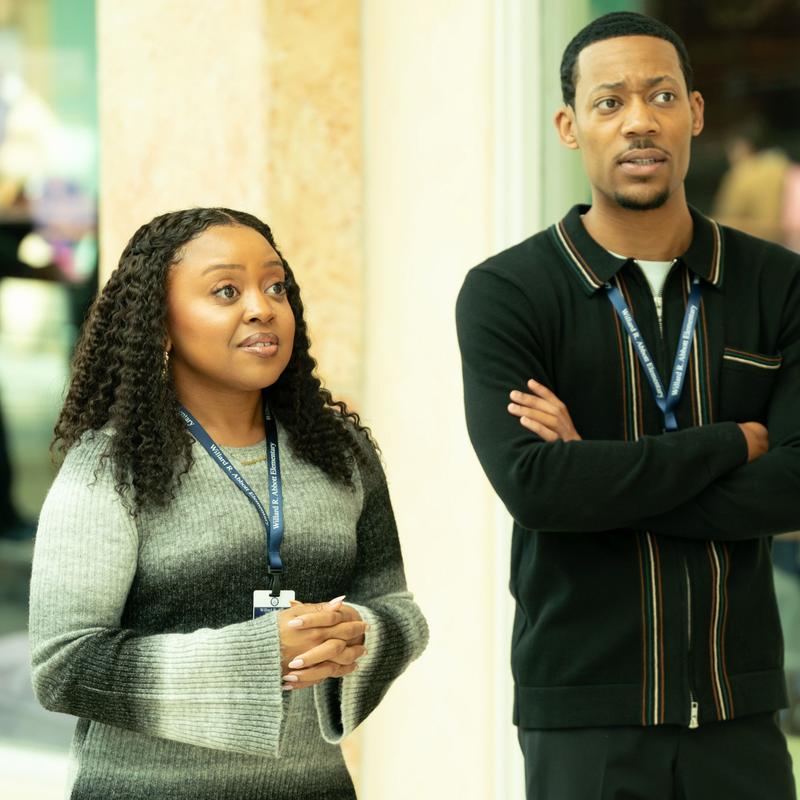
Alison Stewart: I'm talking to actor Tyler James Williams. We're talking about his career and starring in Abbott Elementary, now in its fifth season, new episodes airing weekly on Wednesdays. In this season we're seeing Gregory become a mentor to a younger teacher. Let's listen to a clip from the last episode before the midseason finale. The school shut down because the furnace overheated and the pipes burst, so now they're using an abandoned mall as a temporary school. In this scene, Mr. Eddie is giving the new teacher, Dominic Clark, some advice before the students come back to school. This is from Abbott Elementary.
Gregory Eddie: Yes. You're having a Wild first year.
Dominic Clark: Okay, thank you. Because this is wild, right?
Gregory Eddie: Yes, definitely. I just came through the window.
Dominic Clark: How they gonna put us in a dead mall with no chalkboards, no windows, no cubbies, and just be like business as usual? Like, am I crazy?
Gregory Eddie: No, no. I feel you fully. This is a lot. Kids are about to learn long division in an abandoned Hollister, but unfortunately, it is extremely on brand. You're getting a crash course in the Philly public school system. Anything can happen at any time.
Dominic Clark: Damn. All right, I'm going to see if anybody claimed the Pacsun.
Gregory Eddie: You hang in there. All right now.
Alison Stewart: How is Gregory learning about himself now that he is mentoring a younger teacher?
Tyler James Williams: I think he's learning that it is impossible to do it 100% right. I think in the beginning he thought that if he just did the work and he just followed everything by the book, that everything would go right, but being a teacher and just working with kids in general, there's no way for that to happen. I think he's now learning to pass that information on to other people.
It's crazy that that can be the case in five years. You know what I mean? When the show first started, he was this substitute who was barely even integrated into the show. Now he can give sage advice. He can tell Luke Tenney, who's an amazing actor, it's hard to come into a show like this. He plays Dominic. He can tell him that this is just what it is. You find a way to survive. I think that's what resonates with people the most.
Alison Stewart: Do teachers come up to you and talk to you about their experiences?
Tyler James Williams: If there is a teacher in a 30-foot radius, they're going to tell me. [laughter] It's one of the more beautiful things that come with this. I'm aware of where all teachers are at any given time, but then also there's this level of comfort that they have.
Alison Stewart: Oh, interesting.
Tyler James Williams: Where they naturally lower their guard and let their hair down almost as if you get me. I get the chance to see like your teacher outside of her usual or his usual situation. Kind of just have vulnerable moments. I was at a Nick game the other day, and a woman stopped me and was like, "I'm a kindergarten teacher." She was drunk and having the time of her life, and I was like, "Hell yes."
Alison Stewart: Go for it.
Tyler James Williams: You got to go back on Monday. I know. Have a great time. There's something really nice about that.
Alison Stewart: Do you, not that you would take information from those encounters, but do you get information that you can use.
Tyler James Williams: I do, yes. As an actor, you always get information that you can use. I'm not in the writer's room on this one, so anything that I get is just things I can color into the character. I think it's more nonverbal. It's stuff like where they are in the middle of a school year. I can always tell where a teacher is now by that look in their eye. There's a certain amount of burnout that comes with it naturally.
Like there's nothing you can do. At some point, you're just going to get run down. Tracking that through our season and remembering where they are for field trips. What's the stress level is like. That just helps inform the performance. It's in the moments where you wouldn't even really think about it.
Alison Stewart: I was watching an episode where he just wants his weekend, and they want to go on a camping trip.
Tyler James Williams: That's it.
Alison Stewart: All he wants is-- He just wants his weekend.
Tyler James Williams: That's it. There's one where we had where Gregory was so tired. He falls asleep in the middle of a meeting in the library and wakes up, and is startled, and he has this line. He's like, "Don't touch me." When I thought about it, it was like, it's not even to any of the teachers there, kids just naturally reach their hand out and start grabbing at you. It'd be nice for just a minute if that wasn't the case.
Alison Stewart: I'm talking to actor Tyler James William. We're talking about Abbott Elementary now in its fifth season. Every year there's a Halloween episode, and every year you have an unusual outfit. This year, you dressed up as Ryan Coogler, the director of Sinners and Black Panther. First of all, have you met him?
Tyler James Williams: I have, yes. We've met each other a few times. Right around the time Fruitvale Station was kind of doing its thing, I was doing Dear White People. We were around each other quite a bit in the indie scene. Then shortly after that episode aired, I ran into him at an event and wanted to be like, "Hey, just want to let you know we're never doing this from a bad, negative place."
Alison Stewart: Oh, I don't think he would take it that way.
Tyler James Williams: You never know. Some people do. For me, it was like, Sinners is such a big cultural moment right now. It goes back into what I was talking about before, where it's like, people will remember this time by these moments. When they go back, and they watch this show 10, 15 years from now, they'll remember, "Oh, yes, Sinners was huge because it was such a big cultural reference for us." That, to me, immortalizes all of us in this time.
Alison Stewart: Who comes up with those ideas? Because that was a laugh-out-loud moment.
Tyler James Williams: Our writers' room. I can't even peg any one person. I thought that was hilarious, but then also Darth Ma, which Janelle James as Ava Coleman was equally as. Once the wig started moving, I was dead. [laughter] I don't know how they do it. Every year it's something absolutely ridiculous. The funnier thing to me also is the kids. If you watch their costumes, and you pay attention, you'll find there was one year we-- I think it was the year Beyonce did-- she was on tour, and it was huge. I can't remember which one it was.
Alison Stewart: Renaissance, maybe.
Tyler James Williams: Maybe. We had six different Beyonce's floating around in the background, [laughter] if you pay attention. Six different versions of her. It was fun.
Alison Stewart: You're not new to network TV by any means. You starred in Criminal Minds, Beyond Borders, Everybody Hates Chris. My son loves that show, by the way.
Tyler James Williams: Oh, great.
Alison Stewart: What have you learned from working in network television? Because so much is streaming now, but I'm curious what you learned in network TV.
Tyler James Williams: There's a reason why the network TV model works, and the box that you play in, you have to play in. You see it now with people with streaming shows, where they'll get three seasons over the course of eight years.
Alison Stewart: We talked about that yesterday.
Tyler James Williams: They're just like, "I don't even remember who this character was or what they were going through." There's something about being in people's households once a week, you become a part of their family. With that being said, it's also harder to do because we don't get a year and a half to write. I think we get maybe six or seven in the can before it starts actually airing, and then we're constantly playing keep away. I love it because it's hard, but I also love it because of the return, because of the way people connect to you and the way people respond to you. It's different than entertainment. You become a part of their family.
Alison Stewart: How do you keep up the endurance of one character every week?
Tyler James Williams: Maybe it's because I'm uniquely built for it. I find it the best way to work. When you do a film, you get maybe three months at the most to cover however long the time span of that film is, and then you're done. I get to evolve with this character. I get to live in their skin for years at a time. Then when it's done, and we finally put this to rest, I can say that it's done. That I gave him everything that I had.
Alison Stewart: I understand you did a little bit of directing on the show. Why did you want to make that transition?
Tyler James Williams: I've always wanted to make that transition, from the first time I put my eye behind the lens.
Alison Stewart: Oh, that'll do it.
Tyler James Williams: That did it. I'm also a huge fan of actors and acting. I don't necessarily need to do it. I can just watch other people do it.
Alison Stewart: Oh, interesting.
Tyler James Williams: I think that was another part of it. I love really good actors living in the moment. If you set everything up right and you put the camera where it needs to be and you have the setting right and just let them go, there's nothing more beautiful than that. I knew at some point I wanted to do it, but I also knew that more than likely, whenever I did it, I'd probably have to be in the thing at the same time. That's something that you have to have a really good relationship with your camera department and with your crew and your set. It wasn't until Abbott that I felt like that was time. This was the right crew, this was the right set. I did one episode last year, and then the one I did this year is being aired on Wednesday.
Alison Stewart: Oh, that's exciting.
Tyler James Williams: Yes. The next one.
Alison Stewart: Oh, that's exciting.
Tyler James Williams: It's the next one.
Alison Stewart: Something to look forward to. What did you learn about directing that you didn't know until you did it?
Tyler James Williams: [heaves] It's one of those situations where you get exercised in trust. You have to trust your own ability to know what is necessary, but then you learn how to trust everybody else around you. I think a lot of directors think that they can take control of it and wrestle it in the shit. It's not possible. You have to let the script tell you what it wants. I learned how to listen so much better-
Alison Stewart: Oh, interesting.
Tyler James Williams: -as a director. Listen to what the script wants, listen to what each department head needs and wants, listen to what actors want and need. It's a real exhibition in listening.
Alison Stewart: Did you being an actor help you as a director?
Tyler James Williams: Yes, for sure. I've been directed poorly before.
Alison Stewart: All right.
Tyler James Williams: I definitely have been. All of those little annoyances that I had, I was able to cut a lot of those out, but then also understand when an actor is figuring something out. I think people sometimes panic when that's the case. Let them work. This is an art. They're not robots. They're not going to be super efficient at this sometimes. It may take a minute. All of that. I've been doing this now-- This will be my 30th year as an actor. You pick up some stuff along the way.
Alison Stewart: I would hope so.
Tyler James Williams: Yes, hopefully.
Alison Stewart: My guest is actor Tyler James Williams. We're talking about Abbott Elementary. It's now entering its fifth season with new episodes airing weekly on Wednesday. We went down a rabbit hole to find a clip of you on Sesame Street.
Tyler James Williams: Did you? Which one?
Alison Stewart: Oh, we're going to play it.
Tyler James Williams: Okay.
Alison Stewart: It's in this episode where you're showing Ernie how to draw on a computer before playing a guessing game where he gets to draw the burducky. Let's listen, and we'll talk about you being an actor as a little kid.
Tyler James Williams: Okay.
Ernie: Take this.
Bert: What's that thing?
Ernie: It's a mouse.
Bert: That's a mouse. Okay.
Ernie: Whatever you want to take, whatever want to draw, you click this down, then a color comes up, and you draw what you want to draw.
Bert: Okay. You draw and rubber ducky, and I will guess.
Tyler James Williams: Wow.
Alison Stewart: Even teaching then.
Tyler James Williams: Yes. It was before somebody cleaned up my non-regional dictionary. I could hear--
Alison Stewart: Like you said, that guy is from New York.
Tyler James Williams: Yes. Someone very clearly is like, "That kid is from New York." Wow. Wow, wow, wow.
Alison Stewart: What helped you transition from being a child actor to being an adult actor and a seemingly normal adult actor?
Tyler James Williams: None of us are normal, but normal enough.
Alison Stewart: You're normal enough.
Tyler James Williams: It was the love. The love of the game. I was never in this for the red carpets or the photos or the photos, or the-- I'm having a lovely time talking to you, but even the press. That was never why I did this. I stayed true to the art, and I think also at a certain point in my career, I felt like I was fighting for my career. I knew the road ahead of me. I knew that most child actors don't transition. They don't make it.
It was this compelling urge to be like, "This is all I have, really, at the end of the day, this is all I do," that kept me straight and narrow, but then also it's how I wake up every morning before I go to work. It makes me find that next gear when I don't think that there is one. I'll keep digging into that Bag and I'll keep finding the next gear because when you love something like this, you don't let it fall apart.
Alison Stewart: Were there ever moments in your career when you considered another profession?
Tyler James Williams: Absolutely not.
Alison Stewart: Just you were--
Tyler James Williams: Absolutely not.
Alison Stewart: Wow.
Tyler James Williams: It never even crossed my mind. There's offshoots like directing, you know what I mean? It's like, still in the same vein, but would I ever leave the industry and do something else? No. That's something that I save for my deathbed day.
Alison Stewart: You have two brothers who are in the business as well. Is that helpful for you to have it be part of your family business, stuff you can get together and talk about?
Tyler James Williams: Yes, I think it helps the normalcy because there's stuff that we actually don't talk about, which is really nice.
Alison Stewart: Oh, interesting.
Tyler James Williams: We spend a lot of time together. They're my best friends. We actually spend more time talking about everything else other than the industry. When we do, it's mainly the gripes that we have, the things that are annoying about it, but the least interesting part of our days and lives have to do with what happens in the industry. We're artists in the sense that we take in so much more, and then we'll figure out a way to articulate that somewhere else, but when we're together, we're very rarely talking about the ins and outs of the business.
Alison Stewart: It's interesting. There was a piece written in the New York Times about the love story between your two characters, between Jeanine and Gregory. It said, "Gregory is quietly redefining what a male romantic lead can be, making a case, laugh by laugh, for the cute, sensitive Normie." First of all, what are your feelings when you hear that statement?
Tyler James Williams: I love that. I absolutely love that. Growing up, I didn't see that a lot. I think a lot of times when guys get chosen as romantic leads, they feel like there's a list of things they have to do and the way they have to look and behave. That just didn't align with the real-life men that I knew. I didn't know anybody that perfect.
I didn't know anybody, also, sometimes I feel like in romantic comedies that dumb, you know what I mean? Just like, "Oh, I'm not really paying attention to anything." I thought that was setting an unrealistic expectation. I think people should be able to romanticize their own lives. The more people can see in your character themselves, the more they'll look at their own life and go, "This is a story worth living and telling."
Alison Stewart: Gregory hasn't always been forthcoming with his feelings about Jeannie, sort of stoic. How has he been able to overcome that emotion, that sense of I want to keep it to myself? I'm a little bit scared, actually.
Tyler James Williams: I think that's where the Gregory and Jacob relationship comes into play. Jacob is one of those people who it'd probably be better if he could keep some of his thoughts to himself, but he can't. When he sees something, he's going to push on it. He has to do right by it. It's a story that it feels like Jacob is up close and personal, watching at the same time as the audience. I think every guy needs that friend. I think Gregory may not have had a friend who was as in love with being in love and watching love the way that Jacob is. He helps pull that out of him, and I think also gives Gregory permission to feel them at the same time.
Alison Stewart: What is Quinta Brunson like as an executive producer?
Tyler James Williams: I've worked with a lot of EPs and number ones on call sheets. She's the best to do it. She cultivates an atmosphere for people to thrive.
Alison Stewart: How so?
Tyler James Williams: I know it sounds non-revolutionary, but it really is she's not mean. There's a lot on her plate at all times, and we all know that. It's hard to ignore, but she doesn't take that out on other people. She understands that it takes the help of the other people around her to help execute the show. By doing that, you create an atmosphere where people want to step up and help you and do their job, rather than I just want to do this right so I don't make you mad. That is something that I've known people who've produced hundreds of projects, and they still can't seem to grasp, and they wonder why nobody wants to work with them again.
That is something that she does outside of being a great writer and a great actor. She can do all of the things, but not everybody creates a good work atmosphere that people want to come back to. We have a crew retention rate that's higher than any other show, really, on our lot currently, because people want to come back and work here and for her. I think that speaks more volumes than any of the successes that we've had.
Alison Stewart: When you look down the road, what's on your bucket list? What's on your professional bucket list?
Tyler James Williams: Ooh, professional bucket list. I want to produce more.
Alison Stewart: Interesting.
Tyler James Williams: I'm now seeing that with her and then taking, I think, the information I've built over years, I feel like I have something to add. I feel like I have something to add and can help make, I think, not only the industry a little bit more sustainable, I think each successful show helps stabilize the industry, but also the quality of life and work-life balance of a show.
Alison Stewart: I've been speaking with Tyler James Williams. You can catch them in Abbott Elementary. The show you're directing this season, the episode you're directing is on Wednesday's?
Tyler James Williams: Wednesday's episode. Yes. Mall Part 2.
Alison Stewart: Everybody watch it. Thanks for coming in.
Tyler James Williams: Thank you.