
A State-by-State Guide to the Greatest Burger Joints in America
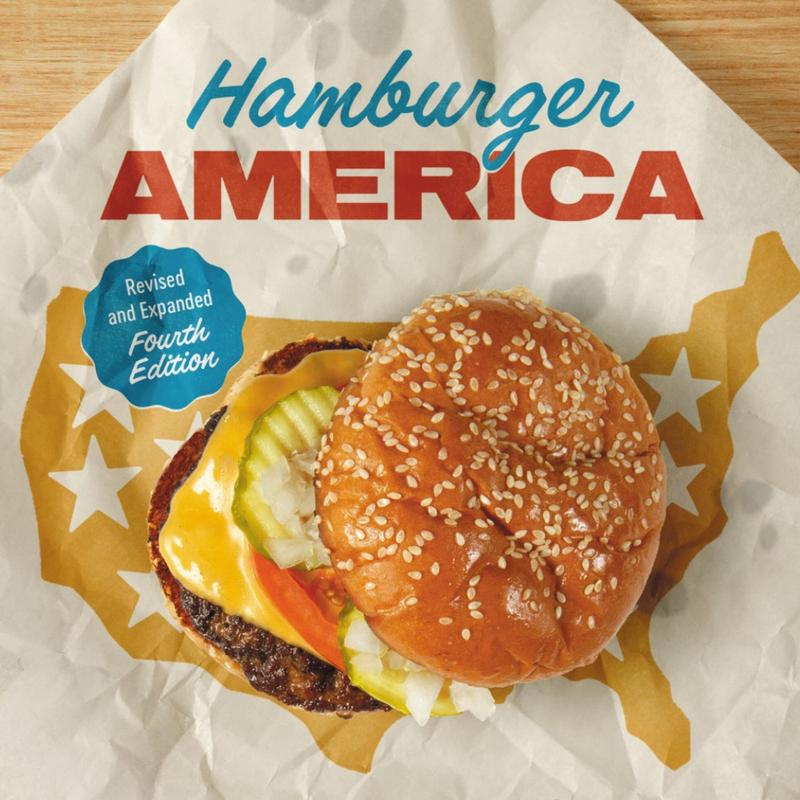
Alison Stewart: This is All Of It on WNYC. I'm Alison Stewart. The expression may be "as American as apple pie," but there's no food more quintessentially American than the burger. The book Hamburger America, from New York State's burger scholar George Motz, has been revised with some great additions. It's a state-by-state guide to 220 burger joints across the country. We're talking roadside stands, diners, mom and pop shops, college town favorites.
For example, there's Shady Glen in Manchester, Connecticut, that serves a four-ounce cheeseburger with not one or two but four slices of cheese. There's Jack's Drive-In just north of Albany, which serves their patties under a glorious caramelized topping of onions. Head to New York City classics like Corner Bistro, Donovan's Pub, and Jimbo's, all featured in the book, with a bit of history behind the institutions. Hamburger America is out tomorrow. There'll be a launch day signing at George Motz's restaurant in SoHo at noon and 6:00 PM, with a new surprise burger will be revealed. George, welcome to the show.
George Motz: Thanks for having me on.
Alison Stewart: Hey, listeners, do you enjoy a good quality burger? Where do you get one? Shout out the best burger joints in your neighborhood or borough. 212-433-9692, 212-433-WNYC. This is the fourth edition of this book.
George Motz: Yes.
Alison Stewart: Why was this a right time for an update?
George Motz: Because it had been a very, very long time since the last update. Solid eight years.
Alison Stewart: Where did you go to find the new restaurants? There are 38 featured in there?
George Motz: You call them new. They're actually old.
Alison Stewart: They're old. Old but new. New to me.
George Motz: We'll call them new entries. New entries. I have a legion of fans out there, I call them EBTs, Expert Burger Tasters. They're the ones I refer to as my first responders to great hamburger discoveries. I go on the road, and I do tons of research myself, but it's really my EBTs that find the best spots. I tell people all the time, "If you want to be an EBT, just reach out." [chuckles]
Alison Stewart: What distinguishes an okay burger from a great burger?
George Motz: I think, honestly, it's simplicity. It's simplicity, and usually the ones-- If you look at the burgers in history that have been around for a very long time, the simpler burgers are the ones that have stood the test of time. They're the ones that make it 100 years. They only have two or three ingredients on them. Some of these stunt burgers that have way too much stuff on them, they don't end up in your mouth very often because they're just too much to eat. It's the ones with the very, very simple ingredients, the ones that survive.
Alison Stewart: The stunt burgers.
George Motz: Yes, stunt burgers, yes. There's one stunt burger, I think, if you were just talking about in the intro, which is the Bernese special, which has those four slices of cheese. It is definitely a stunt burger, but it's a real thing. It's been around for almost 100 years now.
Alison Stewart: That's amazing. Your restaurant, Hamburger America, it's in SoHo. There are lines around the corner.
George Motz: Not every day.
Alison Stewart: A lot of times.
George Motz: A lot of times.
Alison Stewart: You get through. What made you decide to go into this line of work?
George Motz: It was actually a mistake. Complete fluke. I was a filmmaker for many, many years. I was actually a Union filmmaker for 28 years, in the business for over 35 years. I made a film about hamburgers almost-- Actually, at this point, over 20 years ago, I made a film about hamburgers called Hamburger America. Hamburger America was a story of hamburgers and people who make hamburgers, equally about Americans making hamburgers in America. I decided that-- I was just not going to make a big deal out of it. Then, when I put the film out, people got very excited about it. They started to say, "Oh, you're a burger person. You're a burger expert." I said, "No, I'm not an expert. I'm a filmmaker."
Eventually, somebody asked me to make a book about hamburgers. That book was Hamburger America, the first edition, which was 18 years ago, and it had only 100 entries in it. At that point, I started to really know a lot about hamburgers. People started-- They would seek me out for hamburger information, intel all the time.
Alison Stewart: We're talking about what makes a good burger and some of the greatest burger joints across the country, with author, chef, and owner of the restaurant, Hamburger America. Say your name.
George Motz: George Motz.
Alison Stewart: George Motz. His new book is out tomorrow. Listeners, we want to hear from you. Do you enjoy a good quality burger? Where do you go to get one? Shout out your favorite burger joints that you've ever been to in your neighborhood, in your borough, across the country. Our number is 212-433-9692, 212-433-WNYC. You can call in, join us on the air, or you can text us at that number as well. You talk about burgers in Arkansas, Indiana, even Puerto Rico. How much of a difference did you notice in the styles of cooking across the country?
George Motz: There's very different styles. Burger's a burger, has to be cooked a certain way to be defined as a hamburger. It has to be ground beef that is cooked somehow and served on bread, period. Full stop. That is it. That is the definition of a hamburger. You put cheese on it, it becomes a cheeseburger. If you put anything else in it, it becomes your burger, it becomes your style.
Outside of that definition, all over the country, regional uniqueness abounds and usually depends on where you are. If you're in Wisconsin, there's a lot of butter burgers in Wisconsin. There's a lot of great butter in Wisconsin, obviously. If you're in New Mexico, there's the green chile cheeseburger, is very special to the state of New Mexico. Outside of that, if you're in southern Colorado, if you're in western Texas, you can find a green chile cheeseburger, but outside of that, you're not going to really find anywhere else in the country at all. It's amazing. That is a very regional specialty. There are so many different regional burgers out there that are not just based on toppings, but also based on method and how they're made.
Alison Stewart: Like, for example?
George Motz: For example, you have deep-fried burgers in parts of the Midwest, upper Midwest, you have steamed burgers in Connecticut. You have poached burgers, I know I've seen before in Wisconsin. You also have another. You have a indoor charcoal burger in Wisconsin as well. Each one of those methods imparts a different flavor, obviously. There's so many different ways to make a burger.
Alison Stewart: Here's a question for you. It says, "What about Connecticut? I know New Haven has a burger joint that claims to be the original burger. Thoughts?" That's a text we got.
George Motz: I love this question. Here's the thing. The name of the place is Louis' Lunch in New Haven. It is a great place. It has the claim of being the inventor of the hamburger. Unfortunately, it's not. Unfortunately, they hate me for I've dispelled the myth. We have in print newspaper articles that go back to 1893 at this point, and their claim is 1900. They do, however, have the claim, and it's true that they are the oldest continually operating hamburger restaurant in America, at 126 years now.
Alison Stewart: This says, "After a movie at the Angelica Cinema, hunting for a restaurant, we came across Hamburger America. The reasonable price, it made us suspicious until we tasted it. It was perfect. We've been going there ever since. Great pies, too."
George Motz: Yes, there are great-- They say great pies. Oh, good. [unintelligible 00:06:51] the pies. We have a great baker who's a baker in New Jersey who makes great pies for us. All of our desserts are made by the same bakery. Price point is important, especially in SoHo, because in SoHo, I think a lot of the burgers, because they have to be and they can be, they usually go north of $20. Ours is not. We can do that because we're strictly a volume-based business, and we have a lot of capacity to make a lot of burgers in the restaurant. We can crank out a lot of burgers as well. We're also trying to get the line down. That's the--
Alison Stewart: Let's talk to Martin, who's calling in from Hoboken. Hey, Martin, thanks for calling All Of It. You're on the air.
Martin: Yes, thanks for taking my call. Tell you what, the best place, my favorite burger place in Hoboken, where I've lived for more than 40 years, is Court Street Restaurant. They are-- I don't know, I've had burgers all over the country, all over the world. This has got to be one of my favorites, anyway. That's what I'd settle on.
George Motz: That's a great one. Have you been to Krug's before?
Martin: To where?
George Motz: Krug's, also in Hoboken.
Martin: No. No, I have not.
George Motz: That's a great spot.
George Motz: Oh, good, good. I've also been to Bearburger in Hoboken.
George Motz: Krug's is actually in Newark. I'm sorry, my mistake. Krug's is in Newark. Not quite in Hoboken.
Alison Stewart: You can make a little trip. Thanks for calling. Let's talk to Ellen in Stamford, Connecticut. Hey, Ellen, thanks for calling All Of It.
Ellen: Hey, good morning. I've got a great place called Milestone, and they won the best burger in Fairfield County when they opened in Georgetown, Connecticut. They went up to Mystic and opened a very popular Milestone up there. They're about to open in Glastonbury. Their unique concept is they're originally a pizza place. They brought this custom-made oven in from Italy that fires everything at 750 degrees. They started throwing their hamburgers through the pizza place, pizza oven, as well as the creme brulee. I'm telling you, it is so crispy and so good. Couple patties, a secret sauce. It's the best in Connecticut. Louis' Lunch is not the best. It's Milestone Connecticut.
Alison Stewart: [laughs] Thanks for calling, Ellen.
George Motz: Letting some opinions fly. I like it. I don't know how long Milestone's been around, but I have a rule to be in the book, you have to have a burger on the menu for over 20 years to be even considered for the book. Have a great story, and have great history, and obviously, have a great burger.
Alison Stewart: Let's talk about New York City Burger's Corner Bistro.
George Motz: Classic.
Alison Stewart: It's your hometown burger. Let's talk about it.
George Motz: That's right.
Alison Stewart: First of all, what's interesting about the building that it's in? Let's talk about the atmosphere a little bit.
George Motz: Right. It's been the same cafe bistro its entire life, I think. It's been around for a long time, obviously, but it's a classic joint. It really feels like a joint. That's the whole point. Usually, burgers that come from a place like Corner Bistro tend to taste better just because of the place you're eating it in.
Alison Stewart: How has it changed over time?
George Motz: Not a whole lot. Unfortunately, the owner did pass away, the guy who originally put the burger on the menu back in the 1970s, but his daughter runs the place now, which is great. It's in great hands. When she took over the restaurant, she did some renovations, and I say renovations, she had to shore up the floors. The floor was about to go into the basement, and so she had to actually fix-- That was a big deal. I think the slope is still in the bar. It's still there. The burgers are still made the exact same way. It still is a great, great place to get a burger.
Alison Stewart: It's interesting. I went there New Year's Day. I went there by myself, and I looked up, and you can get like a smaller burger than just the big burger. How do you feel about that? Because I didn't want the whole burger. Then I was like, "Oh, wait, I can get a mini burger." How do you feel about it?
George Motz: Well, first of all, hang on, the burger is not that big. [laughs]
Alison Stewart: Was big to me. [laughs]
George Motz: Not that big. It's big if you get the Bistro burger itself, it does come with cheese and an onion. They actually take their bacon, they throw it in the deep fryer. That's why it's so good and crispy. It does make for a very tall burger. I'm very reluctant to appreciate any change in a classic burger joint. You have to really sell it to me.
Alison Stewart: That's hard. That brings me up to the question of, this is a city that's constantly changing. How does the burger continue to survive?
George Motz: Again, it's just based on simplicity. It's trying to not be everything to everyone. We don't have a veggie burger on our menu because there are plenty of places that make great veggie burgers in the neighborhood. Also, I wouldn't go to a vegetarian restaurant and ask for a piece of steak. Why would you come to a hamburger joint and ask for a veggie burger? You can't be everything to everybody. The ones that survive are the ones that really do focus, and they focus on making great food.
Alison Stewart: Let's talk to Diego, calling in from Bed Stuy. Hey, Diego, thanks for calling All Of It.
Diego: Hey, thanks for having me. I actually have a tie for first place. I'm from Los Angeles, and I think Bill's Burgers in Sherman Oaks. Bill passed away recently. Rest in peace. He made a really good burger up into his 90s. He was back there flipping patties.
George Motz: He actually did.
Diego: Then Yuca's on Hillhurst.
George Motz: Oh, Yuca's is great. Yuca's actually is a funny-- Yuca's not a hamburger spot.
Diego: Yes, Yuca's is a taco spot.
George Motz: It's a taco stand.
Diego: They make a great burger.
George Motz: They really do make a great burger. It's true. [laughs]
Alison Stewart: We're talking about Hamburger America. It's the fourth edition of the book with a whole lot of new restaurants in it. New old restaurants in it. It's revised. I'm talking to George Motz. We'll have more after a quick break. This is All Of It.
[music]
Alison Stewart: You're listening to All Of It on WNYC. I am talking to chef, author, and owner of Hamburger America, George Motz. Rhymes with goats. It's a good tip. Thanks so much. We're talking about what makes a good burger and some of the greatest burger joints across the country. That's the name of his book, Hamburger America. Let's stick in Brooklyn. Let's go to Brooklyn. Brennan & Carr, you list.
George Motz: It's actually a sandwich place. Not even a hamburger joint. It's a sandwich place. They're one of the great holdouts. One of the very last roast beef sandwich spots in Brooklyn. Apparently, they were everywhere. They're one of only, I think, two or three that are left in Brooklyn right now.
Alison Stewart: How did they get into the burger business?
George Motz: It's a great question. They had a burger on the menu at some point, and in the old days, they used to serve breakfast-- sorry, served Sunday dinner to the staff at Gargiulo's Restaurant in Coney Island. They would travel the staff for staff meal. Would travel to Brennan & Carr to get roast beef sandwiches, and they'd also like to get burgers. There was a big crew, so they would put out buckets of burgers and buckets of roast beef, and they didn't like the bread that they had there back in the day, so they would bring their own Italian bread with them. They would take this beautiful Italian bread, they would put on it burgers and the roast beef, and they'd put slices of cheese. The Gargiula burger was born at that point.
Alison Stewart: Let's go to Queens. In the book you wrote, "The Donovan's burger is a lesson in how large burgers should be prepared." First of all, how big is it?
George Motz: That's a good question. 9 ounces, I think, or maybe 10 ounces. It's a big burger. It's a thick patty burger.
Alison Stewart: How do you cook that?
George Motz: They cook it in a steak, like a steak salamander, a steak broiler. It's cooked the same way a steak is. It cooks from top and bottom at the same time, which, by the way, is the same way at the Corner Bistro. The idea is that if you cook both sides at the same time, it locks in all those juices and cooks it much faster. It's a very fast way. Great way to make a burger, but it cooks it like a steak. All the juices are locked in there. You take a bite, there are literally juices all over you.
Alison Stewart: What is your strategy for eating that large burger?
George Motz: Lean forward-
[laughter]
George Motz: -and come hungry.
Alison Stewart: Let's take some more calls. Sandy is calling from New Haven, Connecticut. Hey, Sandy, thanks for calling All Of It. We want to hear about your burger joint.
Sandy: Yes, thanks for having me. I went to Yale 10 years ago, and there was a great burger joint called Educated Burger. They have the best char-grilled burgers. If you know any Yale student or alumni that was there around that time, they would vouch for it. It seems closed down, but it was truly a really good burger.
George Motz: It was a good burger. It's true. It didn't make the book because it closed down, I think, before I knew about it. I did know about the Yankee Doodle. Yankee Doodle was a great spot, also. They're also gone, also from New Haven.
Alison Stewart: Let's talk to Sean in Bed Stuy. Hi, Sean, thanks for calling All Of It. You're on the air. Sean's not there. Let's talk to Seth in New Jersey. Hey, Seth, thanks for calling All Of It.
Seth: Hey there. Thank you so much for talking. Great conversation. I'm a native Brooklynite, though I've been in Jersey City for a while, and I had two quick questions. Thanks. First of all, do you remember a place-- It was called Nick's or Big Nick's on the Upper West Side. They made a really sick burger.
George Motz: Yes.
Alison Stewart: I remember that.
George Motz: That was a great spot.
Seth: Yes.
George Motz: Yes. The Greek spot.
Seth: Was a great spot. They were--
George Motz: The Greek spot.
Seth: Yes. Yes, yes. It was really a diner, per se. They just made a phenomenal burger, and they stayed open. It was either 24 hours or-- [crosstalk]
George Motz: I think it was a 24-hour place. I would go there at two o'clock in the morning. No problem.
Alison Stewart: When I worked for ABC News overnight, we would order from Big Nick's at like 2:30 in the morning. Anyway, continue on, Seth.
Seth: There you go. Yes, and that was my experience too. It was usually odd hours. I ended up there. The real question I wanted to ask you. Thank you so much. What is your feeling about the phenomenon of smash burgers, which I have to wonder if somebody with your level of expertise really takes even seriously?
George Motz: Of course, I take it seriously. Absolutely. The reality is the smash burger is the original American hamburger, and people think it's a trend, and it's-- Would you call it a-- The caller said it was a phenomenon. I think it is phenomenal. It's not a recent phenomenon. That's probably what he's referring to. It is unquestionably the original American hamburger method. They would take portioned balls of beef, and they would smack them with the back of a spatula to get them flat so they would cook faster. It was literally done for speed. Only for speed.
Alison Stewart: That's so interesting. This one says, "My favorite is the California Burger. The burger is pre-mixed with a finely chopped celery and carrots, then fried and served with lettuce and tomato. Very juicy and tasty." Have you heard that before?
George Motz: No, but I've done that one. Mixing is always tough for me.
Alison Stewart: It's a tough one. This says, "Best burger upstate New York at the Pines at Mount Tremper outside of Woodstock. Celebrating 10 years this week. It's an amazing burger." This one says, "One of my favorites was a Hatch Green burger at Buckhorn in San Antonio, New Mexico."
George Motz: Yes. Right near the Owl Bar, also in San Antonio, New Mexico.
Alison Stewart: This says, "Buddha Smash Burgers in Henderson, North Carolina."
George Motz: They're newer places.
Alison Stewart: They're newer. Let's go out to Long Island. Hildebrandt's.
George Motz: Hildebrandt's.
Alison Stewart: All right, tell us something that's special about Hildebrandt's.
George Motz: It's been around forever. To me, the most special thing that happened recently was that we almost lost it. We were all trying to find ways to get people excited to maybe buy it or even preserve the beautiful neon sign on the outside. Anything. The business was going down, and a guy walked in for dinner one night. He was taking his dad to dinner there, and he looked at the owner, and he said, "I'll buy it." [laughs] His name is Randy Sarf.
Alison Stewart: Wow.
George Motz: To me, those are my hamburger heroes, the ones that can see the need to preserve this history and go ahead and just buy it if they can, if they can afford it. He did. Randy Sarf bought this place, and he himself, he owns a lot of horses. He's a horse guy. Actually, what he's done is he's upgraded the restaurant and kept everything pretty much the way it is with an upgrade.
Alison Stewart: We are talking about great burgers. The name of the book is Hamburger America: A State-by-State Guide to 220 of the Greatest Burger Joints Across the Country. Its author is George Motz. He's the owner of Hamburger America in SoHo. Listeners, do you enjoy a good quality burger? Where do you go to get one? Shout out your best burger joints in your neighborhood, your borough, or across the country. Our number is 212-433-9692, 212-433-WNYC.
This says, "Shout out to Fred's on Amsterdam Avenue at 82nd Street. My current favorite burger in Manhattan." This is for us. It says, "Big Nick's was open 23 hours, but they never told you which hour it was closed."
George Motz: That's right. That's true.
Alison Stewart: That's very funny. Let's talk to Dean in Brooklyn. Hi, Dean, thanks for calling All Of It.
Dean: Yes, hi. George, I'm wondering if you've ever gone upstate New York to Rochester, where we don't call a hamburger a hamburger. We call it a ground round. It's a super thick patty, it's got holes in it, almost like a waffle. You get it with everything. You just say everything, which includes chili, a meat sauce, chili on top, mayo, all the other stuff.
George Motz: Yes. You've got Bill Gray's, Tom Wall, and what's the other one? Oh, Schaller's, as they pronounce it in Rochester. Schaller's.
Dean: Yes. Don and Bob, you do know your Rochester.
Alison Stewart: [laughs]
George Motz: Oh, yes, those are great. We just put Schaller's in the book recently. Schaller's is a great, great spot. I love it so much.
Alison Stewart: Let's talk to Jeff, who is calling in from Queens. Hey, Jeff, thanks for calling All Of It. You're on the air.
Jeff: Hi, good afternoon to both of you. I have two quick comments. I'll say the best burger I've ever had in my life was at Kumas in Chicago. For those in the Midwest or Chicago, it's a legendary place, because it plays heavy metal like-- I mean, heavy metal--
George Motz: They do.
Jeff: Heavy metal bar. It also serves a really world-class hamburger. The other point I wanted to make, and I'm going to push back a little, George, is that you said earlier in the segment that you didn't necessarily value a place that served a hamburger that-- Not that you didn't value. You said why go to a burger place that serves vegetarian burger or vice versa. I was just going to point out that my partner, she's a vegetarian. We appreciate a place like our local Bearburger down the street from us that has two vegetarian burger options on the menu and still serves up a quality burger. For us, it really works, and we place some value in that. [crosstalk]
George Motz: No, I don't-- My only comment was that I don't know how to, and I didn't want to pretend like I did. That was the difference. That if you have to and you can, that's one thing. Also, I'm in a neighborhood where there's probably 10 veggie burgers within 4 blocks of me, and I prefer that people went to those experts in veggie burgers and try to come to me. That was the only reason. It's true. You go to a vegetarian house, there's no meat. I'm not sure why we'd do the other way around, anyway.
Alison Stewart: Let's head over the bridge to Hackensack, New Jersey, White Manna Hamburgers. You say, "White Manna is beyond a doubt one of the most historically important burger joints in America." Why are they so important?
George Motz: It started out as the Diner of the Future. It was an actual exhibition at the 1939 World's Fair. When the fair was over, a guy named Bridges, last name Bridges, he decided to buy the actual exhibit, the Diner of the Future. The Diner of the Future, by the way, just so you know, it was a griddle in the middle of a room, and it was surrounded by customers sitting at a round counter. The idea was-- It was based on efficiency. It was the idea of indoor fast food was where one person could then just send out burgers in every possible direction in a circle, from a center point. It was an open kitchen.
Basically, the same thing we have at Hamburger America. We have our own version of the White Manna kitchen. Today, there's only two left. The one that I like is because it's the older-- One that's actually from the fair, but the one that's a newer one is in Hackensack. It's set up the same way, where you walk in-- It's extraordinarily efficient. I can't understand why more people don't make hamburger restaurants like that anymore.
Alison Stewart: Let's talk to Ken, calling in from Queens. Hey, Ken, where's your favorite place to go to get a burger?
Ken: First, let me start by saying I've been to Hildebrandt’s. Great place, but All American in Massapequa. Classic place. Get your burgers, get your homemade fries, vanilla chocolate, strawberry milkshakes. Phenomenal place.
Alison Stewart: Let's talk to Talia in Brooklyn. Hey, Talia, where do you go?
Talia: Oh, love Cozy Royale in Brooklyn. They make a great burger. They get their meat right around the corner from their butcher. They own a butcher shop around the corner. The meat's always super fresh, and they do a great dry, aged burger.
Alison Stewart: Let's go to our last caller, Brendan from South Orange. Where do you go, Brendan?
Brendan: I really love a place in Buffalo, New York. It's called Ted's. Maybe more well-known for hot dogs, but the burger is excellent.
Alison Stewart: Thanks so much for calling in. George, if you could get on a plane right now and have a burger anywhere in the 50 United States or Puerto Rico, where would you go?
George Motz: I don't play favorites, Alison. [chuckles]
Alison Stewart: Just a couple. Just a couple places.
George Motz: Two blocks away. My restaurant is great. Good burgers over there. No, I can't play favorites. The minute I play favorites, I'm in trouble. I would say of the 220 restaurants in my book, I'd go to any of those. [chuckles]
Alison Stewart: What do you think is the next big trend for hamburgers? I know you're about simplicity, but if you had to think about what's the next trend in hamburger cuisine, what would it be?
George Motz: We go back and forth between should it be a thin patty, should it be a thick patty, should it be thin? Should be-- Whatever. I imagine it's just going to go back and forth between the two. I think there's a lot of trends out there right now where the patties are super, super thin. I think we're going to start to move back to a slightly thicker patties. People actually want to be able to bite into something that's not too thin. They want to have a-- lack of a better term, a beefy hamburger experience. [laughs]
Alison Stewart: I've been talking to restaurant owner, chef, and author George Motz, whose book Hamburger America: A State-by-State Guide to 220 of the Greatest Burger Joints Across the Country. It comes out tomorrow. Thanks for coming to the studio.
George Motz: Thanks for having me in.
Copyright © 2026 New York Public Radio. All rights reserved. Visit our website terms of use at www.wnyc.org for further information.
New York Public Radio transcripts are created on a rush deadline, often by contractors. This text may not be in its final form and may be updated or revised in the future. Accuracy and availability may vary. The authoritative record of programming is the audio record.