
A Russ & Daughters Cookbook
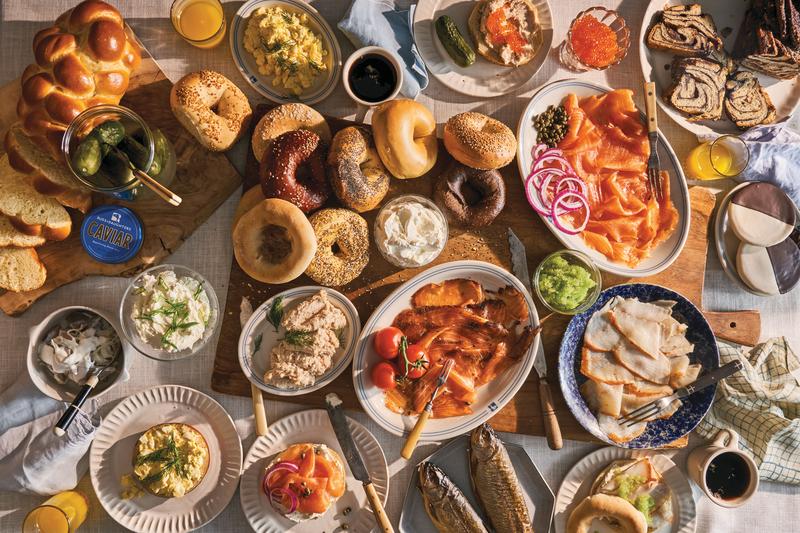
( Courtesy of Flatiron Books )
Alison Stewart: This is All Of It. I'm Alison Stewart. Thank you for sharing part of your day with us. I'm really grateful that you're here. Tomorrow on the show, Wyclef Jean will stop by to preview his residency just up the street at the Blue Note. We'll also have the stars of the movie Twinless, as well as the visual artist Lisa Corinne Davis. That's in the future. Now, let's dive into some history with Russ & Daughters.
[music]
Alison Stewart: Originally, a pushcart operator featuring herring on the Lower East Side, what is now Russ & Daughters came of age when the tenements were filled mostly with Eastern European immigrants. Joel Russ built the business into a shrine. He employed his daughters, Anne, Ida, and Hattie, and the store has been in the family ever since. Still on the Lower East Side, locals and tourists alike stand in line for lox, bagels, sandwiches, and babka-- you should always stand in line for babka. Since 2006, Russ & Daughters has been steered by fourth generation Russes, Nick Russ Federman-- excuse me, Niki Russ Federman. I'm so excited you're here. Niki Russ Federman and her cousin Josh Russ Tupper.
Now, they've joined forces on a new cookbook that not only includes the recipes, but some of their own specialties and the stories behind them. The book is called Russ & Daughters: 100 Years of Appetizing, and on the back of the book, they have an excellent quote from Anthony Bourdain. It reads, "Russ & Daughters occupies that rare and tiny place on the mountaintop reserved for those who are not just the oldest and the last, but also the best." Today is pub day. Welcome to the studio, Niki and Josh. Thanks so much for coming in.
Josh Russ Tupper: Thank you for having us. It's great to be here.
Niki Russ Federman: So happy to be here.
Alison Stewart: Listeners, now's your time. Are you a Russ & Daughters regular? Do you make the pilgrimage down to the store for a special occasion? What's your go-to order? What are some of your favorite memories of shopping at the store if you've left New York? Call in and tell us what you miss about Russ & Daughters. Our phone number is 212-433-9692, 212-433-WNYC. You can call in and you can text us. Either way, we want to hear what you think of Russ & Daughters. Okay, Niki, what was the original title of the store?
Niki Russ Federman: Right. Our great grandfather didn't name it Russ & Daughters until about 1935, and before that, he had a couple names. One was Russ's Cut Rate Appetizing, because there were so many other appetizing stores just on the Lower East Side, so I guess he had to compete on the cut rate. Then the other was J Russ National Appetizing, which I also love, because there was nothing national about what he was doing. He was really serving food to the waves of Eastern European Jewish immigrants on the few blocks of the Lower East Side.
Alison Stewart: For people who don't know, can you give us the reason it's appetizing?
Josh Russ Tupper: Appetizing is a very New York word and New York tradition. The word is derived from the Yiddish word "forshpayz," which is the word for appetizers. We believe the story went something like, there was a Yiddish speaker that tried to say "appetizers" but said "appetizing," like our great grandfather who spoke Yiddish as his first language, and we think that they just went with the "appetizing" as the noun. This tradition is sort of the opposite of the deli tradition: it's the smoked and cured fish and dairy, because you can't have dairy with meat in the kosher laws.
Alison Stewart: One of the things I wanted to ask about, and please correct me if my Yiddish is wrong, you said that the concept of hamish--
Niki Russ Federman: Haimish.
Alison Stewart: Haimish. The concept of haimish has really been important to the store since the beginning. Why did you want to keep that ethos?
Niki Russ Federman: Because in a way, sometimes words from a different language can perfectly sum up an essence. Russ & Daughters is haimish. Haimish--
Alison Stewart: Cozy, right?
Niki Russ Federman: Cozy, comforting--
Josh Russ Tupper: Inclusive.
Niki Russ Federman: Inclusive, unpretentious, maybe even a little gritty, you know? It has some character. A person can be haimish, a place can be haimish, food can be haimish, and that really is sort of our litmus test. When we were opening our restaurant, Russ & Daughters Cafe, that was always the question. Is this dish haimish? No, this isn't haimish enough. Is this menu design haimish? No, it's not. That's always kind of where we want to exist. We want to exist on the haimish line and not cross it. We want people to feel comforted, and that it belongs to them.
Alison Stewart: That's so interesting. You would actually look at the menus and say like, "This doesn't quite feel haimish"? What wouldn't feel haimish about it?
Josh Russ Tupper: I mean, every one of our design decisions was made with this in mind, so it was really like, is this accessible? Does this seem too--
Niki Russ Federman: Precious.
Josh Russ Tupper: Yes, precious, highfalutin. Is this something for the few and not the many? In every decision we made in building that restaurant, it was really with haimish, and it's just more welcoming.
Alison Stewart: When your great grandfather brought his daughters aboard, was that a progressive decision?
Niki Russ Federman: I'd like to think of him as being a pioneering progressive feminist, but if he had had a son, I'm sure it would have been Russ & Son.
Josh Russ Tupper: Well, it almost was. There was a child--
Niki Russ Federman: There was a firstborn, but he sadly passed away as a baby. He did know that there were no other places with "& Daughters" in its name. We're very proud to be-- Russ & Daughters is the first business in this country with "& Daughters," and he made his daughters his partners-
Alison Stewart: Wow, that's really cool.
Niki Russ Federman: -and it was very controversial at the time. I think he understood the marketing appeal of this, but he was willing to take a lot of pushback for it. Some customers assumed that he had fallen on hard times and needed to take a partner, and that there was a Mr. Daughters, but--
Josh Russ Tupper: I like the progressive story. He was a progressive. He was way before his time, the first feminist-- [chuckles] No, not true. There were plenty of feminists before him.
Alison Stewart: It was interesting-- Did the women want to work there?
Niki Russ Federman: Well, I think Hattie, the firstborn daughter, wanted to work there because she wanted to please her father's expectations.
Josh Russ Tupper: The stories we got from our grandmother, Anne and Hattie-- our grandmother was always like, "You just wanted to make papa happy."
[laughter]
Niki Russ Federman: We know that our grandmother, who was the youngest Russ daughter, did not want to do this. She had her own ideas. She at one point wanted to open a dress shop, that was not allowed. The expectation was, "This store is how our family survives in this country, and therefore, you are all expected to participate." So I think it was really meaningful for our grandmother when she was already in her 80s, to see her grandchildren choose to come in and keep this legacy going, and that it was our choice to do that.
Alison Stewart: Because you had other careers before you were in the Russ & Daughters business. What were you doing?
Josh Russ Tupper: I got a chemical engineering degree and worked in semiconductors as an engineer for five years. A little bit different than retail fish.
Alison Stewart: What made you change your mind?
Josh Russ Tupper: For me-- it's weird how similar our brains were, Niki and mine. At the time, I just started thinking more about that side of my family, and what our grandmother-- who was kind of a powerful figure in our lives, she was really a matriarch of our family-- what she did with herself, and whether she really wanted to from the beginning or not, her life was devoted to Russ & Daughters, and just the idea of the small family business. You know, I'm working as an engineer in the Pacific Northwest, and the small family business, even in Portland, Oregon, was really not around. It was these box stores and big stores, and the idea of that small family business being important to our society and who we've all become in this country, I didn't want to see something like that go. And it was my family, so I wanted to support that.
Alison Stewart: How about for you, Niki? Why was this the right choice for you at that moment in your life?
Niki Russ Federman: Well, I grew up in the shop as a shop kid, and Russ & Daughters was a literal mom and pop for me because it was my mother and father, Maria and Mark Federman, who ran it for 30 years before us, so I kind of absorbed from a very young age that there was something-- I don't think I could understand at the time, but that there was something magical going on in this tiny store. When you put food and people together, there's something just base level, so human and beautiful about that. As I grew up, I was encouraged to do anything but, and I had to go on sort of a walkabout, so to speak, and check other things off my list. But with each different career jump I made, it never felt real to me. When I got to the bottom of my list, I had to take stock of things, and I realized that Russ & Daughters is very real.
Whereas I at one point kind of rebelled against it, I thought that I should go and do something different than what my parents, grandparents, great grandparents had done, I came full circle to realize the beauty in being able to continue a tradition, be part of a legacy, but then also realize that as much as we want to keep Russ & Daughters the same, we also can move it forward and innovate and do things. That was a really powerful culmination and realization, so I came back.
Alison Stewart: We got a text here that says, "Niki is great. We always got caviar tins and things for the TV shows we worked on. I personally would always get the chocolate dipped apricots and smoked trout and whitefish salad, just letting you know."
Josh Russ Tupper: Probably not eaten together.
Alison Stewart: Probably not eaten together. This is a good text if you can answer it. It says, "Without giving away any family secrets, can you give us some idea what distinguishes your curing techniques from some other local favorite?"
Josh Russ Tupper: This is an interesting one. We at Russ & Daughters have never smoked our own fish. It isn't legal to commercially smoke in Manhattan due to pollution, so we've always gotten them from local smokehouses, which-- We have 80-year relationships with some of these smokehouses, so we definitely work with them to create our special flavor profiles and stuff, and we pickle our herring, and we make the sauces and things, but we don't smoke the fish.
Alison Stewart: That's interesting. I'm speaking with Niki Russ Federman and Josh Russ Tupper about their new cookbook, Russ & Daughters: 100 Years of Appetizing. Listeners, are you a Russ & Daughters regular? Do you make a regular pilgrimage down to the store for special occasions? What is your go-to order? What are some of your favorite memories of shopping at the store? 212-433-9692, 212-433-WNYC. You said that you pickled your herring and the different food at the store. Were these recipes that were written down, or did you have to ask people like, "How do we do this?"
Niki Russ Federman: Well, the cookbook is organized in terms of showing the evolution of Russ & Daughters, starting with our original store on East Houston Street, but then going from there, it includes recipes from Russ & Daughters Cafe, our restaurant. So, hot dishes, and cocktails, and egg creams, and sweets. Then our bakery, where we make our bagels, bialys, babka, black & whites, et cetera. Some of the recipes, especially with the store, we have those recipes. Obviously, the restaurant, we make those dishes all day, every day. Some other recipes were a bit more challenging. It was an interesting exercise because-- for example, at our bakery, we're making hundreds of dozens of bagels every day, we're making hundreds of babkas every day, so our recipes are--
Alison Stewart: Big.
Niki Russ Federman: The quantities are big, and that doesn't work for a cookbook for someone at home-
Alison Stewart: Oh, that's so interesting.
Niki Russ Federman: -so we really had to kind of reverse-engineer some of these recipes. Also, taking into consideration that people in their own kitchen are not going to have the commercial equipment that we have, they're not going to have a team of bakers like we have, so it was kind of doing things a little bit in reverse to get to the end result for somebody at home to do this.
Josh Russ Tupper: Yes. I will say-- As you know, Niki and I came on 20-something years ago, and that store was run as an old family business. When we would be looking for a recipe, it was sort of like, "Oh, you gotta ask so and so." Through the years, we've written them all down, so we have them, but not initially.
Alison Stewart: You were talking about the different equipment that people have. Apparently, the slicer is very important. Will you please explain to us why the slicer is so important?
Niki Russ Federman: Yes. We continue to practice the craft of hand slicing all of our smoked fish, and it's something that looks very easy to do, but it's actually quite difficult. It can take months of someone practicing to get this-
Josh Russ Tupper: And a lot of fish.
Niki Russ Federman: -and going through a lot of fish. When we hire people to be on the counter, literally, one of the things we do is have them-- we put a knife in their hand behind the counter, just to see if they have [crosstalk]--
Josh Russ Tupper: Like, the first day they show up.
Niki Russ Federman: We can tell if somebody has the capacity to get it, even if it doesn't come right away to anybody.
Josh Russ Tupper: It mostly involves not a shaking hand.
[laughter]
Niki Russ Federman: We use-- It's not an expensive knife. It's just a very particular knife that's very long, and it has a flex to it, and it's incredibly sharp. Once you get good at slicing by hand, one, the quality of that salmon, or sable, or yellowfin tuna, is just incomparable. The thinness and the integrity of the flesh just keeps in a way that it then just is like butter in your mouth. It also becomes, for the practitioner, quite enjoyable. It's kind of meditative to slice, and you're really just in this zone holding this knife very carefully and making these micro adjustments, different angles.
Josh Russ Tupper: It really is an art.
Niki Russ Federman: Then it also offers-- because we're doing everything by hand to order, it offers this moment between the slicer, the counter person, and the person across the counter to talk and engage, which is sort of becoming rarer and rarer to find.
Alison Stewart: It also sounds like there's an apprenticeship element to people who work at Russ & Daughters.
Josh Russ Tupper: Yes. Those trainees that may be taking three months to learn are not ready to cut fish for the customer themselves, so they're working with another employee on the counter. The amazing thing for me about slicing, it's been 23 years, and I'm still learning nuances and different ways to change angles and make slices better. It's really wonderful.
Alison Stewart: Let's talk to Sholto on Line 3. Hey, Sholto. Thanks for calling All Of It.
Sholto: Hey, hello. Hi, Niki. Hello, Josh.
Josh Russ Tupper: Sholto, from South Africa.
Sholto: Yes, that's me.
Niki Russ Federman: Sholto, oh--
Josh Russ Tupper: Old customer.
Sholto: I've been going to Russ & Daughters. The first time I went in there was 1983, and I lived down-- I've been living down in the East Village since then. I saw this place and I wanted to know what was going on, and I went in and I said, "Okay--" I saw there were no women there, so I said, "Okay, who's Russ, and where are the daughters?"
[laughter]
Sholto: I ended up meeting Niki's father--
Josh Russ Tupper: Mark.
Sholto: Yes, Mark, God bless him. You know, I feel like I'm almost part of the family. I used to go there [crosstalk]--
Josh Russ Tupper: First of all, Sholto in '83 must have been 18 years old.
Sholto: Yes, I was 19. That's right.
Josh Russ Tupper: Okay. Amazing.
Sholto: Yes, I just love Russ & Daughters. Then you opened up at the Jewish Museum for a while, and now you have the restaurant, and I just love you guys. I feel like I'm part of the family.
Josh Russ Tupper: Oh, thanks, Sholto.
Sholto: It's just very hard to get in there now, you know? It's so popular.
Niki Russ Federman: Well, that's the thing. Our original store, our spaces tend to be quite small, with the exception of Russ & Daughters Brooklyn where we have a lot of space. All of our other spaces are tiny, so it does give the appearance of being busy at all times, but really, there might just be-- You know, once you put five people in our space, it seems busy, but it's not.
Josh Russ Tupper: Yes, it's crowded, or it looks crowded from the outside.
Niki Russ Federman: Sholto is a perfect example of just the wonderful humans and neighbors and connections we've had the joy of having over so many years.
Josh Russ Tupper: Also, a regular like Sholto who's coming in three, four days a week, and you're just hanging out with him when he comes in, yes, it's really nice. Thank you, Sholto.
Alison Stewart: This text says, "I celebrate every birthday with smoked sable from Russ & Daughters. Is that a good thing to have for your birthday?
Josh Russ Tupper: It's a great thing.
Niki Russ Federman: Oh, sable is so buttery and rich, and it has a thin coat of paprika and garlic. Oh, it's divine. Sable used to be called poor man's sturgeon.
Josh Russ Tupper: Or chicken carp. [chuckles]
Niki Russ Federman: Or chicken carp, which is so bizarre, and I can't tell you the etymology of that one, but it is no longer. It is almost as expensive as sturgeon at this point.
Josh Russ Tupper: Right, it used to be cheap. It's still a wild fish caught from the Chatham Straits in Alaska, and it's delicious. It's that fish that the miso black cod is made from, so it's black cod or sable.
Alison Stewart: What would you have for your birthday from Russ & Daughters?
Josh Russ Tupper: Birthday? Probably caviar.
Alison Stewart: Caviar?
Josh Russ Tupper: Yes, the way that I think caviar should be eaten if you have the means.
Alison Stewart: Which is?
Josh Russ Tupper: You make a blini the size of a plate, and you put 125 grams or 250 grams just in it and roll it up and eat it like a burrito.
Alison Stewart: Ooh, that sounds pretty good. How about for you? What would you get for your birthday at Russ & Daughters?
Niki Russ Federman: Well, I think when people come over, there's always an expectation that there's Russ & Daughters, so if I were having friends or family over, I would put out a whole classic spread. Bagels, smoked salmon, the spreads, the whitefish salad. I'd probably have somebody stick a candle in the babka for me--
Alison Stewart: [chuckles] You know, it's funny that Sholto mentioned the lines outside of the store. Because I've gone by there, I'm like, "Whoa, it's a big line." Has Instagram changed your clientele at all?
Niki Russ Federman: Well, first, I should say there's actually not a line. We don't work with a line. We have a take-a-number system, old school, so you take a number, and then you don't have to wait in a physical line. People go and they sit outside, they take a walk--
Josh Russ Tupper: Right, so it can be deceiving with a bunch of people outside, because half of them are probably waiting for other people inside, or eating something outside.
Alison Stewart: Oh, is that what it is? Because I was down there on Saturday, I was like, "All people outside of it?" But that's part of the ambiance, I guess.
Niki Russ Federman: Yes.
Josh Russ Tupper: Yes. Then I think pre-Instagram, there was this tourist influx with a lot of the guides and a lot of tourists, and yes, Instagram-- I think there was a peak moment where everyone was there to take a photo for Instagram, and thankfully, I think that's going down, but there still is a heavy amount of people. Niki said how we would like Russ & Daughters to be enjoyed. How it was traditionally enjoyed is getting a spread and bringing it home, and sitting down and serving it. Now, it's a lot of sandwiches, because people don't live here, they need a sandwich to take on the road, or sit outside and eat it somewhere.
Alison Stewart: Oh, they're eating it. [chuckles]
Josh Russ Tupper: Yes, so it's interesting.
Alison Stewart: We are talking to Niki Russ Federman and Josh Russ Tupper about their new book, Russ & Daughters: 100 Years of Appetizing. If you are a Russ & Daughters fan, give us a call, 212-433-9692, 212-433-WNYC. After the break, we'll get into some recipes.
[music]
Alison Stewart: You're listening to All Of It on WNYC. I'm Alison Stewart. In studio with me, I have Niki Russ Federman and Josh Russ Tupper. They are from Russ & Daughters, and we are celebrating the release of their new cookbook, Russ & Daughters: 100 Years of Appetizing. There are great recipes in this book. First of all though, I do want to point out to you, how to braid challah. Is it as difficult as it looks?
Niki Russ Federman: It kind of is, hence why we wanted a photographic step-by-step guide.
Alison Stewart: It's awesome. The picture is great.
Josh Russ Tupper: Ultimately, I'm not sure if that helps or makes it seem more difficult, but once you get it, it's pretty easy.
Niki Russ Federman: And if you resort to a YouTube video, we totally get it.
Josh Russ Tupper: Yes.
Alison Stewart: All right. I wanted to ask you about-- people eat challah, they're used to babka, but I want to ask you about some alternatives. If you're someone who just loves challah, what else should you try?
Niki Russ Federman: Well, you could take the challah and turn that into challah bread pudding, which is also in the book, and it's delicious. It has dried Turkish apricots, caramel sauce, it's so delicious. That's one of my favorites.
Josh Russ Tupper: Yes. Then for the babka, there's a recipe in the book that is babka French toasts.
Alison Stewart: Ooh-- Just like regular French toast made with a babka?
Josh Russ Tupper: Pretty much. It's pretty wonderful.
Niki Russ Federman: Also, another baked good that I don't think gets its fair shake that's so delicious is honey cake. The Jewish New Year, Rosh Hashanah, is coming up, and that is a classic sweet dessert. I get it why some people don't appreciate honey cake, because there are not so great options out there, but I happen to think that our honey cake is so good, we make it all year round. We used to just make it for the Jewish New Year, and then realized that, that's a shame, people should enjoy this all the time. It's just very moist, and it's got those warming spices, and lots of honey, obviously. I have it for breakfast quite often.
Alison Stewart: Let's take a call. This is Charlotte calling from Lower Manhattan. Hi, Charlotte. Thanks for calling All Of It. You're on the air.
Charlotte: Hi. Thank you for taking my call. I know Niki and Josh, and my family has been shopping at their store for a very long time. I wanted to mention a recipe situation. I don't know if it's in the book, but I love your whitefish salad. It is not mayonnaisey or cream-cheesey. I believe you use salmon to make it softer and oilier?
Josh Russ Tupper: We do--
Charlotte: Okay.
Josh Russ Tupper: Hi, Charlotte. Nice to hear from you. Yes, absolutely. Our whitefish salad is certainly in the book, as most of our other recipes are, and I'm getting a lot of friends being like, "You're letting the secrets out?" It's like, "Yes, and you can make it if you want, but you can still buy it from us." We do, for our whitefish salad-- it's called whitefish and baked salmon salad. We use about 90% whitefish and 10% baked salmon, which is kippered salmon, hot smoked salmon that's a little smoky, and it kind of mellows out the flavor of the whitefish salad. It's really nice.
Alison Stewart: Let's talk to Lisa calling in from Randolph, New Jersey. Hey, Lisa, thanks for making the time to call All Of It today.
Lisa: Thank you for taking my call. Very exciting to be on the air and speaking with the heirs of Russ & Daughters. How can we modernize or speed up the process of making babka, and dare I say, rugelach?
Niki Russ Federman: That's a great question. That's actually something that we debated quite a bit in making the book, because a lot of these recipes are, in fact, pretty laborious, and they do take time. We ultimately decided we're going to just give people the recipes the way that we do them. They might not be two steps and done, but it's really in taking your time and letting these flavors come together that you get the best product. I mean, at Russ & Daughters, it literally is a two-day process to make our bagels. There are ways to cut corners, and we choose not to.
Alison Stewart: Let's talk to Joel, who's calling in from Forest Hills. Hi, Joel. Thanks for calling All Of It. You are on the air.
Joel: Hi. I go to Russ & Daughters there on Hudson Street every few years or so, and I buy what they call-- it's called the salmon wings. It's more often the Yiddish word "fligl" for wings, which they sell for $5 a pound. It's a lot of work to process it all, which is [unintelligible 00:27:27] only $5 a pound, but it could be a real feeling of achievement to get all the fish meat out. There's some pointy bones as well that you throw away, and the [unintelligible 00:27:44] skin. You can take the skin and bones and make a soup, a fish stock out of it. Meanwhile, you got the lox. I'm very glad that Russ & Daughters still sells the fligles instead of throwing them away or having the workers there process them the way I process them at home.
Josh Russ Tupper: Thank you, Joe.
Niki Russ Federman: Yes. Since we're hand-slicing salmon all day long, you can imagine that we go through many, many sides, so we do trim off the fins of fligles, and if you know to ask, we will sell you that.
Josh Russ Tupper: This is sort of the new-school version though, because when I started, and before me, people would come and buy them to just put in their mouths and pull out the meat. It wasn't like they were scooping out all of-- You know, that fatty fat mixed with meat is sort of like the fattiest nicest part of the fishes, but they would just eat them.
Niki Russ Federman: Some people call them Jewish lollipops.
Josh Russ Tupper: Yes, exactly.
[laughter]
Alison Stewart: As I was looking through the book, and I was looking through the acknowledgments, the last pages of your book are really beautiful. They're all the people who work in the restaurant, pages and pages of people who work in the restaurant. Niki, why did you want to include this as part of the story?
Niki Russ Federman: Because Russ & Daughters is a family business, and it's not just our Russ family, it extends way beyond that, and we have been connected to-- our staff is part of our family, our customers are part of our family. Russ & Daughters is a business that was started by a new arrival to this country. We are an immigrant business, we continue to be that, we're very proud of that, and that's, for me, part of what makes the food so delicious.
Alison Stewart: What are you proudest of this book, Josh?
Josh Russ Tupper: Well, that we got it done. [chuckles] It's been a long process. I mean, this book for us, and particularly for me, is a way that people can bring Russ & Daughters into their home, and hopefully feel the experience of being at a Russ & Daughters, or some of that interaction that we really strive to maintain. It's a special place, and we want people to be able to have it in their homes.
Niki Russ Federman: We set out to make actually more than a cookbook. Yes, there are recipes, practical tools and guides, but we really wanted to tell the story of this 100-year legacy. In so doing, we hope that people see their own stories, New York story, family story, immigrant story, reflected in these pages.
Alison Stewart: The name of the book is Russ & Daughters: 100 Years of Appetizing. My guests have been Niki Russ Federman and Josh Russ Tupper. You don't have to have a cookbook just to stop by. We're happy to have you anytime.
Josh Russ Tupper: That's great.
Niki Russ Federman: Thank you, and we have two great events coming up--
Alison Stewart: Oh, please. Yes, go.
Niki Russ Federman: September 18th in Brooklyn, we're doing a book event with Community Bookstore and The Center for New Jewish Culture. Then on September 20th, it's Russ & Daughters Day on the Lower East Side. This is a day of free events with our local independent bookstore, P&T Knitwear, right around the corner from the Russ & Daughters store. There's going to be a scavenger hunt with an awesome gift prize at the end.
Walking tours-- I'm giving a walking tour of kind of the Russ family favorite places, favorite stores and people. The author, Dan Slater, is giving a a tour of the kind of underbelly of the Lower East Side history, which is-- a lot of people don't know this kind of darker side of the Lower East Side. He wrote this book, The Incorruptibles. We're doing a live podcast recording with Bradley Tusk, the founder of P&T Knitwear, and people are going to be able to come and record their own personal Russ & Daughters memory, Lower East Side memory, in P&T's podcast studio, which is the only free podcast studio in New York.
Alison Stewart: That is just great, and it's completely free--
Niki Russ Federman: Completely free.
Alison Stewart: -you just have to sign up. There's an RSVP to sign up.
Niki Russ Federman: Yes. Just go to russanddaughters.com, look for the cookbook link, sign up. It's 10:00 AM to 5:00 PM. Come for all of it, come for some of it.
Alison Stewart: Oh, I will be there for part of it, for sure.
Niki Russ Federman: Great.
Alison Stewart: Thanks so much for coming in.
Josh Russ Tupper: Thank you for having us.
Niki Russ Federman: Thanks, Alison.