
A 'Ragtime' For Our Times
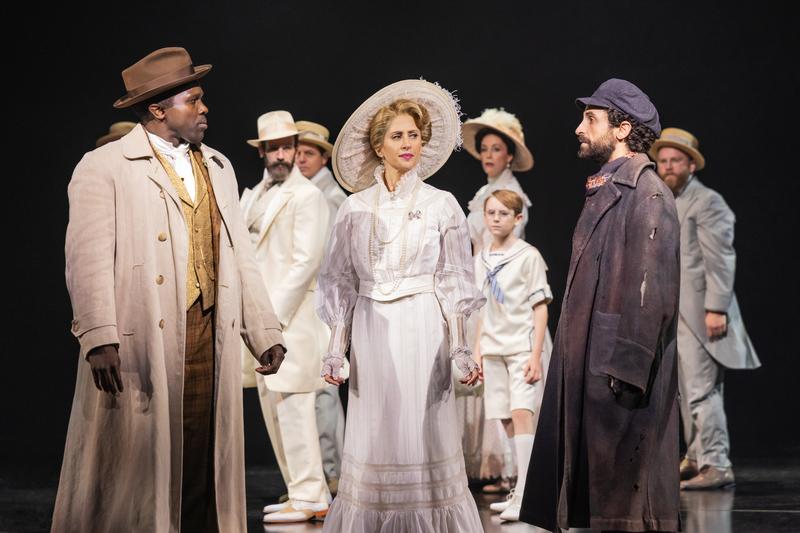
( Photo by Matthew Murphy )
Alison Stewart: This is All Of It. I'm Alison Stewart, live from the WNYC studios in Soho. Thank you for sharing part of your day with us. I'm really grateful that you're here. Coming up on the show today, actor Ethan Hawke joins us to talk about his role as the legendary lyricist Lorenz Hart in the new film Blue Moon. We'll speak with Quan Barry about her genre-bending novel, The Unveiling. That's later in the show. Now, let's get things started with Ragtime. [music]
Alison Stewart: The new Lincoln Center revival of Ragtime is big in every sense of the word. It's got a massive ensemble cast featuring some of Broadway's most talented performers. It features powerful songs and a large orchestra. It's a show that tackles big ideas about the American dream and who gets access to it. The production is so big that we couldn't contain it in one segment. We're going to spend the entire hour today with the cast and director of Ragtime. Later, I'll speak with director Lear DeBessonet about what it took to wrangle the production of this size, along with actor Ben Levi Ross.
First, I'm joined by the three leads in the production. It's the early 1900s, and the lives of three completely different people are about to intersect in surprising ways. Joshua Henry, hi, Joshua, stars as Coalhouse Walker Jr, an optimistic and successful Black pianist who is determined to make things right with Sarah, the woman he loves. Caissie Levy plays Mother, a wealthy white woman living with her family in New Rochelle, who takes in Sarah and Sarah's newborn baby, the child of Coalhouse Walker Jr.
Around this time, a Jewish immigrant named Tateh arrives through Ellis Island. He and his daughter have come from Latvia looking to make a new life. Tateh is played by Brandon Uranowitz. Each of these characters is hopeful, but American racism brings reality to the story. Ragtime is running now at the Vivian Beaumont Theater in Lincoln Center through January 4th. I'm joined now by Joshua, Caissie, and Brandon. It is so nice to have you in studio.
Caissie Levy: Thanks for having us.
Brandon Uranowitz: Thank you.
Joshua Henry: Good to be here.
Alison Stewart: When was the first time that you encountered Coalhouse Walker Jr?
Joshua Henry: 2003, University of Miami Music Library. I remember where I was sitting. If I was in Miami, I'd show you right now. I listened to that cast album. I remember hearing Brian Stokes Mitchell's voice and just being blown away in wonder that how can a voice move me so entirely in such a huge way? I thought, "I want to be a part of telling these types of stories." I think I was 19 at the time. Didn't know a moment like this was on its way, but glad it's here.
Alison Stewart: When was the first time that you thought, "I could do that role now."?
Joshua Henry: Like three weeks ago.
[laughter]
Joshua Henry: Honestly, I think maybe in the last two years, I thought to myself, "I'll be ready to sing something like that." Vocally is one thing, but also understanding what dreams and hopes actually mean is a different thing when you have kids for me. I have three, four-year-old twins and a seven-year-old. I think understanding what it means to fight for something, what it really means to be invested in the future of something for me has been huge in thinking about my kids and what having a dream means as a father, as an American, as a son of Jamaican parents who came to this country trying to make a better life for themselves and their family. Very recently, I would say.
Alison Stewart: Caissie, what was your first introduction to Ragtime?
Caissie Levy: I grew up just outside of Toronto, Ontario, Canada. That's where Ragtime actually did its pre-Broadway run. I saw the production with all the original stars when I was about 14 years old. By then, I already knew I liked to act and sing, but it was one of those formative theater-going moments where I saw that production and thought, "I want to do that." I really never thought I would get the chance to be part of a production of Ragtime, so to be here now feels pretty beautiful and wild.
Alison Stewart: Why didn't you think you would ever be a part of it?
Caissie Levy: I think when I saw it, I was so young, I didn't really see a role for me at that time. I was, I think, most impressed by Sarah, the character of Sarah. She was this young woman with this tragic storyline. Now that I'm a mother myself and I'm many shows into my Broadway career, being able to have Ragtime come back around and look at it with fresh eyes as a woman, as an immigrant myself, who's now also an American, it's been very interesting, and, of course, as a mother, to get to tackle this part.
Alison Stewart: Brandon, you have a long history with this show.
Brandon Uranowitz: Yes, I do.
Alison Stewart: You were in the original version of Ragtime in Toronto, we should say,-
Brandon Uranowitz: [chuckles]
Alison Stewart: -as a WASP-y little boy.
Brandon Uranowitz: That's right.
Alison Stewart: Now you're playing the character of Tateh. What did it mean for you to be back in the production on Broadway?
Brandon Uranowitz: Oh, it's been a really surreal, beautiful, full-circle moment, and incredibly healing for me, actually. I worked a little bit professionally as a kid, and I did get to do this world premiere production with Broadway's greatest, Audra McDonald, Brian Stokes Mitchell, Peter Friedman, the late, great, incredible, beautiful Marin Mazzie. They brought everyone in that production to Broadway except for me. That was really confusing, and devastating, and a little bit traumatizing for me as a kid with dreams of being on Broadway and having it so close, and then it just being taken away from me.
Coming back to it 28 years later in a role that feels so aligned with who I am, the stories, like Joshua was saying, that I want to tell and the identities and culture that I want to represent just feels right to me in a way that as an 11-year-old, I never would have understood. I'm proud of myself for sticking with it. [chuckles]
Alison Stewart: You got a Tony.
Brandon Uranowitz: I did.
[laughter]
Brandon Uranowitz: Thank you, Alison. I feel like I'm right where I'm supposed to be.
Alison Stewart: Joshua, what are Coalhouse's attitudes towards life in America when we meet him?
Joshua Henry: When we first meet him, I think he is fully bought in. I think this is someone who's been very influenced by Booker T Washington. Someone who believes you work hard, you believe in the ideals, you put your mind to it, and it's possible, which is a very real thing. In a song like Wheels of a Dream, we fully see that on display. He and Sarah understanding, fully believing that this is possible for them and their son. They're met with the harsh reality of not quite. It comes with an asterisk, right?
Alison Stewart: Yes.
Joshua Henry: Especially for Black Americans at that time. That's a big shock to the senses. Then we see that it takes a turn. I think that makes me think about a little of [chuckles] my parents when they came to America. It's like there's so much opportunity and there's so much promise, but there was so much of an uphill climb as well.
Alison Stewart: When Tateh-- What does he think life is going to be like in America, and where does he get this idea that life is going to be like in America?
Brandon Uranowitz: He has a very idealistic view. I think it lives in contrast to deep oppression over in Eastern Europe at the time. They're escaping pogroms and cultural violence over there. I think "American exceptionalism" permutated across oceans and borders. I think it gave him a big, big dream. That idealism is very quickly checked, but he never loses hope. That's the thing that I hold onto with that character. He never loses his joy despite the bitter reality of what America is, and the false promise, I think, of the American dream that was falsely sold to folks.
Alison Stewart: Caissie, is Mother someone who has ever given any thoughts to her hopes and her dreams?
Caissie Levy: I think she absolutely has, but very much in private. We meet her at the top of the show, being pretty contented in her position in life, at least outwardly, but having deep longing for something bigger than herself that she doesn't dare say out loud or say to her husband. It isn't until he leaves and goes on his journey that she gets to go on hers.
All these characters have such huge growth throughout the course of the show, but the thing I love most about Mother is that she dares to think about those dreams and hopes at a time when women really weren't allowed to. In doing so, she opens up her life to people and ideas that never would have crossed her path before. It changes the course of her life and her viewpoint.
Alison Stewart: In the show, she shows a lot of sympathy-- maybe not empathy, but sympathy for people around her, but she's married to a man who sees things a very different way. How would you describe their relationship?
Caissie Levy: I think they were young when they got married. I think there was a lot of real love there, and I think that there still is. That's the complicated thing about love and marriage. I think you speak to anybody who's been in a relationship for a long time, and we know all those things can coexist. I think this fractured time in our world, there's a lot of married couples or couples that have been together for a long time, partners, who find themselves on other sides of political divide and have to deal with that. That's very much what Mother and Father in this show are doing. They're growing alongside each other, not always hand in hand. That makes life difficult, but they both do what they think is right.
Alison Stewart: We're talking about the Lincoln Center revival of Ragtime. My guests are Joshua Henry, Caissie Levy, and Brandon Uranowitz. Ragtime is running through January 4th. Brandon, your character's journey, it shows us the best and the worst of America. He comes to the country. He's desperately poor, but he's got talent. He's got amazing talent. He's working in awful conditions, but he figures out a way to get a little bit of money and he gets a little bit wealthy. First of all, how did you research the role, and how did you balance the highs and the lows of the immigrant experience?
Brandon Uranowitz: Oh, reading. Also, I just gave my family history a deep dive. Tateh represents a part of my family. Half of my family came over through Ellis island, and then the other half escaped World War II and came after the war. My family's history is what I've taken with me, and I take with me on stage. The highs and the lows, that's just something that we love as actors, is to just play the range of the emotional spectrum. Something that I love playing Tateh is you get to see him in the lowest pits of despair to the highest mountaintops of joy. It's just a really glorious thing to portray. It feels full and satiating as an artist.
It's just such a joy also to be able to feel my ancestors with me, as maybe cheesy as that might sound. That's what this is. I think that's true for a lot of us on stage telling a very deeply American story, the promise of America and the wound of America, which is something that our director, Lear, talks about often. To play the promise and the pain is deeply satisfying and difficult as well.
Alison Stewart: Everybody should go to the Tenement Museum [unintelligible 00:13:42] seeing the show, right?
Brandon Uranowitz: Oh, yes, of course. Yes, the Tenement Museum is--
Alison Stewart: Incredible.
Brandon Uranowitz: Even if you are not familiar with Ragtime or are interested in musical theater, a visit to the Tenement Museum, I think, is essential.
Alison Stewart: Joshua, a big part of your story has a giant, big metaphor in it in the form of [chuckles] a new car that he is able to purchase, a gorgeous car. What does that car mean to your character?
Joshua Henry: Like many people, Coalhouse believed in the idea that this car was going to give some status. In his community in Harlem, dressing well was very important. I think owning this car meant that he's reached a point where he could provide and could demonstrate that provision to Sarah, who he was going after. At the end of that, when he actually gets the car, he says, "I'm ready, Lord. I'm ready to go and pursue this dream and get back with Sarah," who he had done wrong by.
What I love, and I'm not going to give too many spoilers, but in that scene, we see how that car is built. It's not a pretty thing the way that is represented in Henry Ford. People are being taken advantage of. There's a lot going on in the assembly, which is such a big idea of progress, but at what cost? It's a really beautiful moment that ends with a nice boom, nice little sheen to it. It just goes further into the idea of this beautiful dream, but what's on the other side of it?
Alison Stewart: It's so funny that you mentioned your children, because I want to talk about children in this show, because they're an interesting part of the show, I think, especially your son, Caissie. He's like a spreader of truth.
[laughter]
Caissie Levy: Yes.
Alison Stewart: Tell me a little bit about the role and tell me a little bit about the actor who plays him.
Caissie Levy: Nick is such a special young man. He's such an incredible actor, and he's so present and such a pro.
Alison Stewart: [laughs]
Brandon Uranowitz: Such a pro.
Caissie Levy: Yes, it's pretty wild. It's been really wonderful getting to unlock our relationship over time because he's such a pro that he has been on his gig the whole time. Now in the run of the show, now that we've been running for two weeks or so, we're starting to have little moments where we play more and I'm able to really feel that tenderness towards him that I do with my own son. I have a nine-year-old boy.
I see a lot of similarities between the character and my son, and this relationship of a mother who loves her son so much and just wants him to be okay, and wants him to be fine out in the world, and do the right thing at the right time, that she micromanages just a little too much. Can you tell I have some-
[laughter]
Caissie Levy: -connection here? Even with all of the nitpicking she does with her son and the correcting, it all comes from this place of love, and I think it's unconditional. He's got a little mysticism to him. Like you said, he's a truth teller in the show. No matter what we do, we can't seem to stop that truth from coming out. He's really the best representation of that. It's a very interesting relationship to explore each night.
Alison Stewart: Brandon, you have a daughter in the show. Tateh has a daughter, I should say.
Brandon Uranowitz: Yes.
Alison Stewart: At first, why doesn't he want her to say her name to anyone?
Brandon Uranowitz: That's a great question. I think coming over here and pursuing the American dream is exciting and filled with joy and unknowns. I think there's an element of anonymity that is important to him because I do think there is also a fear that lives. There is the undercurrent of all of the excitement and joy that comes with it. I think it's really just for protection. The thing that drives Tateh throughout the entire story is his daughter's livelihood and her safety. He walks around with his daughter attached to a leash, basically, for the first part of Act One. I think he is just deeply, deeply protective of his daughter, and anonymity, I think, is a part of that.
Caissie Levy: If I may jump in too, rightfully so, because we have the scene-
Alison Stewart: It's a great scene.
Caissie Levy: -where our kids meet, and we meet on the train station. I'm explaining to my son the reason that he has his daughter tied to a rope is that immigrants are terrified of losing their children. Then I add, "So are we, but just not so conspicuously." If that doesn't sum up the white privilege versus the immigrant situation of it all, I don't know what does. These two people from these two different worlds are connecting over something that they have to approach very differently. I think that's where the funny in that moment comes from and where the sadness does, too.
Brandon Uranowitz: Yes, totally.
Alison Stewart: Let's talk about this being a musical. Joshua. All of you have powerful voices. There's so many powerful moments in this show. How do you navigate in a show like this knowing that you have these big climatic moments coming up? Do you reserve your energy? I'm just curious how you do it.
Brandon Uranowitz: [chuckles]
Joshua Henry: I used to say I live like a monk. I don't anymore. I think, like Brandon was saying about just rangy roles, vocally, I try to get a lot of sleep. I often talk like this, even with my kids. They're like, "Daddy, speak up."
Alison Stewart: [laughs]
Joshua Henry: I'm like, "Okay." You have to drink a lot of tea backstage and pastilles. The preparation is insane. I will just say, from listening to music like this in the music library, listening to Ragtime for the first time, I realized that in order to sing in a way that could feel like that, could move people like that, that I had to practice a lot. I sing, when I'm not in the show, five days a week, because I love the idea of moving with my voice, moving people's emotions with my voice. This is not something that you do three weeks before rehearsal or six months, personally. This is a lifestyle of creative growth that I've tried to commit to over several years in my career.
Moments like these, they feel massive. Thankfully, with the right preparation, it's just like, "You have to meet the moment with the preparation that you have." Sometimes you don't always hit the mark, and sometimes you got to clear your throat, and sometimes you got to just gear up for it. You try to slow these moments down.
Alison Stewart: Interesting.
Brandon Uranowitz: For the record, Joshua always hits the mark, by the way. [crosstalk]
Alison Stewart: Yes, he does.
Brandon Uranowitz: [chuckles] Every single time.
Alison Stewart: Back away from your radios, people. People who are listening, we're going to play a clip.
[laughter]
Alison Stewart: This is you and Nichelle Lewis performing Wheels of a Dream on The Late Show with Stephen Colbert.
[MUSIC - Nichelle Lewis-Joshua Henry: Wheels of a Dream]
Beyond that road
Beyond this lifetime
That car full of hope
Will always gleam
With the promise of happiness
And the freedom he'll live to know
He'll travel with head held high
Just as far as his heart can go
And he will ride
Our son will ride
On the wheels of a dream
Caissie Levy: [cheers]
[applause]
Alison Stewart: The crowd goes wild.
Brandon Uranowitz: Oh, they sure do.
Alison Stewart: You have a number like that? You have a number like that, Brandon, as well? I'm curious, why do you think audiences are so plugged into Ragtime at this moment, Caissie?
Caissie Levy: Oh, gosh. I think the world is in a troubling spot. In the depths of fear, sadness, anger, rage, love, we look to art. Ragtime serves all of that up across the spectrum. No matter where you fall, where you come from, where you're going, you resonate with this story in some way. I think people come in thinking that they're in one storyline. Our hope is that they leave having conversations and asking questions about the ways in which they might fall into the other storylines and be affected by those stories, and those characters, and those people. It's all about art. We need art in these tough times.
Alison Stewart: What do you think, Brandon?
Brandon Uranowitz: Oh, I absolutely second what Caissie said. Also, I think the incredible, unique thing about Ragtime is it has this uncanny ability to zoom in on really specific stories, and then seamlessly zoom out and show you the universal. If I can use Tateh's storyline as an example, telling this story that takes place over 100 years ago about a Jewish immigrant coming over from Eastern Europe, we zoom in on that specific story. If we look at it as Americans coming to Lincoln Center in 2025, we can zoom out and look at the universal things that are happening in this country right now, especially around immigration.
My hope is that when we come and see this show, that Tateh's storyline in its specificity can offer a universal glimpse at what's going on, and allow people to ask themselves questions about how they can galvanize and make some change and do something about it. I think it's in that zooming in and out of the universal and the specific that really engages people in the story and connects them to the outside world.
Alison Stewart: Joshua, you want to finish for us?
Joshua Henry: I just think the incredible book by the late Terrence McNally, like Brandon was saying, shows characters that are so at 1 in 10 and the extremes of emotion. Sometimes we can live on our phones, we can live on the news cycle, and we can just get in this humdrum mentality of this is just the way things are, but seeing exuberance, seeing hope, seeing desperation, and like Caissie was saying, putting yourself in those moments, I think really you're invested and you see it in yourself in a very visceral way. I think that's what the glory of Ragtime really is.
Alison Stewart: Lincoln Center's revival of Ragtime will be running through January 4th. My guests have been Joshua Henry, Caissie Levy, and Brandon Uranowitz. Thank you so much for being with us. We're going to talk to your director after a quick break.
Caissie Levy: Thank you so much.
Brandon Uranowitz: Thank you so much.
Joshua Henry: Thank you so much.
[music]
Alison Stewart: You're listening to All Of It on WNYC. I'm Alison Stewart. Let's continue our hour-long celebration of the new revival of Ragtime running now at Lincoln Center. Lear DeBessonet is the new artistic director of Lincoln Center Theatre. She had the task of staging this complex musical, which includes a 28-piece orchestra and a massive ensemble cast. Part of that ensemble includes Mother's Younger Brother, played by Ben Levi Ross.
Younger Brother is part of a wealthy white family in New Rochelle. He's obsessed with an actress caught up in a murder trial. After spending some time with Coalhouse Walker Jr, and after hearing Emma Goldman speak, Younger Brother starts to wonder if he has a part to play in changing America for the better. Under the direction of Lear, these characters serve as part of the heart and the conscience of Ragtime. I'm joined now by Lear DeBessonet. Hi, Lear.
Lear DeBessonet: Hello. Thank you for having us.
Alison Stewart: Actor Ben Levi Ross. Hi, Ben.
Ben Levi Ross: Hi. How you doing?
Alison Stewart: I'm doing well. Lear, why does Ragtime matter in 2025?
Lear DeBessonet: Oh, thank you for asking that. It has been such a thrill to bring it to an audience today right now in this moment. For me, the show is a masterpiece. I think it stands on its own at any time, but there are ways that it is finding a particularly unique resonance in this moment. It's a show that, in a way, it's full of these riches of joy, including this unbelievably gorgeous score, and so many different stories coming together that are both intimate and epic at the same time.
What you see is it's set at the turn of the century, the 20th century. You're seeing these different groups of people, different families come together, trying to build their life in America at that time, and people pursuing their own version of the American dream. There's something about the way that this musical is able to both, again, create this panoramic sense of that time, and both the beauty and the complexity of art story as Americans. Just also the level of truth in performance, I think, that this particular cast is bringing to it that is, I'm so grateful to say, resonating very deeply with audience members. For me, as an artist, that's why I make work to begin with, hoping that it will resonate.
Alison Stewart: Ben, I saw this on the day of the No Kings protest. Our audience was vibrating a little bit in the theater. Do you feel the audience having this almost spiritual moment when they're seeing Ragtime?
Ben Levi Ross: Oh, absolutely. I think that what Lear has done, what we've all created, is a space for this group catharsis that's really rare. There is a spiritual-like experience when you go to the theater in any regard, but the space that's been created with Ragtime is a space for people to really feel the community that they have around them. I've heard a lot of people, actually, that come to the show sitting next to strangers. By the end of Act One, both of them are weeping and turning to each other, and saying, "What are we experiencing right now?" Not just because of the sonic experience of listening to Joshua Henry sing,-
[chuckling]
Ben Levi Ross: -but also because I think it's moving them on so many different levels. If you saw it on Saturday, the city was vibrating at a very different level. Playing Mother's Younger Brother, I think I was reflecting a lot of the anger that a lot of people are feeling. I definitely have experienced that connection with the audience, especially after Younger Brother becomes radicalized. There's a real resonance that I'm feeling from audiences every night.
Alison Stewart: On a practical level, what do you like about working with such a big ensemble?
Ben Levi Ross: Oh, gosh. On a practical level, one of my favorite things ever is the fact that I get to share the burden of doing a show eight times a week with a large ensemble. Prior to this, I was in a musical called Dear Evan Hansen for many years.
Alison Stewart: Dear Evan. Heard of it?
[laughter]
Ben Levi Ross: I was in it on and off for five years of my life, so it was a big part of my growth as a performer. I didn't leave the stage once during that show. That was also close to a three-hour show. With Ragtime, we have this incredible ensemble of principals, and this unbelievable ensemble that, really, we're sharing that. I don't want to call it a burden, but it is a physical-
Alison Stewart: Yes, [unintelligible 00:31:47].
Ben Levi Ross: -taxation on our bodies. Being able to pop back into the story and know that the story was completely taken care of while I was gone is so wonderful.
Alison Stewart: What were the biggest challenges for you as a director in making sure you have all of these storylines with so many different characters, how they can each have their moment to shine, but it can be a cohesive experience?
Lear DeBessonet: It's an excellent question because the orchestration of large-scale work, really, I think, requires the director to have a scalpel edge around clarity of story. The Beaumont space, which is, I think, the most magical stage in New York City, is also a thrust stage, which means that it's a curved stage that has audience essentially on three sides, as well as the stage having a lot of depth.
It means that the audience has a very intimate relationship to the show that almost any seat you're in, you will feel like you really have a lot of access to the performers. That also requires a little bit of extra work from the director because it means that not everybody is even watching the story from the same physical angle.
Alison Stewart: Oh, interesting.
Lear DeBessonet: What I feel is I think of myself as a conductor of emotion where my job is to have my own heart and body so connected to the story, and to where your eye needs to be, and where your ear needs to be. One of the things that I really take so seriously and pride myself on is I'm hoping whenever somebody comes to see a show of mine, they feel like they can hear every word. That is much more than about the sound design and the volume of the actors. To hear every word, every stage picture has to be right. It means that a person can't ever be saying a key line while they're walking. They have to be still, they have to be in the right position, they have to be lit properly.
It's truly this great orchestration, all these little details about craft that hopefully the audience doesn't have to be aware of because I want the audience to just be in the moment. I will say that directing musicals, it is a craft, and it's something that I have loved studying and being just a very deep student of for a really long time. I hope the audience gets to feel that clarity in our production.
Alison Stewart: Ben, do you remember a moment of direction that Lear gave you that you still use every night?
Ben Levi Ross: There are so many. [chuckles] Actually, I was just thinking while Lear was just talking how incredible it is to sit here next to her right now and hear what she was focused on while I've just completed a weeks and weeks' long rehearsal period with her, because there is this scalpel specificity. I remember when we were doing runs of the show just in the room before we moved into the theater, Lear would sit all the way to the side so that she had the eye of an audience member sitting all the way to the side of the thrust of the stage, so that every moment in the show, no audience member was left out of seeing these moments.
It's hard for me to even think of one thing that Lear told me. Something that I think about is her attention to tone in the show, and how we need those moments of levity in order for people to also feel comfortable experiencing the depths of a lot of the pain of the show, and knowing where that levity can take place and where it's appropriate, because there actually is a lot of humor in this show. [laughs]
Lear DeBessonet: There really is. That's the thing, is it's a very entertaining show in addition to holding all of the deep things we've been saying. I think it's a great evening at the theater just on a purely entertainment level.
Ben Levi Ross: Definitely.
Alison Stewart: I've been speaking about the new Broadway revival of Ragtime. My guests are director Lear DeBessonet and Ben Levi Ross. Ragtime is running now at the Vivian Beaumont Theater at Lincoln Center through January 4th. Why do you think your character, who starts out as a lovestruck boy and he turns into a radical,-
Ben Levi Ross: [laughs]
Alison Stewart: -what do you think is the pivot moment for him?
Ben Levi Ross: The pivot moment is definitely when he stumbles into a rally that Emma Goldman is holding, speaking to a group of people that are ready to go on strike. That is the pivotal radicalizing moment for Younger Brother. I think a lot about 2020 in America. I think about that year a lot, because I think a lot of white Americans had a reckoning, whether it was in their own family units or whether it was just in a solitary moment on the Internet. There is this reflection that I'm seeing between Younger Brother and that time.
I think bringing Ragtime to New York in 2025, this character is resonating on a different level than perhaps even in the original production, because I think a lot of people are seeing themselves in this person. Some people could look at this character and think, "That is a crazy turn. That person switched very quickly," but that's how it happens. People hear something that resonates deeply with them, and they have an awakening one day out of the blue, and they realize, "Oh, I have to commit my life to this." That's an incredible character to explore.
Alison Stewart: Lear, there are many sensitive elements to this story. There's racism, there's antisemitism. Racial slurs are used, complicated dynamics between the white family and the Black family. There's police brutality. How did you want to make sure the production was handling all of these plot points without sugarcoating the story and making it a musicalized version of the story?
Lear DeBessonet: Thank you for that question. It does hold all of those elements, in addition to things like romance and childhood. I think it covers a lot of the human spectrum. In our dealing with it, we were looking to pursue truth in performance and in staging. We also were trusting the material. A musical is not in the genre of naturalism. Simply the fact that people are singing, especially when they're singing with a 28-piece orchestra,-
Alison Stewart: [laughs]
Lear DeBessonet: -and singing with the kind of voices that these Olympic athletes of the theater have, you're not in naturalism. You're in a space that is aiming for truth, but it is still inherently a heightened truth. Seeing any one of those touchy subjects dealt with on television or film is a really different experience than seeing them in a musical. Actually, part of what I love is that sometimes I understand when people say, "I'm not reading the newspaper anymore. It's too much for me today," or, "That documentary looks amazing, but I can't bear to watch it." I understand where they're coming from. We have to protect our spirits and getting through the day.
Everything about this show is done with a spirit of invitation, and welcome, and connection. I think part of the gift of it is you're able to experience these parts of American history that have pain to them. Those things are still with us. They're still present with us right now. Because you're experiencing it in community, you're not by yourself behind a screen, you're actually with other people, and music is holding you up as you experience them, I think that, at least for me, it's actually able to crack open a different piece of my own heart or my own mind when I experience it in this context. I think it's a very refreshing and actually a strengthening experience.
Alison Stewart: Anything you want to add, Ben, before we wrap up?
Ben Levi Ross: I just think what we have is something really special.
Lear DeBessonet: Yes.
Ben Levi Ross: I really do. [laughs]
Lear DeBessonet: We want everyone to come and join us.
Ben Levi Ross: We do. This is also just New York theater at its apex. We have the largest orchestra on Broadway right now. You don't have that. We have this enormous cast of incredible talent.
Lear DeBessonet: I would come to see any one of these performances.
Ben Levi Ross: [laughs]
Lear DeBessonet: If any one of these performances was happening somewhere, I would go see it.
Ben Levi Ross: [laughs]
Lear DeBessonet: This is like watching a stage full of that level of performance.
Alison Stewart: We've been discussing Ragtime. My guests were director Lear DeBessonet and star Ben Levi Ross. Ragtime is running at Lincoln Center through January 4th. Thank you for sharing your afternoon with us. We really appreciate it.
Ben Levi Ross: Thank you so much.
Lear DeBessonet: Thank you. You are marvelous. Thank you so much.