
A New Movie Filmed Fictional Group Therapy
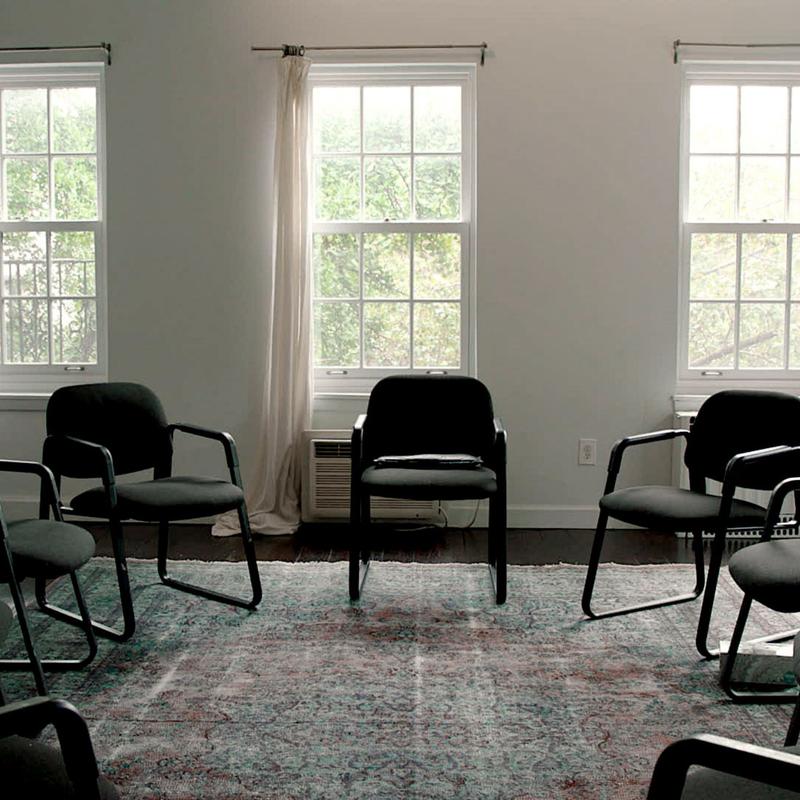
Alison Stewart: You are listening to All Of It on WNYC. I'm Alison Stewart. A new film attempts to capture group therapy as realistically as possible by putting a real therapist in the room. The movie is called Group: The Schopenhauer Effect. Here's the backstory. Years ago, filmmaker Alexis Lloyd set out to make a series about the experience of group therapy. He researched it by becoming a patient of Dr. Elliot Zeisel and spending more than a year in his group. What emerged from that was a web series inspired by Alexis Lloyd's own experience with a group of newcomers portraying a group therapy session, including a newcomer named, you guessed it, Alexis. The only non-actor was Dr. Zeisel, AKA Ezra, or Doc.
Now, the real Alexis has adapted that web series into a film. Alexis, the character, is played by actor Thomas Sadoski. The film, Group: The Schopenhauer Effect, is now screening at the Quad Cinema. Thomas, Alexis, and Dr. Zeisel, welcome to All Of It. Nice to see you all.
Thomas Sadoski: Thank you. Thank you for having us.
Alexis Lloyd: Thank you.
Alison Stewart: Alexis, the film is named after a book, The Schopenhauer Cure. When did you first read that book?
Alexis Lloyd: A while ago, seven, eight years ago. Actually, it was the coincidence of two friends of mine who don't know one another so well, who talked to me about the book within a month. I had been resisting making films that deal with psychiatry, psychoanalysis, and psychotherapy for 30 years because it was my father's profession. I thought, "Okay, maybe it's time that I take a look at a small transgression about my rule of not going into my father's field." That's what I did, and I was really intrigued by the book and by the setting. That's how it started.
Alison Stewart: Why did you think that there was a series idea or perhaps a movie idea in there?
Alexis Lloyd: I didn't start wanting to make a film about group therapy. The initial motivation was probably in my being at the Actors Studio in New York. They helped me getting my green card. I was very thankful. I just had a daughter, a baby girl, and I thought, "Maybe now is the time that I go in a deeper dive in New York City." I always wanted to work with New York actors, and I went to the Actors Studio once a week for quite a while, a couple of years. After six months, I thought, "I'm looking for a film to make or a series to make that would allow me to capture the specific acting skills that actors have been working at the Actors Studio for 50 years."
When I read the book by Irvin Yalom, I thought, "This is a perfect crossroads between what I was witnessing and experiencing at the Actors Studio and what goes on in these settings." That's how it took place.
Alison Stewart: Dr. Zeisel, what was your reaction when Alexis approached you with this idea?
Dr. Elliot Zeisel: Alexis and I met at a group psychotherapy conference, actually, at the end of a lecture. When we got together to talk about the possibility of his researching this project, I invited him to become a member of a group, thinking that the best way to learn about group is to actually participate in the process as fully as possible, so that Alexis was invited in, not as a researcher, but as another person who was curious about himself and about his relationships. Group is a wonderful place to learn about those two things. I welcomed his participation without any understanding about how it would unfold and what it might lead to.
Alison Stewart: Why was it interesting to you to participate in the film?
Dr. Elliot Zeisel: As time developed, a couple of things come to mind. My undergraduate education was in economics, but I was always visually involved. I was someone who could draw. In my last year of college, I think I made a short documentary. The film was always of interest to me. I was curious as I emerged from those early years to find out more about myself. I was a 22-year-old. I was directionless, depressed, and in need of treatment, so I got myself into treatment. The interest in film took a backseat, and for the next 50 years or so, I devoted myself to developing the art and craft of being a psychoanalyst and then a group therapist as well.
When Alexis arrived, and we started having these conversations, it occurred to me that there's a great deal that could be accomplished in helping demystify the process of group and that this vehicle that he was creating would be a wonderful way to introduce a wider population to the power of group, to what can happen to people in group treatment. It was that that motivated me to sign on. It took him a year to convince me to be on camera.
Alexis Lloyd: I did. All important decisions in life, say, "Well, let's bring it to group." When I came, not only with the idea that I wanted to make a series or a film about group therapy, but also to have Elliot play the part of the group leader, the pushback from the group was as strong or stronger, and it really became a one-year process to convince them.
Alison Stewart: Thomas, let's get you in on this conversation. When did the project come to you?
Thomas Sadoski: When Alexis reached out, Alexis and I had worked together in the past, and he's somebody whose artistic sensibility and artistic courage, which I guess is a polite way of saying "madness," is something that I trust implicitly. Alexis and I worked together some years ago on a project that I thought was equally as fascinating and fun. We had a really extraordinary time working together. When he reached out to me, I said, "Oh God, this is great." I had another opportunity to work with Alexis on something that is going to be utterly unique, which is usually the work that he creates. When he explained to me exactly what the process was going to be, I was terrified. It was unlike anything that I had ever done before.
The idea of improvising an entire film is a pretty terrifying prospect for somebody who's trained in the theater. I knew also that meant it was exactly where I needed to go artistically. If I'm that scared and that resistant to the idea, then that means it's going to teach me something. Off we went.
Alison Stewart: It's amazing. In the film, you realize that it is based on a scripted outline, but that the dialogue is improvisational. Thomas, how did that work?
Thomas Sadoski: We sat down with Alexis. He told us who we were as characters, what it was that we were hiding, what it was we wanted to accomplish, and then kicked us in the butt into the room and turned on the cameras and said, "Go." In between takes, he would come and say, "Great, great, great. Here's some important story points that I think that we need to stay on in order to move this thing forward." One of the great problems of having improvisation is that all improvisers become the focus of their own story, and it can become a little bit muddy, so having Alexis there with a sense of the overarching story that he wanted to tell, just to come in and suggest, "Let's stick more on this. Let's stick a little bit more on this."
Then we would shoot these 90-minute takes. We would shoot actual 90-minute group therapy sessions together.
Alison Stewart: Wow.
Thomas Sadoski: Then after a few of those in a day, we'd go home. I don't know about anybody else, but just stare blankly at the ceiling and attempt to reassemble yourself psychologically.
Alison Stewart: Dr. Zeisel, that's interesting. I wondered for you, was the improvisation difficult for you, or is that part of what you do in many ways?
Dr. Elliot Zeisel: That's a wonderful way of thinking about it. I was not acting. I was just doing my job. In the work, I'm trained to follow the process in the group. I was paying attention to what the actors were producing in real time and just responding as I'm trained to, trained to bridge people together to understand and name resistant behavior, to invite exploration of certain hesitations that people have in revealing something about themselves or in engaging other people in the moment. For me, it was just another day at the office in a way. What was more difficult was that the hair and makeup process was not familiar to me, had to get there early for hair and makeup. Apart from that, it was a day at the office, and the only acting I did comes at the very end of the film.
Alison Stewart: We don't want to give that away. Alexis, do you remember a moment that surprised you?
Alexis Lloyd: Many moments, luckily. Let's say mostly a good surprise, which was in the first two, three minutes, I knew that with the rules of the game that I had set, which is uninterrupted takes, I would not stop and say, "Okay, let's do it again. Let's do this scene again. It was great, but push a little less, push a little more." The test would be after two minutes of the first take of the first day. I was behind the monitor, I had my headphones on, and that was where I realized that the actors were doing something in between reality and illusion. They were really fully one foot in each, and they were doing it. They were actually, during the time, the sort of here and now of a group session.
They were in the here and now of what Actors Studio actors train themselves in, which is: "Don't come with an agenda, just follow the flow of what's going on with this group." This is where Dr. Zeisel had a wonderful intelligence, skill, and intuition about staying in the moment. "Don't go in the future. Don't go in the past. In the future, you're going to get anxious. In the past, you're going to be depressed, but in the present, you can let things happen to what's going on between you and the other characters." The actors became characters, the characters became the actors, and inhabited that wonderful space in between. That's what I filmed. It was the big, wonderful surprise that it was happening even with people who had not trained for this for years.
Alison Stewart: It sounds like live radio. You have to stay present in the moment.
[laughter]
Alexis Lloyd: Absolutely. The number of actors starts noticing after having done the film that on more than one occasion in life, it starts to be similar. You put people in a room that don't necessarily know one another. They haven't been lifelong friends, but very quickly, sometimes something unusual happens, which is a real connection between people who don't know one another so well, who are not family members, who are not old friends. All of a sudden, it clicks, and you start noticing things looking like a group therapy conversation going on in lots of other situations in life.
Alison Stewart: I'm speaking with Alexis Lloyd, writer and director of the new film Group: The Schopenhauer Effect. Actor Thomas Sadoski is also here, along with Dr. Elliot Zeisel, who co-stars in the film. Group is currently screening at Quad Cinema. Dr. Zeisel, your character Doc says that he sees himself, that group therapy is often depicted terribly on screen. What mistakes do you see in the way group therapy is depicted in media?
Dr. Elliot Zeisel: I think for the most part, group therapy is not very well understood as a modality in the field of mental health in general and in the population for sure. In the past, anytime it's been portrayed in film or television, it's been the butt of a joke. I think the contribution that this film makes is that it is, in a way, a public mental health service. It's a public mental health service because it really does portray the deep inner work that can happen between people. It happens between people in a group, member to member. It happens between a member and leader.
In that process, you get to see parts of yourself. When one person in a group is talking, they're speaking for at least four or five other people in the group. Through the process of identification, you're learning throughout the process. I think we captured something unique. The group of actors, I think, sound more like an ensemble theater group than they do sound like movie actors. Is that a fair thing to say, Tommy?
Thomas Sadoski: Forgive me for disagreeing. I think we sound more like a jazz band.
Dr. Elliot Zeisel: Oh, even better.
Alison Stewart: Explain yourself, Tom.
Thomas Sadoski: I think that in this fantastic way, again, sort of landing back with improvisation as an art form, particularly an art form that I was always resistant and terrified of. What I realized is that what happens when all of the instruments get on the same page, when they all get on the same flow, when they all get on the same beat, is that it's a constant surprise between which notes are being played and which notes are not being played. More often than not, only the people in the flow together on that stage know which notes are being played and which notes are not being played. I think that's exactly what happened with us. I love actors. I love working with actors.
I also know that there is a way in which I will fall victim to the expectation of performance that I think evaporates in a way that I have only witnessed in jazz. It was something that we experienced in that room in a way that I had never seen before between a group of actors working on the same thing together.
Alison Stewart: Thomas, what did you learn about group therapy while working on this film?
Thomas Sadoski: Everything. I came in completely raw. I had had no experience with it at all. Alexis and Doc and a couple of very generous souls agreed to put me through my paces in one session up in Doc's house in upstate New York, where we drove up and went through it for a little while, and what an extraordinary experience that was, and then cast to the wolves exactly as I should have been in this experience. From it, I learned so much about the value of this as a modality, but I learned so much about the value of this in terms of the way that the 12 Step recovery rooms help people find community that helps put the training wheels on your bike as you go back out into humanity and learn to live a sober life from whatever it is. Group does very much the same thing.
It allows you to work through whatever it is that you've got in a safe environment. Not that the idea of safety is one that is required or even expected in a group, but you are not going to suffer the potential physical consequences of telling somebody exactly what you think of them in a group therapy room, the way that you would out in the world. You work through that stuff and find ways to come to communion with humanity. I'm amazed by it, and I think it's an incredible tool not only for people, but especially for artists.
Alison Stewart: There are parameters that happen in group therapy, Dr. Zeisel. The members of group, they can "practice their desires" is one thing. I think that's what Doc says in the film. What does that mean, "practice their desires," and how is it useful in group therapy?
Dr. Elliot Zeisel: As sentient creatures, we have three ways of expressing ourselves. We can feel things first through our body. We can feel things and then express them through action, or we can feel things and express them with language. We can discharge the tension by speaking. Group is a wonderful place to expand your capacity to tolerate the stimulation of life with people. In the character of the other members, you'll find people who matter to you. You'll find your mother, your father, and your sister, your brother, your partner, your boss, your coworker. In the same way that those people stimulate you, for better or for worse, you'll have reactions in group that stretch your emotional system.
If, for example, you have an interest in developing a capacity for relationships, you can talk in a group. As Tommy pointed out, there are safety measures built into group. Nobody leaves their seat. Nobody acts anything out. You're again invited to expand your emotional capacity by speaking. If you're stimulated by somebody, if you're either in love with them or you're hating them at the moment, you get to put that into language in the service of understanding. If you keep practicing that and you keep inviting yourself into an awareness of just how that bubbles up inside of you and what you can do to put language to it, you do that for six months in a group, and then you take that outside.
You'll find yourself having an ability that you didn't know you had. You'll find yourself doing things that you would before then be frightened or terrified to try out with people.
Alexis Lloyd: We were looking for a good, perfect title for the project, and one of them that came, we decided not to use because it's a bit too much of a cliche, is the fact that the origin of psychoanalysis, it was called The Talking Cure. We thought, "Oh, should we use The Talking Cure? No, that's too much of a cliche," though it's a good title depending on the day. On Monday, I say, "Oh, that's perfect. Let's just do that." Tuesday, I say, "Oh, no, that's really too much." The Talking Cure is the reason why I could see the bridge between the art of filmmaking, the art of acting, and trying to find that setting.
Group therapy is such a perfect space where people are pushed to use language in a different way than they do with their family, with their friends, with their colleagues, because they are invited to mix the subconscious, the unconscious, if it can, or the subconscious and the conscious in a dance. That can only happen when it is not scripted. I'm coming back to the fact that why was it not scripted is that this type of conversation needs a level of spontaneity, a level of letting go of control, of letting go of "I want to say this, and I need to control the way I say it."
For me to be able to film this language of emotions that are not the controlled part of it, but the less controlled part of it, and film this, this is what I wanted to film, which takes us to the Schopenhauer reference because for Schopenhauer, one of the interesting ideas of Schopenhauer is that art is a suspension from the grind of reality and allows not only the creator, but also the viewers to be creative in the way they are stimulated or they are reacting to what's going on. One of the ways that I can explain the Schopenhauer effect is that reality, for Schopenhauer, is rather miserable. There's a lot of pain, anxiety, melancholia, but art is a space where there is a suspension for this because individuals don't go fully in the illusion, but also they are slightly suspended from reality.
Alison Stewart: The name of the film is Group: The Schopenhauer Effect. I've been speaking with its writer and director, Alexis Lloyd, as well as actor Thomas Sadoski and Dr. Elliot Zeisel. Thank you so much for joining us.
Alexis Lloyd: Thank you.
Thomas Sadoski: Thank you.
Dr. Elliot Zeisel: Thank you for the opportunity.
Alison Stewart: I'm Alison Stewart. You've been listening to All Of It. I appreciate you listening, and I appreciate you. I will meet you back here tomorrow.