
A New Box Set Celebrates the Legacy of the "King of Zydeco," Clifton Chenier
Alison Stewart: This is All of It on WNYC. I'm Alison Stewart. In his heyday, pioneering zydeco musician Clifton Chenier played with artists like Etta James, Little Richard and Ray Charles. Now, a monumental new box set from the Smithsonian Folkways honors him on 100 years after his birth. Available as four CDs or six vinyls, the set includes 67 tracks, 19 unreleased performances, and 160-page book full of rare photographs, extensive liner notes and an 80 page biography.
Raised in southwest Louisiana, Clifton picked up the accordion as a curious teenager, playing a sound he heard that would become known as rhythm and blues. Needed to find a way to mix that R&B with Caribbean sounds and the Creole folk music of his childhood. It was the birth of zydeco. Let's hear an example. This is Clifton Chenier.
[MUSIC - Clifton Chenier: I'm A Hog For You Baby]
I'm a hog for you, baby
And I'm rootin’ all around your door
I'm a hog for you baby
And I'm rootin’ all around your door
Alison Stewart: The box set Clifton Chenier: King of Louisiana Blues and Zydeco is out now. Joining us to discuss is the producer and director of the Arhoolie Foundation, Adam Machado. Hey, Adam.
Adam Machado: Hey there. How are you?
Alison Stewart: I'm doing okay. As well as his son, zydeco musician C. J. Chenier. C. J., welcome to All of It.
C. J. Chenier: Glad to be here.
Alison Stewart: So glad to meet you, sir. Adam, tell us about the first time that you heard Clifton's music.
Adam Machado: Oh, man. I started working with Chris Strachwitz, who's the founder of Arhoolie Records, in the early to mid 2000s, and he introduced me to Clifton's music. I wasn't aware of it at that point, and it just knocked my socks off.
Alison Stewart: C. J., you knew him as dad. What was your dad like as a person?
C. J. Chenier: [laughs] He was a even headed, level minded person that loved what he did and loved the music that he played. He was just natural.
Alison Stewart: Adam, when you started doing your research and attempting to learn more about Clifton's life and his life behind the music, what are some of the things that people had to say about him?
Adam Machado: I think, first of all, people who saw him play in a dance hall, maybe in a small room in Louisiana, among his people, his community, they all talked about just the magnitude of his presence, and just the power really that he just played on stage, standing there in a room, which I never got to see him play in person, but I heard a lot of stories about growing up down around rural Louisiana and how that impacted his approach to music. It's interesting.
Alison Stewart: C. J., what was life like for your dad growing up in Louisiana?
C. J. Chenier: I grew up in Texas actually, but my dad was a road dog. You know what? He was a road dog. I'm a road dog. He traveled a lot. He had to present the music to the public, everywhere he possibly could. Back then, there's no such thing as airplay on the radio or definitely no Internet and none of that kind of stuff. The main thing he had to do was pound the pavement, and that's what he did.
Alison Stewart: Did he ever tell you the story of how he started playing the accordion?
C. J. Chenier: Not really, but my Aunt Louise told me he used to just hang around in the barn at their house over there. He used to hang around in a barn and practice inside that barn while-- Because I think it was a little too much noise in the house.
[laughter]
Alison Stewart: A new box set from Smithsonian Folkways celebrates the centennial pioneer of Clifton Chenier, who blended Black creole music with his childhood and R&B and sounds, the '40s and the '50s. Producer Adam Machado is here alongside his son C. J. Chenier, who's also a musician, to discuss his legacy. Adam, Clifton is a pioneer of zydeco, which is this weird take on the French word for snap beans. What's the story behind zydeco?
Adam Machado: [laughs] That's a big question.
Alison Stewart: It is.
Adam Machado: I think one thing is I was talking to Lil' Buck. Senegal is the guitar player for Clifton for many years. He said about whether Clifton Chenier invented zydeco. He said he didn't invent zydeco, he made it. I always thought that was a really good way to put it. This music came out of the rural French Black music of Louisiana, accordion-based music with a lot of highly African rhythms, really rhythmic music, a dance music for house parties.
Clifton grew up, his father playing house parties and listening to that music, listening to some of it that had made it onto records. As a young man, as a teenager, here comes rhythm and blues on the radio. As a young person interested in the latest thing happening with a deep grounding in the traditional music of his area and his family and so forth, he put it all together into this new style that came to be known as zydeco.
Alison Stewart: C. J. do you remember when you first heard zydeco?
C. J. Chenier: I didn't know what I was listening to pretty much. I came from the funk era. I was listening to a lot of Earth, Wind & Fire and stuff like that. One thing about zydeco music is when I heard my dad playing it, even though I might not have understood everything, I was always patting my foot and bopping my head all the time because it just had that effect on you.
Alison Stewart: Adam, Clifton was first recorded in 1955 by a talent scout whose name was John Fulbright. Is that right?
Adam Machado: Yes.
Alison Stewart: For Elko Record Label. What set his sound apart from other artists at the time?
Adam Machado: I don't think you really had accordion-led rhythm and blues bands at that time. I think that was about the biggest thing that set him apart. It was 1954 when Fulbright came down to Louisiana and convinced him finally, after years of trying to convince him, to head into a studio and make a recording. It was '55 when he came out to California and made his first records that hit national airwaves with specialty records.
Alison Stewart: Why did it take him so long to want to make a recording?
Adam Machado: That's a question I would love to ask Clifton, but whether he just wasn't ready to leave his home place. Maybe C. J. had some insight into that, or he wanted to refine the music more, or he was just-- What do you think, C. J.? Why did it take Fulbright several years to get him finally to agree to go to a studio, make a record?
C. J. Chenier: Because my dad didn't trust nobody. He had minimal trust in anybody when it came to his music. That's just the bottom line. I guess Mr. Fulbright had to convince him that he wasn't a crook.
Alison Stewart: How do I have cred, you know? Let's listen to one of his songs. This is Clifton Chenier.
[MUSIC - Clifton Chenier: Session Recording]
Way down in Louisiana,
underneath the evergreens,
I was sitting there all alone,
Along came a Creole queen
A mother dear had a bottle head
As they were strollin' along
She said [unintelligible 00:07:48]
underneath the evergreens,
I was sitting there all alone,
Along came a Creole queen
A mother dear had a bottle head
As they were strollin' along
She said [unintelligible 00:08:19]
Alison Stewart: When was that song recorded, Adam?
Adam Machado: That was recorded in '64. That was the first recording session that Chris Strachwitz did with Clifton Chenier in 1964 down Houston, Texas.
Alison Stewart: It has a percussionist on it. That's very important. Who the percussionist?
Adam Machado: That's Bob Murphy. Bob Murphy was a teacher, and he played in lots of bands. In the late '50s, early '60s, he was playing in little beer joints and doing dance hall tours of Clifton around Texas, Louisiana, Oklahoma. He is a real dynamic character. If you ever see the movie about Arhoolie Records called This Ain't No Mouse Music!, he features in it. He's just electricity. He just comes alive. Beautiful guy.
He was on that record. Then he also gave us an unissued recording. He gave me, handed me a disc with an unissued recording that he had made. Clifton sitting in with his band around '59 or '60 that Bob had recorded just with portable equipment in front of the stage that he did, that he borrowed from the school where he was a teacher. Those are two of the 19 unreleased cuts that are on this box set. Really, they are the earliest extant live recordings of Clifton that we're aware of.
Alison Stewart: That's spectacular. Hey, C.J. how would you describe your father as a performer on stage?
C. J. Chenier: Dynamic. When he got on the stage and put that accordion on, he could do no wrong. It's like everything that came out his fingers was right. He let me know that one time when I told him they played a wrong note, which I would never do again in life. He told me, just like this, "Hey, mister, when it comes to my music, I don't play no wrong notes." He was a real dynamic performer. He captivated everybody with his-- Just the way he looked and the way he presented himself and the way he held that accordion and played it and sang those songs in French. I would just call him a dynamic performer.
Alison Stewart: C. J., there are different kinds of zydeco songs. There's fast songs, but there's also slow songs as well. What are some of the differences in the subject songs that are a fast zydeco song versus a slow zydeco song?
C. J. Chenier: A lot of the fast songs were with songs that were telling jokes. They're supposed to be funny. Zydeco was always a happy music. Then it came down to, even though my dad was a zydeco musician, he carried a harmonica in his pocket and he played-- He would hum and sing the blues all the time. The ballads and the slower songs always told a story, especially the song I'm Coming Home. The slower songs told more stories. The faster songs are more, let's have a joke, let's have fun.
Alison Stewart: Let's listen to a slower version. This is Someone Told Me It Was all over by Clifton Chenier.
[MUSIC - Clifton Chenier: Someone Told Me It Was all over]
Someone told me it was all over
When you walked away from me love life, baby
Someone told me it was all over
When you waved your hands and told me goodbye
Why? why? why?
Why you walk away from me, baby?
Please, please, please, baby
Don't walk away from me
Why? Why? Why? Why?
Why you wanna make me cry?
One day, you will love me, love me
I will be too for me
Alison Stewart: We're talking about a new box set, Clifton Chenier: King of Louisiana Blues and Zydeco. It is out now. My guests are Adam Machado and C. J. Chenier. He is a musician as well as well as Clifton's son. Adam, you wrote an 80 page biography of him, of Chenier, for this book, for this release. Tell us a little bit more about it.
Adam Machado: When I started working for Chris Strachwitz and Arhoolie, and he introduced me to Clifton's music, and I was entranced by it and started going down to Louisiana with Chris, I guess I just began to ask questions out of curiosity of people who knew him down there, fans, neighbors, friends, family. That was quite a while ago, 2013, 2014. Just started piecing together the story. There wasn't that much written about him. Liner notes and a few essays and books and things.
There's a great one by Ben Sandmel. I really liked a longer book by Michael Tisserand called The Kingdom of Zydeco. Those were key sources. I wanted to hear stories that maybe didn't make the book. Really get a felt sense myself for life down there in the words of those people who knew him. I just beat the pavement around Louisiana. I talked a lot with Chris about his relationship to Clifton because they had a key relationship in promoting each other and also bringing this music to a bigger stage.
Alison Stewart: C. J., what do you hope that people will remember about your dad?
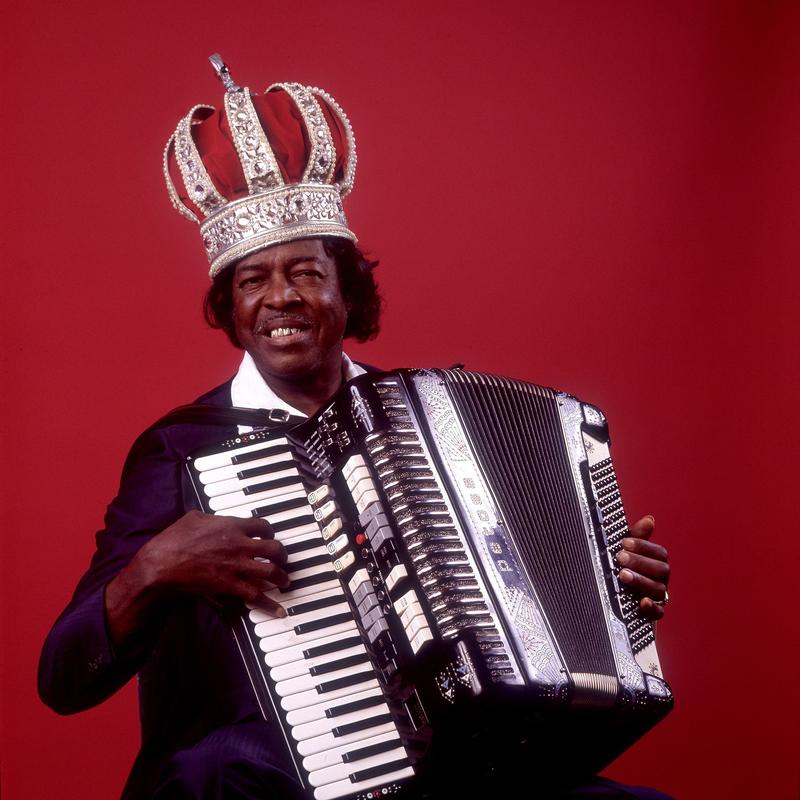
C. J. Chenier: I want them to remember how much his heart and soul was poured into that music. A lot of people had this thing about being the king of zydeco was a gimmick. That couldn't be no further away from the truth because that's the life he lived. When he felt real good about it, he would put his crown on. He called it a king hat. He didn't call it a crown, but he put his king hat on because he felt good that night.
I want people to remember that this man started off back in the days where you're a Black man and you traveling to the countryside and playing an accordion, which nobody played but Lawrence Welk back then, and singing in French. He went through a lot of stuff just to get what he was doing across to the public. I want them to remember that this man went through a whole lot of trials and tribulations so they could have the music that they're dancing so much to today.
Alison Stewart: Preach, I'm telling you. The box set Clifton Chenier: King of Louisiana Blues and Zydeco is out now. I've been speaking with its producer, Adam Machado, and his son, musician C. J. Chenier. Thank you so much for joining us.
Adam Machado: Thank you. Thanks for having us.
C. J. Chenier: My pleasure.