
A Journey Through Lebanese Cuisine with Anissa Helou
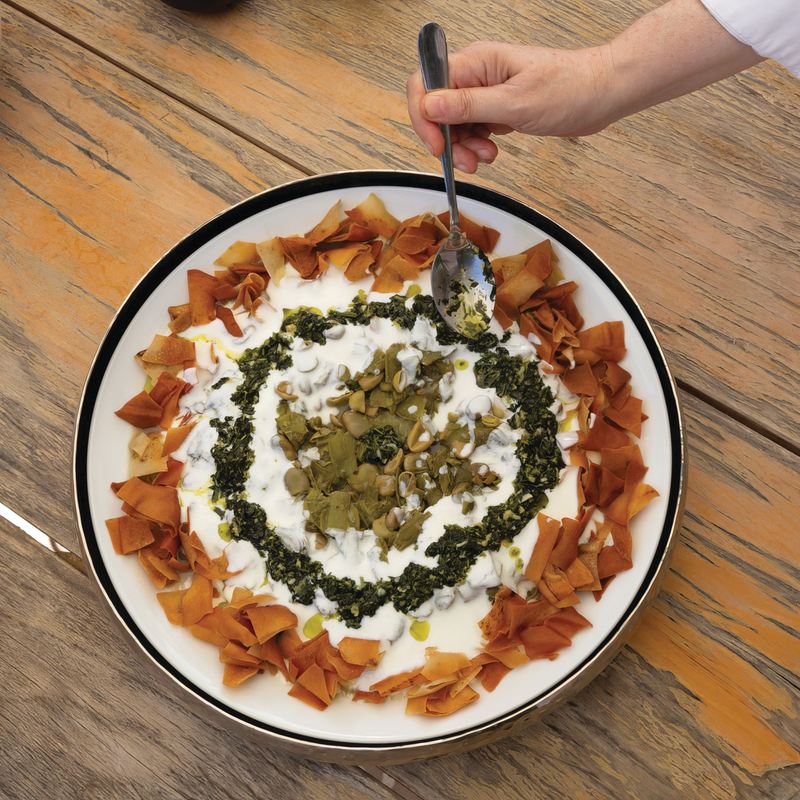
Alison Stewart: This is All Of It on WNYC. I'm Alison Stewart. Though James Beard Award-winning cookbook author Anissa Helou spent her first 21 years living in Beirut, she still had a lot to learn about the culinary history of Lebanon. For her latest cookbook, she set out on a tour around the small but diverse nation, looking to discover dishes and culinary traditions she had never encountered before. The result is a cookbook that combines recipes with history. It's titled Lebanon: Cooking the Foods of My Homeland.
The cookbook includes staples of Lebanese cuisine like hummus, tabbouleh, and shawarma, but it also includes many regional recipes that you might not find elsewhere, like a special flatbread from southern Lebanon and a meat pie with roots in an ancient city. Anissa Helou is speaking at the Museum of Food and Drink tomorrow at 7:00 PM. Her cookbook, Lebanon: Cooking the Foods of My Homeland, publishes tomorrow. She joins me in-studio for a sneak peek. It is really nice to meet you.
Anissa Helou: Lovely to meet you, Alison.
Alison Stewart: First of all, I do want to talk a little bit about the unrest that's happening. As we went to air Monday, it's 1:38. Israeli forces have entered southern Lebanon. First of all, how's your family? Is everyone okay?
Anissa Helou: I have very little family left, but lots of friends, and for the time being, they're okay. Many of the people I worked with or met for the book are not okay because they're in the south.
Alison Stewart: We wish them our very best. We'll say prayers for the prayers for them. You traveled through Lebanon to work on this cookbook. What were those travels like? Where did you go? Where did you know you wanted to go?
Anissa Helou: I actually wanted to go everywhere, as much as I could. I had divided the country: the south, the east, the northeast, the north, and then the coast, or let's say Beirut and all around Beirut, so I knew more or less which were the regions and the confessions that I needed to look into more in depth. With my friend who lives there, the photographer Dalia Khamissy, who took the location photographs, we planned our-- I think I went to Lebanon every two or three months over two years. We would get into her car and say, "Okay, we're going down to Tyre," this very southern city by the sea. Then meet people more inland and cook with them and everything. We would go up north in search of the tiny stuffed vine leaves, which we had at a friend's.
We crisscrossed the country over a couple of years, every two or three months for about a week or two. Not consecutive, but a few days at a time. It was really fascinating because even though, as you say, I was born and brought up in Lebanon, many places, dishes, and people were a revelation for me.
Alison Stewart: Tell me one thing that you learned about Lebanon that you didn't know before.
Anissa Helou: [chuckles] I don't know about that, but one thing that surprised me, actually, is that I expected to see a lot more picturesque settings as we went more and more into rural sort of areas. I think because of the civil war, a lot of the country outside of the main cities have been developed, like villages, even my mother's village. My mother is no longer with us, but where she lived, up northeast of Beirut in a Christian enclave, which was a very tiny village with stone houses, is now a town. She moved there after the end of the war. That surprised me.
Otherwise, I discovered a lot of bulgur wheat dishes that I didn't know at all. I was quite intrigued by the variety. It's one of our staples, but I didn't realize how many different cooked dishes there were.
Alison Stewart: You write a lot in the opening pages of the cookbook about the history of Lebanon. The cultural diversity of the country, how does geography play a role?
Anissa Helou: Geography plays a role. Even though it's a tiny, tiny country, the climate doesn't change that much. Of course, there's snow in the mountains. We have very high mountains. It's not so much the climate that changes. It's, first of all, the confessions. In the south, you have a lot of Shia Muslims who have a different culture from even the Sunni Muslims, who are mostly in the north, or the Christians. It's within the communities that there is variety rather than in the geography. Of course, in the south, it's more coastal because it's more coastal land than mountains. Where my mother lived, inland from Beirut, is very mountainous. In the north, you have plains and also mountains. Almost the whole of the inland of Lebanon is mountainous, but also, you have big plains in the Beqaa Valley, so there is--
Alison Stewart: Part of it's all coastal, one part that's all mountains, and everything in between.
[laughter]
Alison Stewart: Lebanon was occupied for years by the French, ancient Romans, and the Ottomans. How have those cultures contributed to its culinary traditions?
Anissa Helou: I'm sure they have a lot from ancient times. What's interesting is that for a long, long time, the mountainous region, like the mountains of Lebanon, were autonomous. Under the Ottomans, they were autonomous. That part of Lebanon has retained more its own character, whereas the other parts were sort of influenced by the different invasions. Because the invasions were over centuries and centuries and centuries, you have its layers and layers of history.
Alison Stewart: You mentioned that there were different religions in Lebanon. Aside from the obvious, are there cultural differences between Muslim Lebanese and Christian Lebanese cuisines?
Anissa Helou: There are the rituals.
Alison Stewart: Rituals?
Anissa Helou: Of course, they have different dishes as well. For instance, the Christians, because they don't eat meat every Friday and they don't eat meat during Lent, they have a lot more vegetarian dishes. These vegetarian dishes are also shared by the Muslims with varieties, but as side dishes rather than main dishes.
Alison Stewart: One of the culinary practices in Lebanon you describe is the communal kitchen. What are communal kitchens used for?
Anissa Helou: Actually, this is, let's say, more recent. Because there are lots of NGOs in Lebanon, they finance these co-ops for women to earn their own living, let's say, by doing what they know best, which is cooking. In some of these kitchens, the kind of funds, the NGO funds, have evaporated, let's say, or stopped. They converted them into communal kitchens because they have all the equipment. The women who want to make their yearly preserves, what we call mouneh, they come there to use all the professional equipment, the huge pots and pans, the big juicer, whatever. They make their yearly preserves there.
I spent a day in one of those kitchens. I thought it was just wonderful because in one corner, there was a woman who was making the handkerchief bread to order for various people. There was another woman who was creating crates of tomato to make tomato paste or concentrate. There was another woman who had kind of deseeded pomegranates. She had buckets of pomegranates.
Alison Stewart: Oh my gosh. That poor woman.
[laughter]
Anissa Helou: Poor woman. They were juicing it in a professional juicer. Another woman had cooked a ton of tiny eggplants that she wanted to stuff and preserve in olive oil. It was an extraordinary atmosphere.
Alison Stewart: My guest is Anissa Helou, author of the new cookbook Lebanon: Cooking the Foods of My Homeland. It's out tomorrow. Also, tomorrow at 7:00 PM, Anissa will be speaking at the Museum of Food and Drink. Let's talk about hummus. What variations are there on hummus in the country?
Anissa Helou: The national hummus plate is with olive oil, a garnish of boiled chickpeas, chopped parsley, paprika, and lots of olive oil drizzled all over. In the north, they would use toasted walnuts and hot ghee.
Alison Stewart: Oh yes, butter. Butter?
Anissa Helou: Yes.
Alison Stewart: It makes it completely different. Also, they don't use garlic up in the north. Everybody's used to very garlicky hummus, but there it's not garlicky at all. There were varieties in the South, I think, but I have a very bad memory, and I don't remember.
[laughter]
Alison Stewart: Some people advocate using dried chickpeas for hummus, but you do not believe in that?
Anissa Helou: I believe in making my life easy in the kitchen. In the markets in Spain, you can buy ready-cooked chickpeas. They've been perfectly boiled without any preservatives and everything. From that day, from going through the market in Barcelona, I decided there is no point in me boiling hummus (chickpeas). I can buy them in beautiful jars in Spanish brands with no preservatives whatsoever, just preserved in salted water. I rinse them and peel some, not all, because it takes forever. Then make the hummus, and it's perfect. As perfect as if I'd boiled the chickpeas myself.
Alison Stewart: You also dedicate a chapter to kibbeh, one of the most popular foods in Lebanon. For those who aren't familiar, what is kibbeh?
Anissa Helou: It's a mixture of mincemeat, lamb, generally, very fine bulgur wheat, and spices. There are many, many, many, many ways of making it. This is the initial paste, let's say, or mixture. You can make it into a pie without crusts, so a crustless pie, where you have two layers of kibbeh and a layer of stuffing made with onion, minced meat, and pine nuts. You can make little balls. These little balls you can fry, you can cook in a yogurt sauce, or in a kishk sauce, which is fermented bulgur wheat and yogurt, or in a tahini sauce, or you can grill them over a charcoal fire, but you make them a slightly different shape. Then, of course, there are the vegetarian versions. One made with pumpkin, the other made with flour.
Alison Stewart: Ooh.
Anissa Helou: There are so many variations that I could have, really, written a book only about kibbeh.
[laughter]
Alison Stewart: All by itself. You write that Sunday is Barbecue Day in Lebanon. What did Sundays look like for you growing up?
Anissa Helou: We often went to my grandmother. My grandmother lived in a beautiful flat in the Christian part of Beirut. We lived in the Muslim part. She had a big balcony. In Lebanon, everybody has a mini barbecue, which is a rectangular metal box on legs, short legs, where you do a charcoal fire, and then you put the grill, and you grill whatever you want. This is politically incorrect because they're little birds, but in fig season, we used to love having these little birds that fed on figs. My uncles would hunt them. I'm talking about more than 50 years ago.
Alison Stewart: Okay, sure.
Anissa Helou: It was politically correct then. It's not anymore because they're endangered. We'd have kebabs, chicken wings, or quail flattened (butterflied quail), or kafta, the mince meat with parsley and onion. It would depend.
Alison Stewart: There's a chapter in the book dedicated to cooking with yogurt or sauces. What's important to remember when cooking with yogurt?
Anissa Helou: You have to stabilize the yogurt. It's absolutely essential. Yogurt will break if you let it boil very hard and if you don't stabilize it. Some people will stabilize it with cornstarch, and others will with egg. I like to do it with egg because I find that the texture is finer. You need to stir it all the time, and you need a medium-low heat. For me, you shouldn't let it boil too hard. Just bring it to a simmer and then add whatever you're cooking with it, and bring it back to that simmer, and then serve it.
Alison Stewart: There's a recipe for shish barak, meat dumplings in yogurt sauce. You write, the first mention of the dish comes from a 15th-century cookbook. What's the history of the dish?
Anissa Helou: In that 15th-century recipe, I don't think they're cooked in yogurt, but they are dumplings. Dumplings exist everywhere in the world, almost. I'm assuming that the medieval dumplings were not as tiny as the ones we make now, and maybe the mixture of meat inside was different. In the case of shish barak, the modern Lebanese version, they're very, very tiny. Some people boil them before adding them to the yogurt sauce. Other people put them in the oven and crisp them up. Other people, like my mother, cook them immediately in the yogurt sauce.
Alison Stewart: Oh.
Anissa Helou: This is what I like.
Alison Stewart: My guest is Anissa Helou, author of the new cookbook, Lebanon: Cooking the Foods of My Homeland. It's out tomorrow. Also, tomorrow at 7:00 PM, Anissa will be speaking at the Museum of Food and Drink. You include a whole section about stuffed pastries, both fried and baked. When you think about the difference between the two, what is the main difference between the dough that is used for fried pastries and the dough that's used for baked pastries?
Anissa Helou: I think it's the same dough. It's a dough that has a lot of oil in it, so it's a kind of flaky dough. When you fry it, it becomes even flakier because it bubbles up, and it becomes a bit like puff pastry, but it's not puff pastry. When it bakes, if you brush it with oil, it gets even flakier. I mean, before putting them in the oven. It can be the same dough, and it can be a dough made with milk, but that's more Syrian than Lebanese.
Alison Stewart: What is your favorite thing to stuff in pastries?
Anissa Helou: I think I love stuffing with labneh.
Alison Stewart: Love it. Got it in my refrigerator right now.
Anissa Helou: If you mix a bit of tomato, butter, and onion with the labneh and spice it with cinnamon and allspice. The labneh has to be very dry. You make the fatayer, which are the triangles, and you bake it in the oven. Then, when you bite into it, you've got this hot pastry. All of a sudden, the labneh, which doesn't really melt, but kind of flows into your mouth with all these flavors, the spices, the onion, and the tomato. It's like a madeleine moment, really.
Alison Stewart: I want to ask you about fish dishes. Given the coastal element of Lebanon. There aren't that many fish dishes in your book. What's a fish dish in the book that you'd like to give a shout-out to? Is there an explanation why fish is not that important?
Anissa Helou: It is important. It's because it's important that it doesn't have very many recipes for it. Fish has always been expensive in Lebanon because there isn't that much in the sea, and it's only coastal, so you don't have it all over the country. You do now because there is transport, but in the days before easy transport. It's very valued. It's very priced. Basically, it's either barbecued, roasted in the oven, or fried. They love frying it and eating it with fried pita and a very lemony tahini sauce.
In the north, they have these spicy fish sauces, which I love. There are different ways of doing spicy fish, which is called samke harra. My mother used to make a mixture of cilantro, walnuts, garlic, pine nuts, and a bit of onion, and then stuff the fish and bake it. You can also make a tahini sauce with the walnuts, the cilantro, and all this in a pan, cook it until there's a little bit of oil on the tahini, so the tahini cooks. Then you pour it over the fish.
There's a plain cilantro sauce with onion. I did a samke harra tasting while I was researching the book for my friends, and I was very surprised that they preferred the very plain version.
Alison Stewart: Ah, interesting.
Anissa Helou: Yes.
Alison Stewart: In this book, what is the most unusual recipe that you found?
Anissa Helou: I would say the most extravagant recipe is the stuffed zucchini with stuffed vine leaves and chicken, all cooked at the same time. The chicken is wrapped in cheesecloth, and the stuffed zucchini and stuffed vine leaves are around it. The sauce is very lemony. The chicken is stuffed with rice, meat, and pine nuts. It's so extravagant. For one thing, it takes forever to prepare. It's very plentiful, so you have to have a lot of people around the table. By the time I finished preparing it, I was dead, but I invited friends. It's just an amazing thing to have a whole chicken with all the stuffed vegetables around it on the platter, serving it. It's very unusual, also, because I didn't know. I had never seen the chicken cooked with the stuffed vegetables. It was a friend in the south who told me about it.
Alison Stewart: Let's end on dessert. What's your favorite dessert in the cookbook?
Anissa Helou: Knafeh, without a doubt.
Alison Stewart: Ooh. Tell me what it is.
Anissa Helou: It's a very sweet cheese pie that you eat.
Alison Stewart: Cheese pie?
Anissa Helou: Yes, it's a cheese pie, but very sweet because it's covered with sugar syrup. You eat it in a sesame bread that looks like a handbag. The whole thing is dripping with syrup. You eat it for breakfast. You can imagine what a calorie shock it is at the beginning of the day.
Alison Stewart: [laughs] In terms of something simple like pita, if I want to make it at home, give me a piece of advice.
Anissa Helou: You have to let the dough rest once you flatten it. It's very important. First, you have to flatten it in quite an even round shape, like a circle, so that it puffs up evenly. Then you let it rest in between—we call it 'couche' in baking terms—but floured kitchen cloths. You let it rest for 10-15 minutes, so the dough has rested. Then you put it in a very hot oven, preferably on a hot stone, and then it puffs up very quickly. It's like magic. You think it's very easy, but it's not that easy.
Alison Stewart: Your advice is, "Let it rest"?
Anissa Helou: Yes.
Alison Stewart: Just let it rest. My guest is Anissa Helou. She's the author of the new cookbook, Lebanon: Cooking the Foods of My Homeland. It is out tomorrow. Also, tomorrow at 7:00 PM, Anissa will be speaking at the Museum of Food and Drink. Thank you so much for making the time to be with us today.
Anissa Helou: Thank you, Alison.
[music]
Alison Stewart: And that is All Of It. I'm Alison Stewart. I appreciate you listening, and I appreciate you. I will meet you back here tomorrow.