
Trump's Plan to Tank America
Garrett M. Graff: Someday, we will tell our children about this month, and they will not be able to fathom what we chose to do as a country to ourselves.
Brooke Gladstone: World leaders say that the US-Europe relationship is forever changed. From WNYC in New York, this is On the Media. I'm Brooke Gladstone.
Micah Loewinger: And I'm Micah Loewinger. Also on this week's show, we dive into the surveillance tech ICE is using, like the Mobile Fortify app, which scans faces.
Joseph Cox: ICE believes a result from this app is a definitive proof of someone's immigration status and can override a birth certificate.
Brooke Gladstone: Plus, ICE has launched a full-throttle recruitment drive.
Drew Harwell: It seemed exactly like the methods you would use if you were trying to sell Coca-Cola but trying to carry out the biggest mass deportation in American history.
Micah Loewinger: It's all coming up after this.
[music]
Micah Loewinger: From WNYC in New York, this is On the Media. I'm Micah Loewinger.
Brooke Gladstone: And I'm Brooke Gladstone. On Wednesday, Donald Trump seemed to reverse course on Greenland.
News clip: The president tonight in the heart of Europe abruptly backing off two bold threats regarding his ongoing quest to control Greenland. Tariffs and military action. Posting he's reached a framework of a future deal with the secretary general of NATO, but when pressed, providing no further details.
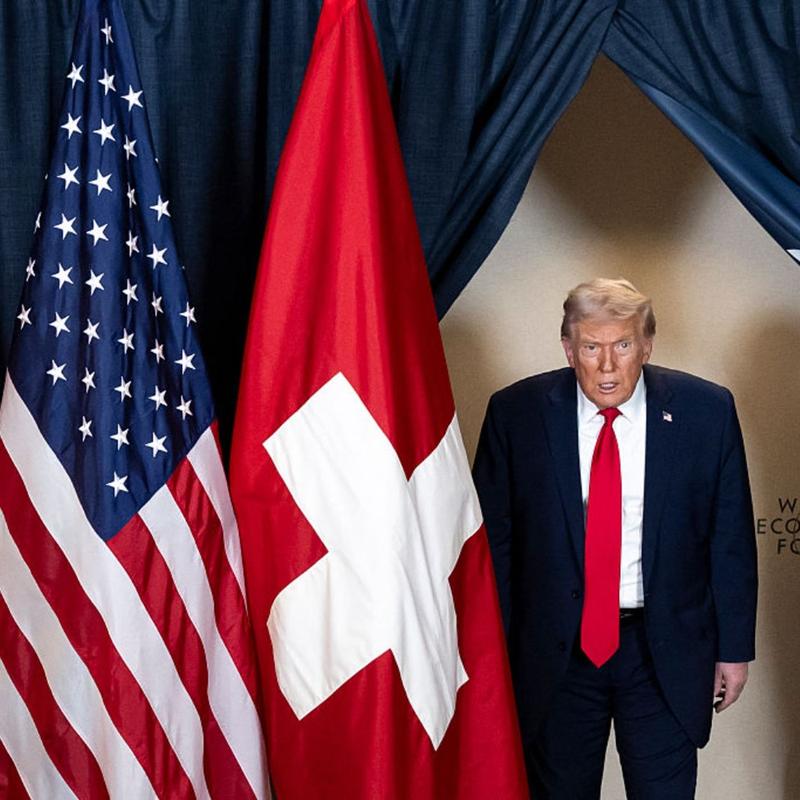
Brooke Gladstone: This mere hours after Trump's address at the World Economic Forum in Davos, in which he rambled on, sometimes incoherently, sometimes threateningly, about how the US needs to own Greenland.
US President Donald Trump: All the United States is asking for is a place called Greenland. We want a piece of ICE for world protection, and they won't give it. They have a choice. You can say yes and we will be very appreciative, or you can say no, and we will remember.
Brooke Gladstone: Greenland is, of course, part of Denmark, a US ally, and member of NATO. Thus, Trump, with his rumbling and whining, threatens to upend a mutual defense contract and solid alliance between the US, much of Europe, and Canada, that's been a shield and a hedge against aggression since 1949. Now, Denmark has sent troops to the island in the high north to defend against Trump's imperial ambitions. This week at Davos, we saw America's once staunchest allies basically say it's over.
Ursula von der Leyen: We will only be able to capitalize on this opportunity if we recognize that this change is permanent.
Brooke Gladstone: European Commission President Ursula von der Leyen.
Ursula von der Leyen: Of course, nostalgia is part of our human story, but nostalgia will not bring back the old order.
Prime Minister Mark Carney: We knew the story of the international rules-based order was partially false.
Brooke Gladstone: Canadian Prime Minister Mark Carney.
Prime Minister Mark Carney: That the strongest would exempt themselves when convenient, that trade rules were enforced asymmetrically, and we knew that international law applied with varying rigor, depending on the identity of the accused or the victim. This fiction was useful, and American hegemony in particular helped provide public goods, open sea lanes, a stable financial system, collective security, and support for frameworks for resolving disputes. This bargain no longer works. Let me be direct. We are in the midst of a rupture, not a transition.
Brooke Gladstone: Garrett M. Graff is a journalist and historian and author of a recent piece in WIRED titled We Are Witnessing the Self-Immolation of an Empire.
Garrett M. Graff: Since he came to office a year ago, Donald Trump has set about consciously dismantling what to me are the six core sources of national strength and influence for the United States on the world stage.
Brooke Gladstone: Right. You call them the six pillars. Just go through them all.
Garrett M. Graff: The first is easy access of immigrants to the United States and the pull of foreign students to our world-class schools and universities.
Brooke Gladstone: Okay. Now, let's go to the second pillar. Rich and steady government support of higher education, medical research, and laboratories.
Garrett M. Graff: Of course, it's very related to that first pillar, how we have these world-class schools and why they attract the very best talent from all over the world.
Brooke Gladstone: The third pillar?
Garrett M. Graff: The whole story of growth of the economy in the last 50 years has been the story of broad trade access to US markets and, reciprocally, a flow of US products to the rest of the world, lowering trade barriers, and making the global economy ever more frictionless.
Brooke Gladstone: The fourth one is an unyielding and unquestionable adherence to the rule of law at home.
Garrett M. Graff: The rule of law in the United States had been so firmly established, the idea of a fascist government secret police, that a president would be using the Justice Department to punish political enemies, that business leaders would actually have to think about their standing with the president personally to decide whether they could move forward with a corporate merger or bribe the president personally in order to be able to continue doing business. This is something that, until even just a year ago, seemed unthinkable to even mention.
Brooke Gladstone: Likewise, this would be the fifth pillar, a firm, unyielding and unquestionable network of geopolitical alliances that knit a security blanket across the entire globe.
Garrett M. Graff: That has been really the bedrock of US foreign policy going back to the end of World War II. We emerged from that war in this moment where we don't want a world war to ever happen again, and we are going to build the network of global institutions to help ensure that problems going forward are solved with diplomacy and not military might. We stood up these institutions like NATO, like the United Nations, like the World Bank, and the International Monetary Fund to try to make this world safer, more stable, and more secure.
Brooke Gladstone: You have a sixth pillar.
Garrett M. Graff: Yes, and all five of these pillars come together to firm up another equally critical pillar, a politically independent and fiscally prudent monetary policy that established the US dollar as the world's safest reserve currency, made US Treasury bonds the savings bank for the entire world, and made US banking networks and capital markets the place to be for any company looking for access to investors. You look at all six of these things, and Donald Trump has done irreparable damage to all six of these.
Brooke Gladstone: Has this happened before in American history?
Garrett M. Graff: Countries have made mistakes. Empires rise and fall as technology changes, as geopolitics change. You can point to Napoleon making the disastrous decision to invade Russia. You can talk about the decisions of the Austro-Hungarian Empire at the start of World War I, but no country in the modern history of the nation state has chosen to commit suicide by its own choice, undermining its core sources of national strength.
Brooke Gladstone: Can we stipulate, though, that this rules-based order, as we call it, hasn't worked for everybody? America has played fast and loose with its tenets over and over again. This is something that Canadian Prime Minister Mark Carney emphasized in his speech, that there were a lot of things where participants in the rules-based order just pretended not to see.
Garrett M. Graff: This world order has seen huge tragedy. The Cold War was felt acutely by people in countries like Vietnam and Cambodia. The United States has been a hugely destabilizing force in Latin America and Central America. There are all sorts of problems with America atop the world order.
Brooke Gladstone: The end of the Cold War weakened American power because nations didn't have to compromise their individual interests as much to get under America's security umbrella. We know that America did some awful things. Maybe we had it coming.
Garrett M. Graff: There is an entirely cogent argument that one could make that the world was due for a reshuffling of that world order. What to me is so stunning about this particular moment, though, is the idea that America is doing this of our own accord, that we are forcing these other countries to look elsewhere for peace, strength, and stability, because we are ceding that ground to Europe, to China, to no one. You look at Vladimir Putin or Xi Jinping, and they just must be gleeful watching Donald Trump's actions over the last year. This week in Davos, China is right there pitching itself to Europe and the world beyond to help pick up the pieces of this broken American century and leadership role.
Brooke Gladstone: Trump is not entirely without friends. He, on Thursday, inaugurated his Board of Peace. He is the head of it for life. The countries that have joined, 21 so far, had to, I guess, kick in $1 billion as a kind of membership fee. Among the 21 countries are Belarus, Hungary, Israel, Pakistan, Turkey.
Garrett M. Graff: It is a stunningly unimpressive list of the countries that, historically, America has most held its nose while doing business with. These are, for the most part, our most uncomfortable allies.
Brooke Gladstone: Not to Trump personally.
Garrett M. Graff: Not to Trump personally. That's the one uniting characteristic of everything that we are watching Donald Trump do, from tearing down the East Wing and building a ballroom to building the Trump arch in Washington.
Brooke Gladstone: Not to mention the Kennedy Center.
Garrett M. Graff: All of these things are about trying to build a legacy that so changes the arc of the world that it cannot be undone.
Brooke Gladstone: Which brings us inevitably to the question, can this be undone, or is it, as many European leaders said this past week, it's just over? As Gramsci famously said, "The old world is gone. The new world is yet to begin. In the interregnum, there is much morbidity." Is it just over?
Garrett M. Graff: That's the heartbreak of this, Brooke. I think that this world is gone. We could elect a whole string of presidents going forward who believe in NATO and invest in NATO, who try to restart USAID, who try to lure the best foreign students back to the United States to do research at our universities, to rebuild the trust in the Justice Department. I think whether you're a potential immigrant to the United States, whether you're a corporate leader in the United States or abroad, or you're the head of state of a foreign country, in the back of your mind is always going to be the United States is only one election away from a Donald Trump again.
I closed my WIRED piece talking about the famous opening of historian Barbara Tuchman's Guns of August, her book about World War I. She opens with the grand funeral of England's Edward VII in May of 1910, this fabulously colorful parade of mourning that brought together 9 kings, 7 queens, and 40 more imperial and royal highnesses. What none of them realized in that moment was that was really the high point and last gasp of the grand era of geopolitical dominance and the peak of the colonial powers of Europe, which, over the rest of that decade, destroyed itself in the trenches and poppy fields of the First World War and ceded control of that world that they had inherited and led for a century to the upstart America across the Atlantic Ocean.
That was the moment that our century really began. Someday, we will tell our children about this month of January 2026 in world politics. They will not be able to fathom what we chose to do as a country to ourselves. They will never be able to contemplate what the United States once meant to the world beyond, because the relationship of the United States to the rest of the world has been so fundamentally altered by this last year.
Brooke Gladstone: I want to go back and ask you a couple of things that I skipped over.
Garrett M. Graff: The complete collapse of the world order, and we missed a subject or two? I don't believe it.
Brooke Gladstone: How much of NATO's power rested on belief in the liberal rules-based order that is crumbling?
Garrett M. Graff: That's all an alliance really is, Brooke. It's the promise that when you need me, I will be there. The moment that Denmark or any of these other European nations is now facing down Russia in Europe and has to, every so often, start to turn around and check over its shoulder whether the US is an adversary or an ally, the whole promise collapses.
Brooke Gladstone: Can Europe recreate a system of stability that the world can rely on, the way that the US once did?
Garrett M. Graff: I think it could, absolutely. This is what the grand European experiment of the last 80 years has been. The creation of the European Union, the creation of the euro, the European Commission, and the European global market.
Brooke Gladstone: It certainly hasn't been smooth sailing.
Garrett M. Graff: It has not been smooth sailing, but it has been a world struggling to be born. A vision for a future for a united Europe. Even that is under its own threat. We saw Brexit the same time that Donald Trump was elected the first time. We've seen how devastating that has been politically and economically to the United Kingdom. That's not to say that Europe can't pull it together and build something new.
Europe on its own will never be as powerful as Europe and the United States and North America was together. From the US perspective, one of the things we really need to worry about is when Europe looks around for its partners going forward, Europe and China could be an incredibly powerful partnership for the 21st century that leaves the US sitting on the sidelines.
Brooke Gladstone: Europe could take the opportunity to say, "Wow, that was 80 years of bullying. To hell with you, guys."
Garrett M. Graff: A lot of my work is as a World War II historian. To me, part of this is the story of where we are exactly 80 years after the end of World War II, that we are losing the last of the greatest generation who fought and won World War II, the last of the generation who understood how hard this world was to build the first time to fight against fascism and to root out fascism once it took hold in the continent of Europe and how much work it took to build these international institutions.
The baby boomers have spent effectively all of their lives growing up under the umbrella of peace, security, stability, and economic success given by this policy recipe. What I really worry about is these decisions being made by policymakers who don't understand the high cost it took to achieve this level of peace, security, and economic prosperity, and are willing to burn it all down now for Donald Trump's own ego and narcissism without worrying about what comes next.
Brooke Gladstone: Garrett, thank you very much.
Garrett M. Graff: I would say, Brooke, it's always a pleasure, but this is a pretty depressing conversation.
Brooke Gladstone: [chuckles] Garrett M. Graff is a journalist and historian and author of the newsletter, Doomsday Scenario. His recent piece in WIRED is called We Are Witnessing the Self-Immolation of a Superpower.
Micah Loewinger: Coming up, Minnesotans are bundling up against the cold and ICE.
Brooke Gladstone: This is On the Media.
[music]
Brooke Gladstone: This is On the Media. I'm Brooke Gladstone.
Micah Loewinger: And I'm Micah Loewinger. There was news out of Congress this Thursday.
News clip: To Washington, DC, tonight, where the House passed a package of spending bills to keep the government open.
News clip: In the end, seven Democrats crossing party lines to vote with Republicans to fund the Department of Homeland Security, which, of course, includes Immigration and Customs Enforcement, ICE.
Micah Loewinger: Out of the North Star State on Friday.
News clip: In Minnesota, organizers of a statewide economic blackout are urging people to stay home from work and school and to close businesses in protest of the ongoing immigration enforcement surge happening there.
News clip: Lawful law enforcement operations. That's what's been happening on the ground in Minnesota.
Micah Loewinger: Press Secretary Karoline Leavitt responding to anti-ICE narratives earlier this month.
Press Secretary Karoline Leavitt: These are illegal alien, criminal, pedophiles, murderers, rapists, some of the worst of the worst criminals who--
Micah Loewinger: According to a new poll from CBS last week, the majority of Americans, 56%, do not believe that ICE is prioritizing criminals for deportation. While there's not much recent data, arrest records reviewed by The New York Times in 2025 are clear. Only about 7% of ICE detainees have a violent conviction, and about two-thirds have no criminal record at all. On Tuesday, a child was picked up by ICE agents in his family's driveway.
News clip: Five-year-old Liam Ramos is seen wearing a Spider-Man backpack near his home as a masked agent stands behind him.
Zena Stenvik: The agent took the child out of the still-running car, led him to the door, and directed him to knock on the door, asking to be let in, in order to see if anyone else was home, essentially using a five-year-old as bait.
Micah Loewinger: Of course, the cruelty is not limited to non-citizens.
Ramon Menera: You're not allowed. This is private property. You're not allowed. I'm from this country.
Micah Loewinger: That's US citizen Ramon Menera, a resident of Columbia Heights, Minnesota, who was detained last week by ICE.
ICE Agent: You know what, sir? Now, talking to you, seeing, hearing that you have an accent, I have reason to believe that you are not born of this country.
Ramon Menera: You just base it on accent?
ICE Agent: Look, sir, are you going to do this the easy way, or are we going to take you in?
Micah Loewinger: This is what legal observers call a "Kavanaugh stop," a term named after the Supreme Court justice who wrote an opinion in September, essentially greenlighting ICE's power to racially profile suspects.
Police Chief Mark Bruley: What we're hearing is they're being stopped in traffic stops or on the street with no cause and being forced to demand paperwork to determine if they are here legally.
Micah Loewinger: Police Chief Mark Bruley of Brooklyn Park, a city in Minnesota.
Police Chief Mark Bruley: We started hearing from our police officers the same complaints as they fell victim to this while off duty. Every one of these individuals is a person of color who has had this happen to them.
Micah Loewinger: If it's happening to cops, you know it's bad. There's reason to believe that it's even worse than we thought. This week, we learned that ICE agents had been secretly instructed that their work doesn't need to follow the Fourth Amendment, which protects people from unreasonable search and seizure by the government.
News clip: According to a memo from the acting ICE director obtained by the Associated Press, immigration officers can enter homes without a judicial warrant.
Micah Loewinger: Which helps explain what happened to US citizen Chong Li Tao, a Hmong immigrant, earlier this week.
News clip: An Asian-American grandfather, who was speaking out after being dragged out of his home by federal officers Sunday in St. Paul, without any clothes on, into the freezing cold after agents broke into his home without a warrant.
Micah Loewinger: ICE officers say they detained Tao while searching for two registered sex offenders. As the Associated Press reported, according to a public registry, Tao has no such record, nor does anyone living on his block. Considering how violently and, well, erroneously federal agents have targeted people, it's worth digging into how exactly ICE chooses which homes to raid. According to Joseph Cox of 404 Media, an independent tech outlet, the agency has been quietly amassing an arsenal of surveillance tools. He began by telling me About Tangles and Webloc, two applications made by a company called Penlink, which now help guide officers around cities like Minneapolis.
Joseph Cox: The one that's a lot more interesting to me is the one called Webloc. This allows ICE to look at all of the phones it may have data on in a particular neighborhood. Now, usually, when ICE would need phone location data, maybe they would get a warrant. They would go to AT&T or Verizon or T-Mobile and get the data that way. With Webloc, they don't need a warrant at all. [chuckles] They're just buying the data.
Micah Loewinger: From what I understand, an app like Webloc can basically purchase data that people are maybe unknowingly already giving to apps that they use for very pedestrian things like Candy Crush or Tinder or MyFitnessPal. How does that work?
Joseph Cox: Yes, unknowingly is the key thing here, because I doubt that many people know this is going on. Whenever an ad is about to be placed in front of you inside an app, there is this near-instantaneous and pretty much invisible process going on where all of these companies are trying to outbid one another to get their ads in front of a certain demographic. Males who are 18 to 35 who live in this part of Los Angeles or whatever, that's very normal. That is just how online advertising works, especially in the United States.
A side product is that you have these companies, such as Penlink, hoovering up all of that data. That can include the location data of mobile phones. Sometimes spy firms will buy an advertising company to gain access to this. Sometimes they will take one over. Other times, they'll misrepresent and gain access to the data that way. The result is that they hoover up all of this information. They add additional information to it to make it more useful to the authorities, put it in a very nice, searchable interface, and then sell it to ICE.
Micah Loewinger: Then, when ICE is using Webloc, what are they looking at?
Joseph Cox: You'd say, I want to see all of the phones in this part of Los Angeles at this time and this date. From there, a map will appear on their screen. They will then draw a shape like a circle, and it will immediately show all of the phones that Webloc has data on for that location at that time. They can then click these interesting and novel features, such as the route button, which will show the exact path a phone took to either get to that location or to leave it. You could see the exact highway that that phone took to get to where the person presumably lives.
Micah Loewinger: How does this not run afoul of the Fourth Amendment, which requires law enforcement to get warrants before searching?
Joseph Cox: Yes, this is a basic tenet of the US justice system in that law enforcement have to get a warrant or potentially some sort of other court order to protect people from unreasonable search and seizures. That's why law enforcement need to get a warrant to go to AT&T or Verizon to get location data. That changes when the government buys the data, essentially. This is according to an internal legal analysis from inside ICE that was shared with me by the ACLU. ICE believes that people are willingly giving up this location data from their phone because they could turn off location services. They could uninstall the apps which are selling their location data, and that's the legal basis they have.
Micah Loewinger: That feels like such a technical cop-out. It's like, "Well, the terms of service were there. You just didn't read 30 pages of legalese before you downloaded Tinder." It's maybe technically true, but give me a break.
Joseph Cox: Even then, some companies who harvest and sell location data say, "Yes, we will opt you out." Even when you do that, they still gather location data, and they still sell it. Even if somebody is very well-informed, and even then, the location data may still be gathered. These people have not provided informed consent.
Micah Loewinger: Okay, let's talk about another app that ICE has been using, Mobile Fortify. This is facial recognition software that allows the user to take a picture of someone and then real-time bring up some of their information. It's the same tech that customs and border patrol use at the airport.
Joseph Cox: I first learn about Mobile Fortify last June through emails, links from inside ICE. I'm then trying to find evidence of it actually being used on American streets. Slowly, I get this trickle of videos on social media. It's not always clear what is going on, but ICE or Customs and Border Protection officials will point their phone directly at someone's face, and then they'll go look at the screen. Now, you may think, "Well, they could just be taking that person's photo or something like that."
Micah Loewinger: Recording a recruitment reel or something, right?
Joseph Cox: Exactly, but then in some of the videos, I started to notice the officers saying something explicit.
ICE Agent: An ID, you got something that you can show me?
US Citizen: I have school ID.
ICE Agent: Let me see that.
US Citizen: I was born here, but I don't got an ID.
ICE Agent: You don't have no ID?
US Citizen: No.
ICE Agent: Can we do facial?
Joseph Cox: "Can we do facial," which, to me, was a clear acknowledgment that they were doing facial recognition.
Micah Loewinger: Last year in Oregon, an agent took two pictures of a 45-year-old woman ICE had detained after a raid. The app came back with two different names for this woman, and they arrested her anyway.
Joseph Cox: Yes. The first thing you learn about facial recognition is that it's not always accurate. In fact, with people of color, especially Black people, we've seen multiple cases of that, it can repeatedly misidentified people who have been arrested and detained, even charged, even though there was a mistake in the facial recognition technology. This case you're referring to, it's a woman who goes by the initials MJMA in the court transcript that I obtained. She was swept up in an immigration raid in Oregon.
Her and around 30 other people were detained. In this testimony from a Customs and Border Protection official that I got, the official admits that they took two different photos using the Mobile Fortify app of this woman. Both times, it returned different names. Now, logically, I'm thinking, well, at least one of those has to be wrong. [chuckles] People do not have two names. We were going to publish an article on that. Then I managed to get in touch with the lawyer representing her, and he said that both of the names were incorrect.
Micah Loewinger: Yet, they still detained her.
Joseph Cox: Yes, I would say, though, they were detaining her probably anyway. It was part of this larger sweep of this apartment complex. There was a van involved, and she was in the driver's seat, and that sort of thing. From my read of the testimony, she was probably going to be detained anyway. That being said, this app, Mobile Fortify, this is what ICE is using to identify people in the field. We've seen multiple videos on social media of ICE or other DHS officials going up, pointing their phone at people. ICE believes a result from this app is a definitive proof of someone's immigration status and can override a birth certificate. I don't know how the agency can say that when it's giving a woman two different names.
Micah Loewinger: Each one of these examples is raising my blood pressure even more, but let's talk about another tool that ICE is using called Enhanced Leads Identification & Targeting for Enforcement, or ELITE. Webloc and Tangles were already in existence that not just the government are using, but ELITE is an app that was created specifically for use by the government by Palantir. This is the surveillance company co-founded by Peter Thiel. What does ELITE do? You actually looked at an official handbook for the app.
Joseph Cox: It is, again, a map interface, and it will show icons signifying all of the potential immigrants in that area. You then click on a particular person. It will bring up their individual dossier, their name, date of birth, a photo if they have it, and crucially for ICE, their address and an address confidence score. Addresses to them are gold because it gives them a specific location to raid. Even if they don't necessarily find the specific person there, they're also doing it just to find densely populated neighborhoods where they think a lot of people they might be able to detain will be located.
Micah Loewinger: You said that ELITE will note the source of the address, such as the government agency that supplied it. Which government agencies do we know are giving addresses and similar data to ICE?
Joseph Cox: Yes, so the user guide I obtained for ELITE lists a few different government agencies. The first is the Department of Health and Human Services. There is also mention of United States Citizenship and Immigration Services, USCIS. Obviously, part of DHS. There is a mention of something called CLEAR in all capital letters. I believe that may relate to a data product from Thomson Reuters. That company has not responded to my request for comment, but they have contracted with ICE repeatedly and sold them data before.
Micah Loewinger: Is this the parent company of the news organization Reuters?
Joseph Cox: Yes, as well as being a news organization, Thomson Reuters has a data product that they will sell to private industry and many government agencies as well. We've reported before that ICE is able to take, say, license plate data from Motorola, for instance. It pairs it, or it can pair it with data from CLEAR. That can be people's addresses, personal information, all of that sort of thing. I would stress that this user guide is not an exhaustive list of all of the data sources that ELITE may be getting. It just says somewhere around the end of the list, it's integrating new data sources. I fully expect that there could be more that we just don't know about.
Micah Loewinger: The fact that this rogue agency is using shady and, at times, frighteningly inaccurate apps to skirt laws, that feels like it should be a very big concern for lawmakers, at least the ones who still care about basic civil liberties. If and when Congress were to do something about it, what would be the first step towards new privacy legislation?
Joseph Cox: Well, there's a few things. Democratic lawmakers have acted on this in some capacity, or they have tried to act on it. You have Senator Ron Wyden introduced the Fourth Amendment Is Not For Sale Act a while ago. That would have banned agencies from simply buying data. They would have to get a warrant or some other legal mechanism. That would stop the stuff like Webloc and Tangles and that sort of thing. Another one, Rep. Thompson, who recently, with other Democratic lawmakers, I think a group of six of them, introduced potential legislation that would rein in Mobile Fortify, the ICE facial recognition app, saying it can only be used at ports of entry.
You can't roll it out to local police, which is what DHS was trying to do as well. Potentially, there's some room there for legislative action as well. More fundamentally, the United States does not have a federal privacy law. You have a law in California doing its thing. I think you have one in Illinois around biometric data. Of course, in the EU, you have GDPR, very overarching, all-encompassing data protection regulation. The US just does not have that, which is what partly allows the country and agencies to just buy information on its citizens and residents.
Micah Loewinger: You and your team at 404 Media have done incredible work on this story, on this beat. I am surprised it's not being covered more frankly. Why do you think these surveillance efforts are so poorly understood to this point?
Joseph Cox: The coverage question is a really interesting one. When you cover this, there is a danger that you present it to the reader. Some abstract problem over there with some tech company making some tool in the distance. That is why I think there is relatively little coverage around the tech powering ICE. You have to show, "This is how this technological product is impacting people in this city or on the ground." I think we're breaking through with a few overarching stories.
After I first revealed that Fortify existed last June, we eventually found all those social media videos of ICE actually using it. Now, it was concrete, and people could understand it. They could literally see with their own eyes. The other one is this new Palantir system called ELITE, where I think that is finally providing a through line in between Palantir, the obscure, strange tech company that everybody has heard of, but nobody really knows where it does, and what is actually happening on the ground with ICE. I think we've made that link, and I'm sure many other journalists will as well.
Micah Loewinger: Joseph, thanks for doing this work.
Joseph Cox: Absolutely, thank you.
Micah Loewinger: Joseph Cox is an investigative reporter and co-founder of 404 Media.
Brooke Gladstone: Coming up, it's hard to avoid seeing those ICE recruitment ads your tax dollars are paying for.
Micah Loewinger: This is On the Media.
[music]
Brooke Gladstone: This is On the Media. I'm Brooke Gladstone.
Micah Loewinger: And I'm Micah Loewinger. ICE's ability to upgrade their technology, in part, came from a dramatically upgraded budget. Last July, in the so-called One Big Beautiful Bill Act, Congress tripled ICE's annual budget from about $10 billion to roughly $30 billion. Another line item for those expanded coffers, what the agency calls wartime recruitment, a task granted roughly $100 million. Drew Harwell is a technology reporter for The Washington Post. He and his colleagues obtained a variety of files from ICE employees about the effort, including one called a "surge hiring marketing strategy" document, which lays out, in very precise detail, all the ways ICE wants to solicit new recruits, including producing a ton of ads.
Drew Harwell: The ads are broken up a couple of different ways. One, you have the classic kind of Americana nostalgia ads that basically read propaganda from World War I. White people on the frontier fighting these invaders. Uncle Sam features prominently. Then you have this other kind of mix that's this very modern, memey, edgy kind of campaign that's all action movie posters, video games. The Halo video game features prominently. It makes this policy issue of immigration into this game, this battle.
Micah Loewinger: Just to zoom in on the Halo ad, on the Department of Homeland Security's Instagram, we saw an image with the words "Destroy the flood." For those who haven't played Halo, which is a hugely popular video game series, humans are basically fighting a parasitic alien called the Flood that takes over living things and turns them into zombies. This is like an extremely dehumanizing lens through which to talk about non-citizens. I want to get to who these ideal recruits are. It's not just Gen Z, and it's not just on Instagram. Up until recently, you could hear ads running on Spotify.
Advertisement: In too many cities, dangerous illegals walk free as police are forced to stand down. Join ICE and help us catch the worst of the worst.
Micah Loewinger: You can see recruitment ads on local TV across the country.
Advertisement: Join the mission to protect America with bonuses up to $50,000 and generous benefits.
Micah Loewinger: You can find similar ads on Hulu, HBO Max, Snapchat, YouTube.
Drew Harwell: Yes, and I remember growing up seeing the military "Army of One" ads that made a similar point, where you could be the knight on the front lines. There were TV commercials. Now, these ads are everywhere.
Micah Loewinger: So pervasive that SNL did a sketch last October with Tina Fey as Kristi Noem and Amy Poehler as Pam Bondi.
Tina Fey (Kristi Noem): Do you need a job now?
Amy Poehler (Pam Bondi): Yes.
Tina Fey (Kristi Noem): Are you a big tough guy?
Amy Poehler (Pam Bondi): Yes.
Tina Fey (Kristi Noem): Tough enough for the army or police?
Amy Poehler (Pam Bondi): No.
[laughter]
Tina Fey (Kristi Noem): But do you take supplements that you bought at a gas station?
Amy Poehler (Pam Bondi): Daily.
[laughter]
Tina Fey (Kristi Noem): Do you like to use zip ties because people in your life don't trust you with keys?
Amy Poehler (Pam Bondi): You know it.
[laughter]
Tina Fey (Kristi Noem): Then buckle up and slap on some Oakleys, big boy. Welcome to ICE.
[laughter]
Micah Loewinger: I think it's worth mentioning that after that sketch, the DHS X account clipped the first 10 seconds of it to make another ad, which raises something odd about what ICE is up to. The New Yorker reported this month that the Department of Homeland Security has repeatedly used pop songs over some of its recruitment ads by artists like Olivia Rodrigo, Sabrina Carpenter, and even a SZA parody song from an appearance on SNL. You'll hear this music over footage of ICE arrests. Rodrigo, Carpenter, and SZA have denounced these videos as hateful, evil, and "peak dark," respectively. It seems like ICE is thriving off of these responses, intentionally trolling famous people to try to drive more headlines and virality.
Drew Harwell: Clearly, and we had gotten some internal messages from ICE where they talk about, "Well, we don't really have the rights to this music. Maybe it's not the best idea." Members of the ICE team who's putting these out basically say they don't care. This has been something that the administration has been very clear about. They like trolling the libs. They like being out there smashing people in the face every day.
They want to go viral. People who agree with it tend to share it because they think it's funny. People who hate it and despise it share it as well to show their disgust. To the algorithm, it's all the same. I think the big question is whether any of this actually works. General polls of people's sentiment toward Trump's immigration policy is way underwater. The social media campaign of being very aggressive and in your face, it hasn't reversed that, right? It hasn't made people as a whole support Trump's immigration policy. Maybe the strategy is being driven by very online people who love trolling. People love being edgy, but is that actually good policy for government?
Micah Loewinger: What are the implications here? It feels like 4chan marketing for people who also grew up on 4chan. I'm thinking of one of these ads The Intercept reported on that ICE posted just two days after Jonathan Ross shot and killed Renee Good in Minneapolis. It's an image on the Department of Homeland Security's Instagram that reads, "We'll have our home again," which is just innocuous nativist language until you realize that that phrase is the title of a song by a group called Pine Tree Riots that's been embraced in neo-Nazi spaces online for quite some time. The lyrics to that song were the opening to a manifesto posted by a white supremacist who, in 2023, shot up a Florida Dollar General and killed three Black people. Why post that dog whistle if you're not trying actively to recruit white supremacists?
Drew Harwell: There's been enough of these examples now that it's impossible to say that this is all coincidental. DHS and ICE, when we have brought this stuff up to them, they have said, "Oh, you're going to the Nazi thing again. How tiring," but it doesn't really explain why this keeps happening.
Micah Loewinger: You don't just accidentally use Nazi songs. [chuckles]
Drew Harwell: Trip over your feet and accidentally use far-right dog whistle memes. I think part of it is that some of these people come from Republican policy shops, Republican press shops that were very online. They came up into this environment where they were young edgelords, right? Part of what this document suggested also was that they were going to be going to pro-ICE influencers. Creators on Rumble and Snapchat and YouTube and Instagram paying them money to get the message out about recruiting.
There's definitely a big online component. The part that really jumped out to me and felt interesting was how they've moved into the real world, where they're using techniques like geofencing, where they look at a real-world place like rodeos, gun shows, UFC fights, NASCAR races, hunting shows. They're drawing basically a circle around these areas. Anybody who sets foot into those events is going to get a pop-up ad on their phone.
They're also doing billboards and bus stops. It really struck me as a pretty sophisticated effort. I talked to marketing experts who do this for real companies. They felt it seemed exactly like the kinds of methods you would if you were trying to sell Coca-Cola, but they're applying it to this government agency that's trying to carry out the biggest mass deportation in American history.
Micah Loewinger: Because they believe that the people attending these types of events are their prime demographic?
Drew Harwell: Yes. In the document, they talk about their target market being people who are conservative, people who see themselves as patriots, people who listen to patriotic right-wing podcasts, but also people interested in military affairs, guns, and tactical gear, people who are really into watching fitness influencers. Some of this is not super new.
ICE has traditionally-- when they've wanted to backfill positions that they've lost to attrition or retirement, they've often got people who have trained as cops and local police departments and sheriff's offices who want a federal job, but they need so many people now. They're trying to cast a really wide net and going after people who may not have the training and may just be some guy scrolling social media.
Micah Loewinger: What evidence do we have that DHS is not being so judicious in who they allow into the ranks?
Drew Harwell: There has been some reporting on this, especially by people like Nick Miroff at The Atlantic, where they've said they're getting a lot of applications in. They're getting a lot of people who are expressing interest in these jobs specifically because ICE is offering $50,000 signing bonuses-
Micah Loewinger: -and help with student loans.
Drew Harwell: Student loan reimbursement programs. They're basically throwing money at new applicants. ICE is telling us, this advertising campaign is working. They're getting all the applications they need, 100,000 or more applications, and yet the reporting from people like Nick Miroff and The Washington Post, as well, has found that people are coming in. They're not able to pass the fitness requirements. They're hitting all kinds of roadblocks in terms of the testing. We talked to people who are former DHS, ICE officials. They've said they're shifting the bar to a point where they're bringing in people who are not going to be great candidates.
Micah Loewinger: In fact, there was that viral story from independent journalist Laura Jedeed, who wrote about how she was allegedly hired by ICE after visiting a career fair in Texas last summer. Here she is on Democracy Now!
Laura Jedeed: I went in. I handed in my résumé. I did a skills-based résumé. I'm a veteran. I served two tours in Afghanistan. On the surface, the résumé looked pretty good. Had a very brief interview, took all of six minutes. Then I left, assuming I would never hear back. Because I'm a very Googleable person, I'm the only Laura Jedeed on the internet. I make no secret of how I feel about ICE and Trump.
Micah Loewinger: She goes on to say that she initially missed the email from ICE and never filled out the paperwork that they requested with that offer. Stuff like a background check or an affidavit, saying she'd never committed domestic crimes. Then a few weeks later, she says, "I got a message from Labcorp saying that ICE wanted me to do a drug test."
Laura Jedeed: Then nine days after that, I was curious. Had they processed the drug test yet? I logged onto the ICE hiring portal. Not only did the drug test not seem to be relevant, I was listed as having joined ICE as of three days earlier.
Drew Harwell: Which is wild to me because she has reported critically on this agency for a long time. If the agency would not look into the most superficial information about this potential recruit, what are they missing from everybody else?
Micah Loewinger: You mentioned that poll numbers would have us believe that there's actually a sizable backlash to ICE's activity across the country. That said, DHS is claiming big new numbers, upwards of 220,000 job applications in five months. Does that seem legit to you?
Drew Harwell: It's their numbers. I don't have any reason not to trust them. Number of applications is not necessarily a proxy for perfect candidates who are being hired, right? Some of these might be repeat applications. Some of these might be applications that don't work. Again, some of this is probably a reflection of the $50,000 signing bonuses. Some of these deportation officer jobs pay $50,000 salaries. You're basically doubling the salary year one. I think it's impossible to disentangle the success of this kind of recruitment strategy from the actual advertising. We just don't know if one is connecting to the other.
Micah Loewinger: So many of these examples are incredibly dark. I guess I'm trying to make sense of what it means exactly.
Drew Harwell: I think, for me, what I'm left with is just this shifting on what we find is acceptable as a way to talk about these things, like the tone with which the government is discussing, getting shock troopers in to enforce the border laws and kick people out of the country. These are policies that are, again, life-or-death issues that one would hope would be discussed seriously in a sober way.
Maybe that's too much to ask. How much the 4chan culture and the edginess of the internet, how dark it is and nihilistic, how much it has bled into public affairs, and how much has consumed media and politics in this country. If we're talking about deportation in this way on the internet, the people who are setting policy are going to be seeing this. They're going to be finding it acceptable to talk about the job in this way. I just think it's a leading indicator of how this policy is shaped in our country.
Micah Loewinger: Drew, thanks for doing this reporting.
Drew Harwell: Thanks for having me.
Micah Loewinger: Drew Harwell is a technology reporter for The Washington Post.
[music]
Micah Loewinger: That's it for this week's show. On the Media is produced by Molly Rosen, Rebecca Clark-Callender, and Candice Wang. Travis Mannon is our video producer.
Brooke Gladstone: Our technical director is Jennifer Munson, with engineering from Jared Paul. Eloise Blondiau is our senior producer, and our executive producer is Katya Rogers. On the Media is produced by WNYC. I'm Brooke Gladstone.
Micah Loewinger: And I'm Micah Loewinger.
Copyright © 2026 New York Public Radio. All rights reserved. Visit our website terms of use at www.wnyc.org for further information.
New York Public Radio transcripts are created on a rush deadline, often by contractors. This text may not be in its final form and may be updated or revised in the future. Accuracy and availability may vary. The authoritative record of New York Public Radio’s programming is the audio record.