
Trump’s “Madman Theory” Is on Full Display in Iran
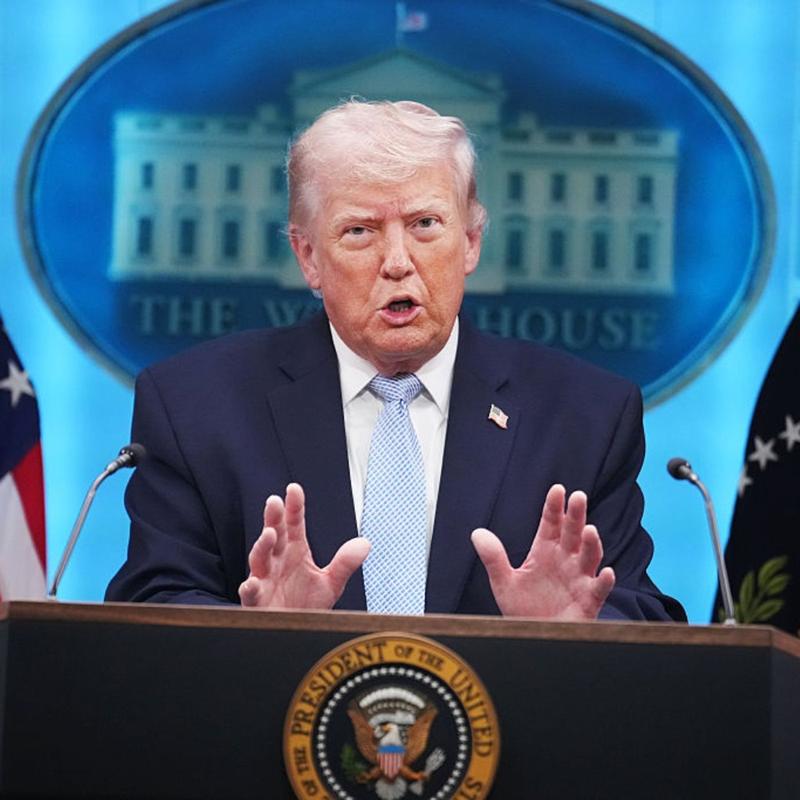
Brooke Gladstone: President Trump declared victory on Tuesday evening after negotiating a tenuous ceasefire with Iran. This after days of increasingly alarming rhetoric.
President Donald Trump: The entire country could be taken out in one night, and that night might be tomorrow night.
Brooke Gladstone: What happens when the madman theory of foreign policy is no longer so theoretical? From WNYC in New York, I'm Brooke Gladstone. Trump's geopolitical game of chicken has been attempted before by Richard Nixon during the Vietnam War.
Bill Scher: North Vietnam storms into Saigon and takes over the whole country, so the whole thing doesn't work. Still, madman theory gets talked about as if it is a reasonable strategy to employ.
Brooke Gladstone: Plus, extremists find a home at one of the world's farthest-reaching radio stations based in Maine.
Allan Weiner: The KKK contacted us, and they were really pleasant and nice. I said, "Sure, we'll put you on the air."
Brooke Gladstone: It's all coming up after this. From WNYC in New York, this is On the Media. Micah is out this week. I'm Brooke Gladstone. Over the past week, President Trump's messaging around the war with Iran has been something short of presidential. Let's review, starting last Sunday.
News Clip: "Open the [beep] strait, you crazy bastards." That is President Trump's latest threat to Iran.
News Clip: The President now issuing a 48-hour ultimatum, calling on Iran to make a deal with or reopen the Strait of Hormuz. Trump writing, "Time is running out. 48 hours before all hell will reign down."
Brooke Gladstone: The President doubled down on his threat during his Monday press conference.
President Donald Trump: The entire country could be taken out in one night, and that night might be tomorrow night.
Brooke Gladstone: On Tuesday morning, he took to Truth Social.
News Clip: Posting on social media minutes ago, "A whole civilization will die tonight, never to be brought back again. I don't want that to happen, but it probably will."
Brooke Gladstone: Apocalypse loomed after sunset, and yet some news outlets seemed intent on parochial concerns more in tune with their branding. Here's CNBC.
CNBC Reporter Sara Eisen: This deadline that President Trump has set, 8:00 PM, has threatened to destroy a civilization. How does an investor process that? Is it a bigger upside risk or downside risk?
Brooke Gladstone: Then, as the clock ticked down, both sides claimed victory.
News Clip: Breaking news, a last-minute deal tonight between the US and Iran to stop the fighting, at least temporarily. Iran will reopen the Strait of Hormuz, that crucial oil shipping lane that has been choked off for weeks, and the US will stop its attacks for at least two weeks.
Brooke Gladstone: Then, on Wednesday, we saw Israel destabilizing the ceasefire by continuing the deadly wave of strikes against Lebanon it had pursued since the war began.
News Clip: This ceasefire agreement is not even 24 hours old, and there's signs that it's falling apart. Iranian state media reporting that Tehran is prepared to exit the ceasefire agreement if Israel continues its bombing, its airstrikes.
Brooke Gladstone: This sort of ceasefire between the US and Iran holds at the time of this recording. We end the week where we began, with Iran effectively in control of the Strait of Hormuz, ongoing strikes in the Middle East, and a military operation whose objectives shift with every passing presidential post or speech. Trump's rhetoric echoes on, painting an unnerving picture of the brain connected to the arm connected to the finger on the nuclear button. Here's retired US Army General Mark Hertling reacting to Trump's first national address about the war.
General Mark Hertling: If I were a four-star general today in his military, I think I'd walk out of the room saying, "We're all going to die," because he doesn't know what he's doing. He has no friggin' clue. Where are the people standing up and saying, "Enough"? I don't care what your ideological background is. This guy does not have common sense. He just doesn't have a sense of reality.
Brooke Gladstone: Bill Scher is the politics editor of the Washington Monthly and author of the recent column, Trump Believes in "Madman Theory." But He’s Actually a Madman.
Bill Scher: When Trump was campaigning, this is in October of 2024, meeting with The Wall Street Journal editorial board, the question was posed to him, what would he do if there was a threat to Taiwan militarily? Trump said essentially that, "President Xi wouldn't do that because he respects me and knows that I'm effing crazy."
Brooke Gladstone: [chuckles] What does this exchange reveal to you about Trump?
Bill Scher: Well, Trump has always deliberately cultivated a persona that he is crazy. He wanted his foreign adversaries to look at him as someone who could do something insane and, therefore, given whatever concessions he wanted in a negotiation, but he also wanted to convey to a domestic audience, not really crazy.
Brooke Gladstone: That he's a statesman worthy of the Nobel Prize.
Bill Scher: There's method to the madness. I only act this way to prevent war. You can go back to the first term, where Nikki Haley, who was the UN ambassador, said in her memoir, she was about to speak with North Korean officials. He told her, "Make them think I'm crazy." He once told his attorney general, William Barr, "Do you know what the secret is of a really good tweet? Just the right amount of crazy."
It was always on his mind that he should burnish this persona, but with a positive end. To some extent, people have largely believed that. We didn't get into a military quagmire on his watch in his first term, but in the second term, Operation Midnight Hammer with Iran in 2025, the drug boat attack killed several dozen people without any evidence, but didn't cause any political problem for Donald Trump.
He did the military operation that abducted the dictator of Venezuela without any obvious blowback to himself. That seemed to whet his appetite for a bigger strike with Iran, one that is much harder to contain and control, even though he's trying to find the off-ramp right now. As you look back at the past week, where Trump threatens on social media, he's going to wipe out Iran's civilization, tells them to, "Open the effing straits, you crazy bastards, or you'll be living in hell," and you get to a two-week ceasefire.
It's obviously very tenuous. Some are already arguing, "Well, this is just madman theory in practice." He says a really crazy thing, but he doesn't actually want to do the crazy thing. The point I'm trying to make is he already did the crazy thing by going into the war in the first place. We've already lost the lives of nearly 4,000 people, injured 40,000 people, without achieving any actual strategic objective.
Brooke Gladstone: In fact, one could argue, "losing ground."
Bill Scher: Iran wasn't in this much control of the strait before this war. Now, it is.
Brooke Gladstone: It's making tons more money from the oil that it sells.
Bill Scher: The problem with madman theory, if your bluff gets called, you're left with two very unpalatable choices. Do an incredibly crazy thing or surrender and throw your word out the window.
Brooke Gladstone: Right. Madman theory is really just redubbing "playing chicken." Richard Nixon is credited with inventing it.
Bill Scher: In the memoirs of one of Nixon's top aides, H.R. Haldeman, who goes by Bob. He recounts an anecdote from the 1968 campaign. The Vietnam War is in full swing. Nixon says to Haldeman, "I call it the madman theory, Bob. I want the North Vietnamese to believe that, 'For God's sake. Nixon is obsessed about communism. We can't restrain him when he's angry, and he has his hand on the nuclear button,' and Ho Chi Minh himself will be in Paris in two days begging for peace." Nixon denied that he said this, but this is the strategy that was employed. Ho Chi Minh did not beg for peace in two days. They didn't budge at all.
Brooke Gladstone: They didn't believe him.
Bill Scher: They didn't believe him. They felt that the American people had already turned on the war. Nixon did escalate the war for the entirety of his first term. Once again in 1973, they then have a peace agreement that essentially withdraws American support for South Vietnam. Two years after that, North Vietnam storms into Saigon and takes over the whole country, so the whole thing doesn't work. Still, madman theory gets talked about as if it is a reasonable strategy to employ. Certainly, Trump has internalized it, but the theory behind it is very, very flawed.
Brooke Gladstone: Nixon's attempt at the madman theory or tactic was an abject failure. Do you want to liken that experience to that of Trump's?
Bill Scher: Go back to North Korea in the first term. He talks about fire and fury. They do a handshake deal. North Korea still has the same amount of nuclear weapons as it had before-
Brooke Gladstone: -and has tested them, begun the process of developing longer-range missiles.
Bill Scher: Trump likes to talk in a menacing manner and then follow with the handshake. Once you start dealing with an adversary like Iran, these are true believers. The Supreme Leader purposefully held a meeting in the wide open, saying, "I'm not going to go into hiding. If I die, I die." Trump is calling it a regime change, but it's just different people's names behind the desk. How do you play a game of chicken with an adversary like that? It's no longer in any reasonable interpretation to get you to peace.
Brooke Gladstone: Now, Trump and his loyalists claim victory.
Jesse Watters: Trump just got Iran to cry "uncle." They've been calling him crazy for making threats, but guess the threats worked. The strait's on its way to being opened, and Iran's promising to stop firing missiles and drones.
Rob Finnerty: His threats were so crazy that they wanted out. They blinked.
Jim Hanson: I have a question for all the people who were losing their minds today and howling that President Trump should be hauled out of the White House in shackles and frog-marched away to be tried for war crimes. Now that it worked, is he going to get an apology from them?
Bill Scher: Well, it all presumes that we've won something here. We don't have access to the Strait of Hormuz. Energy prices are still heavily escalated, and the global economy is still disrupted. The regime is still in place, and there's no change to the status of the nuclear program. They have presumably degraded their military to some degree.
Brooke Gladstone: That was always the easy part.
Bill Scher: Exactly. The challenge with any of these adversaries is asymmetrical warfare. They clearly have a capacity to use drones to cause damage, and they have significant power over the global economy through the strait. That is unchanged by this.
Brooke Gladstone: There's the madman theory, where Trump claims to be acting crazy as a means to an end. Then, there's the alternate theory that he's truly as crazy as a soup sandwich. Nuttier than a squirrel turd.
Bill Scher: [laughs]
Brooke Gladstone: Obviously, we don't know what condition he's in. We don't have a diagnosis. We won't for a while, if we ever do. Still, despite the general benumbing of much of America to Trump's increasingly extreme rhetoric and peculiar affect, something is going on, right?
Bill Scher: In the past month, he has said, "We don't need the strait reopened because we have plenty of oil, and European countries should be tough enough to go get it themselves," that the strait will open naturally at the end of the conflict. Nothing we need to do about it, and then saying to Iran, "Open the effing strait, you crazy bastards, or you'll be living in hell." The statements don't make sense. Whatever the mental affliction is that causes someone to behave this way, we're never going to find out.
I certainly think we have enough to see with the naked eye. This person's not fit to be commander-in-chief. If you had a majority of his cabinet members under the 25th Amendment, write a declaration asserting that and then backed up by a two-thirds vote of the Congress, obviously, Trump diehards would complain, but I think the average American voter would be like, "Yes, I get it." People who were beside themselves that Joe Biden was experiencing cognitive decline, and look, I was a person who said Biden should withdraw after that terrible debate that he had.
Brooke Gladstone: In the run-up to the election. Pause there for a moment, because you went through a transformation, because you believed your eyes.
Bill Scher: Yes. Well, what's very difficult when you're dealing with aging is, how do you distinguish between what's an innocuous senior moment, you mixed up a name, you forgot a number, and genuine cognitive decline? There can be some overlap between the two things. Nothing had happened prior to the debate that made me question his ability to do the job. I don't have any reporting that Biden was incapable of executing a policy because of whatever his condition was. Certainly, by the debate, that's when I said, "Look, you're not in a condition to run for this office again."
Brooke Gladstone: Biden often made mistakes even as a very young man-
Bill Scher: Exactly.
Brooke Gladstone: -just like Trump. When he says something completely absurd, prices decreased 4,000%. He says it over and over and over. That's just Trump, right?
Bill Scher: Trump has cultivated a reputation that he has no attachment to the truth. If he says something that's manifestly wrong, it doesn't matter, because it's just the way the guy is. Whatever's going on there, it's now reaching a point where he's making policy decisions that are leading to people dying. In the case of Biden, I still can't connect anything going on with Biden's mind to a policy decision that was dangerous. Whereas with Trump, if I was in the position to do so, I wouldn't necessarily wait for the formal diagnosis. I would go 25th Amendment right now, so no one else has to die.
Brooke Gladstone: There are some people who think that the mainstream press is sanewashing Trump, putting the things he says and does in a political or tactical context as if it were normal.
Bill Scher: Well, you saw this with Easter statement. When Trump says, "We're going to obliterate your civilization. Open the effing strait, you crazy bastards," and that gets reported as, "Trump makes threatening statements," I understand why you might call that sanewashing. Not just to pick on New York Times or the Associated Press, but I saw Al Jazeera do the same thing.
Even they had this traditional approach to trying to write a headline in a neutral way. You could do that to such an extreme that you really miss what the story is. The story is that Trump did something that is manifestly crazy. The more that individual people say it at town halls, the more that columnists say it in opinion pieces, the more that elected officials say it on the House or Senate floor or in media interviews, the more it is said that will then lead to media coverage and build narrative.
Brooke Gladstone: Shortly after Trump posted on Truth Social on Tuesday about wanting to end the civilization of Iran, there was a lot of rhetoric online about the 25th Amendment, as you said. In order for Democrats in Congress to invoke the 25th, they'd need actions from the vice president and a majority of the cabinet. That ain't going to happen, so what's left?
Bill Scher: It's not like the public is being brainwashed to salute whatever Trump wants or does. His numbers are down. Special elections are breaking very heavily Democrats' way in places of the country that you would not expect. Clearly, people are very upset at the direction of the country. We have every reason to say publicly, whatever's going on with Trump, he ain't right that, right now, someone is in charge of the military that should not be in charge of the military.
Brooke Gladstone: Bill, thank you so much.
Bill Scher: It's my pleasure. Thank you.
Brooke Gladstone: Bill Scher is the politics editor of the Washington Monthly and host of the history podcast When America Worked. This is On the Media.
[music]
Brooke Gladstone: This is On the Media. I'm Brooke Gladstone. US and Israel's war with Iran has destroyed lives and infrastructure, played havoc with the global economy, and also spawned, no surprise, a meme war. AI slop, emphasis on "slop," is being lobbed by both sides. We've all seen our government's video game come action film entry, but here's one shared by members of the Iranian government.
[music]
Brooke Gladstone: It takes the form of a Lego movie and depicts Donald Trump and Benjamin Netanyahu as little yellow block-headed Lego pieces. As high-tech propaganda is launched back and forth by the warring parties, another much older media joined the conversation. Not as propaganda, but as a warfighting tool.
Radio clip: [foreign language]
Brooke Gladstone: You're hearing a man's voice reading numbers in Persian, a Cold War era tool known as a number station, used to send encoded messages long distances via shortwave radio transmission. This particular one started broadcasting within hours of the first salvo against Iran. Shortwave, the way less listened to, but way farther-reaching cousin of AM/FM radio, was the subject of the second season of our series, The Divided Dial. Episode 3 was about a shortwave station that bills itself as a peace and love outfit. In reality, it broadcasts right-wing hate and racism. Katie Thornton is the intrepid reporter and host of both Divided Dial series. She'll take it from here.
Katie Thornton: It was July of 1987, on a hot, muggy Thursday in New York City. Temperatures had been climbing into the 90s all week. As people all over the city ran fans in their windows, wrapped wet towels around their necks, and hit the beach, a 34-year-old man named Allan Weiner from Yonkers was out on the water, a 200-foot-long freighter.
Allan Weiner: Then it's not a gleaming clipper ship, but a broken-down bucket, which has drawn the attention of the federal government.
Katie Thornton: It drew the Fed's attention because of what was happening on board.
Announcer: There's a new rock station in town. Well, not really in town, really in the water, and it may be illegal.
[music]
Katie Thornton: Allan was a tech-savvy hippie with round glasses and a long bowl cut in the style of Johnny Ramone. Together with his comrades, Allan launched a pirate radio station.
Allan Weiner: The only people that have radio stations in New York are gigantic corporations. This is the only other way to do it, especially if you don't have much coin.
Katie Thornton: This was not Allan Weiner's first time hijacking the airwaves. He'd been illegally broadcasting for half his life, first getting a knock on the door from the FCC when he was just a teenager, but this was by far his most ambitious effort.
Announcer: Radio New York International, they call themselves, with a rock-and-roll accent and a pacifist beat.
Katie Thornton: With the stated goal of spreading peace, love, and understanding, Radio Newyork International broadcasts for listeners up and down the East Coast. Artists sent in records for them to play on the air.
Isaac Jeffreys: All right, thanks to Ramones here at RNI, Radio Newyork International. I'm Isaac Jeffreys.
Katie Thornton: As for the news media, they pulled out all the stops to cover the story.
Channel 5 News Reporter: Channel 5 News has spared no expense in tracking down these pirates. We've added this vessel to our investigative fleet. It's a duplicate of the one used on Miami Vice. With us is our captain, Fred Shaw. Fred, these pirates--
Katie Thornton: From their first broadcast, Radio Newyork International taunted the Federal Communications Commission, kicking off their transmission with a topical song from the 1960s.
[MUSIC - Every Mother's Son: Come on Down To My Boat]
Come on down to my boat, baby
Come on down where we can play
Katie Thornton: After only four broadcast days, just as Allan and his first mate were starting to get their sea legs.
Announcer: Good evening. Some defiant DJs who wanted to thumb their noses at Washington have instead gotten an FCC fist in the face.
Katie Thornton: Federal agents did come on down to their boat.
News clip: Shortly before 5:30 this morning, the Coast Guard and FCC engineers moved in. The FCC dismantled the radio equipment, and the Coast Guard arrested the two RNI staffers on board: Ivan Rothstein and Allan Weiner.
[music]
Katie Thornton: Allan was incensed as they took him off the ship in bracelets.
Allan Weiner: We weren't breaking any laws whatsoever. They feel we were a completely illegal station. Now, freeform rock and roll has been snuffed out.
Katie Thornton: They had anchored the boat just over four miles off the coast of Long Island, which, per Allan's interpretation of the law, was international waters, but the government said that international waters started much further out.
News clip: Wiener and another man have now been charged with illegally broadcasting rock-and-roll music and peace chatter.
Katie Thornton: Radio Newyork International was dead.
News clip: The men who wanted your ears were chained, taken away, and could spend years in jail. Do you know how many robberies there were in this town last year? Murders, burglaries, but two pirate DJs won't bother you anymore.
Katie Thornton: Allan ended up avoiding jail time for this stunt, in part thanks to the ACLU coming to his defense. After years of trying to skirt around the FCC, this arrest did change something for Allan. It made him realize that if he wanted to get on the air for good, he'd have to go legit. Allan set out to get his own licensed station. The FCC dragged its feet for years, saying in the official record that it didn't want to give a license to Captain Hook. In the late 1990s, Allan the pirate won. In 1998, he launched WBCQ.
[music]
The free speech sound
heard the whole world round.
WBCQ. You're on The Planet.
Katie Thornton: It wasn't in the coveted corporatized market of New York City. It was in the 800-person, blink-and-you'll-miss-it town of Monticello in far northern Maine. That was all right, though, because Allan wasn't going for a local audience. He was going to use the shortwaves to bring the freeform peace and love mission of his pirate ship out to the world.
Allan Weiner: Hello?
Katie Thornton: Early last year, I reached out to Allan Weiner. Hi, Allan, it's Katie calling.
Allan Weiner: Hello, Katie.
Katie Thornton: He mentioned that he and some of his engineering buddies would be gathering for last April's solar eclipse, which happened to pass directly over WBCQ.
Allan Weiner: Come on up. You can't miss the station. It's got a ginormous antenna.
Katie Thornton: Other than a friend of mine who told me about the station, no one I knew had ever even heard of WBCQ, and I know a lot of radio freaks. I took Allan up on his offer. 2 miles ahead, and 1 mile right. If I look north, northeast, I should see the tower. Holy [beep]. Well, he was not lying when he said you can't miss it. One of, if not, the most powerful, commercial broadcast stations in the world. No one's ever heard of it. No one even knows it's here, and I am closing in on it.
WBCQ Station Engineer: Now, during totality, I'll remove the solar filter from the telescope. You can look at it in totality without the filter.
Katie Thornton: When I arrived at the station, Allan was there with his wife Angela, some friends, a farmer neighbor and the station's engineer. They offered me sunscreen and eclipse-proof glasses.
Allan Weiner: Three minutes. Oh, there's barely anything left. It's a pinhole sun. Yes, pinhole sun. Rest in peace, Chris Cornell. What a beautiful man.
Katie Thornton: One of the guys who came up for the big event was named Tim. He has a long-running weekly show on WBCQ, playing mostly rock and roll, sprinkled in with some funny skits and stories. Like Allan, he had long gray hair, though Tim's was notably more unkempt. Also, like Allan, Tim got his start in pirate radio a long time ago.
Tim: I was with my buddy and thought, "Hey, why not?" Each of us popped a tab of acid, and we're starting to trip our brains off. I ran next door, and then I grabbed a bunch of records and a reel-to-reel tape machine, and patch cables, and broadcasted on shortwave. I called it Radio Timtron Worldwide. It was just a goof.
Katie Thornton: Another friend of Allan's had been an engineer at the US-based Christian Science Monitor shortwave station, which used to broadcast news and information to Eastern Europe during the Cold War.
Christian Science Monitor's Former Engineer: When the Berlin Wall came down, we got quite a few letters in, thanking us for broadcasting. It makes me feel like I helped tear down the Berlin Wall.
Katie Thornton: At WBCQ, I got the full range of shortwavers' aspirations. Some of them wanted to use the power of this megaphone to promote democracy, others just to have a little fun. For the time being, our focus was elsewhere: on the sky and the sun and the moon that was rapidly stepping into its path. Finally, the moment we'd been waiting for was here, and it was breathtaking.
Allan Weiner: You can look at it. Now, look at that. The eye of God.
Tim: How cool is that?
Allan Weiner: That is it.
Tim: It looks like John Bonham's bass drum insignia.
[laughter]
Katie Thornton: During the eclipse, we sat in the shadow of this huge, shiny new antenna, but elsewhere on the property, radio equipment clanked away inside various trailers and falling-down shacks. There were lots of old school buses and World War II-era radar devices. Allan told me he uses them to search the skies for extraterrestrial life. A massive anti-aircraft gun was parked at one of the station's driveways. That big, new antenna was just so out of place with the rest of the station. I wanted to know how it all came to be. Allan and I chatted as he showed me around.
Allan Weiner: We're a free-speech radio station on shortwave, and we lease airtime to anyone. $50 an hour, and that's what we were charging when we went on the air.
Katie Thornton: From the time WBCQ launched in 1998, anyone could buy airtime. Buy an hour every month, every week, every day, you pay, Allan will beam it out. It's kind of insanely affordable. For reference, I used to work at a small community radio station that charged $50 for a 30-second underwriting announcement, those, "Programming is supported by," messages you hear.
When WBCQ started, the exodus from shortwave was well underway. About a fifth of Americans were already on the internet. Despite that, there was still demand for affordable airtime. WBCQ started adding more frequencies. This was all happening before they got the big new antenna, but the station could still reach pretty far, South America, even Antarctica. Folks bought airtime to play niche music shows, classic rock, deep cuts, even old wax cylinders and 78s. As Allan quickly discovered, when you advertise yourself as a haven for free speech on a medium that was already home to militia leaders and extremists, that's who shows up.
Allan Weiner: The American Nazi Party. Do you know they were one of the first people to sign up with us? They came to us, "Oh, free speech? Right on the air." I said, "Yes, no problem."
Katie Thornton: Allan's father was Jewish, and Allan was mostly raised Jewish, though his mother was Roman Catholic, but Allan thought of himself as a free thinker, a First Amendment warrior. Having Nazis as paying customers posed no ethical dilemmas for him, at least not at first.
Allan Weiner: We had a programmer that kept getting on the air and telling people to go out and kill the Jews. I kept calling him up and going, "Look, you can't encourage people to go out and kill people. If that happens, you're going to go to jail. I'm going to go to jail because we'd be complicit, and you can't do this." They wouldn't listen. Even my father heard that.
Katie Thornton: Allan's father did not like tuning in and hearing Nazis.
Allan Weiner: He called. He says, "Son, what are you--?" "Yes, I know, I know. I'm going to fix it."
Katie Thornton: After multiple warnings about the Nazis' explicit calls for violence, Allan pulled the broadcast, citing the station's self-imposed hate speech policy.
Allan Weiner: Which basically says, if you get on the air and encourage people to go out and harm other people, we're going to give you a warning. We're going to say, "Don't do that," and if they don't, "Pfft."
Katie Thornton: The Nazi show was called American Dissident Voices. When Allan cut it, it caused a stir. Deep in the archives of one popular shortwave show, I found a call-in that dealt with the cancellation head-on.
Bill Cooper: We're talking about American Dissident Voices being booted off of WBCQ.
Katie Thornton: The host was Bill Cooper. He was a hugely influential thought leader in the conspiracy and militia movements of the '90s.
Bill Cooper: Good evening. You're on the air.
Mike: Yes, this is Mike in South Florida. Good evening, Bill.
Bill Cooper: Hi, Mike.
Mike: I don't agree with the person of WBCQ because he became judge and jury with no due process.
Caller: If the radio station makes a claim that they will broadcast anybody's opinion, then they should honor that promise.
Mike: He simply pulled the plug.
Bill Cooper: Yes, he certainly did that.
Katie Thornton: And then.
Bill Cooper: Good evening, you're on the air.
Allan Weiner: Hi, Bill, it's Allan Weiner.
Katie Thornton: Allan called in.
Bill Cooper: Hi, Allan. Well, I think a lot of people out there are glad you called. I hope you understand, this is not--
Katie Thornton: Allan told listeners that he alone was responsible for the decision, but that axing the show violated every principle he held dear.
Allan Weiner: That everyone has a right to speak on the radio, and everyone should be given that right. However, I did change the way I felt on that one specific program because I did get some input from a lot of other people. The day I decided to pull it off, I knew it was a no-win situation. To all the listeners out there that hold me to my principles of allowing all voices on the air, I apologize, and I am sorry. In this one instance, and I plan to make it the last instance, I had to do it.
[music]
Katie Thornton: Allan did indeed make it the last instance. Hate groups kept coming to WBCQ, and Allan kept selling them airtime.
Allan Weiner: The KKK contacted us.
Katie Thornton: Allan told me about this on my visit.
Allan Weiner: They were really pleasant and nice, and I said, "Sure, we'll put you on the air," and they were very, very impressed.
Katie Thornton: Maybe it was his own crystallizing free-speech absolutism, or maybe it was the fact that it didn't take long for WBCQ to start feeling the economic squeeze of the internet era, but Allan was quickly entering the business of shortwave extremism. Within a few years of launching, he welcomed a guy named Hal Turner, who used the shortwaves to call for violence.
Hal Turner: I advocate shooting and killing these Mexicans as they cross the border.
Katie Thornton: Turner also called for the murder of Jews, Black Americans, LGBTQ people, and politicians.
Hal Turner: We don't want to have to kill you, but we can kill you. If need be, we will kill you.
Katie Thornton: Hal Turner first made a name for himself as a frequent caller to Sean Hannity Show on the big AM station WABC in New York, but Hal went to shortwave because he felt AM and FM conservative talk had grown soft. On shortwave, he said whatever he wanted.
Hal Turner: There are approaching, on the horizon, situations where killing elected officials may be necessary. Well, what are a few lives in the grand scheme of liberty? Not a big deal.
Katie Thornton: Allan's assortment of extremist talk shows and the occasional esoteric music program was far from a cash cow. Allan needed people to buy more time. He offered big discounts for hosts who bought airtime in bulk. A few, including Hal Turner, came to buy several hours, most every day. At one point, Allan was even in talks with Radio Sputnik-
Allan Weiner: Radio Sputnik is Russia, and they almost leased one of our transmitters.
Katie Thornton: -to take a whole frequency, 24/7. Yes, what happened with those Radio Sputnik conversations?
Allan Weiner: They decided not to go. I don't know why, because we really made them a good deal. See, we can get people on--
Katie Thornton: One man did have around-the-clock presence on one of WBCQ's frequencies. His name was Ralph Gordon Stair, also known as R.G., also known as Brother Stair.
Ralph Gordon Stair: I don't believe there's a man on the face of the Earth that is higher in spiritual authority in the Kingdom of God than I am. I don't believe that.
Katie Thornton: Stair was a self-proclaimed prophet who preached an ultra-conservative, homophobic, and misogynistic Christian ideology. He bought airtime on other shortwave stations, too, and he didn't just use his show to preach. He also used it to recruit listeners from as far away as New Zealand to live with him on his farm in South Carolina.
At the farm, the men wore long beards, and the women always wore full-coverage skirts and had their hair in tightly wound buns. People who visited have said that there were radios and loudspeakers set up in every one of the compound's buildings and on the fields so that followers would hear Stair's preaching even as they worked his land. Stair's flock took a pledge of poverty when they joined, giving their money to his Overcomer Ministry.
Ralph Gordon Stair: The Overcomer Radio Broadcast.
Katie Thornton: At one point, Stair was spending $100,000 a month on shortwave and local radio broadcasts.
Ralph Gordon Stair: Heard around the world, 7 days a week, 24 hours--
Katie Thornton: In 2017, video surfaced of Stair molesting a 12-year-old girl during a sermon. More women came forward with reports of abuse. Stories and court cases from years prior came to light, alleging everything from fraud to the improper burial of babies who died, apparently after Stair encouraged mothers to forego modern medical care in favor of faith healing.
Ralph Gordon Stair: You're dealing with a doctor, he won't tell you the truth. You'd better get away from him.
Katie Thornton: Multiple people who escaped the Overcomer Ministry said R.G. Stair was running a cult.
Ralph Gordon Stair: --can deal with truth. It's just deceit, this lying, this half-truth--
Katie Thornton: Thanks to survivors who spoke out, the FBI and local law enforcement investigated Stair. Later that year, they raided the farm.
News Reporter 8: More victims brought their stories to police. Stair, facing more charges of criminal sexual conduct this time, many involving children.
Katie Thornton: Stair's show was dropped from a bunch of local stations, but in Allan and his wife, Angela's eyes, he still had a right to the airwaves. Yes, Stair bought lots of time on WBCQ, but it wasn't like he was making the station rich. Allan still couldn't always afford to repair or maintain equipment. He'd let go of staff.
Allan Weiner: The $50 we get here and there, that doesn't pay the bills. It doesn't.
Katie Thornton: For WBCQ and a lot of shortwave stations that survived into the internet era, this was the play: offering a megaphone to religious extremists and the far right while still barely scraping by. In 2018, everything changed at WBCQ. Coming up, Allan gets a huge leg up and that powerful new antenna from an unexpected source. This is Season 2 of The Divided Dial from On the Media.
[music]
Brooke Gladstone: This is On the Media. I'm Brooke Gladstone. We're listening to Episode 3 of our series, The Divided Dial, all about shortwave radio. Right before the break, we heard about how WBCQ was struggling financially. In 2018, that all changed. Here's Katie.
Katie Thornton: WBCQ got a many-million-dollar cash injection, and that massive new antenna. It can pump out 500 kilowatts of power, 10 times as much as WBCQ's other signals. The town's electric system wasn't even powerful enough to support it, so Allan offered to split the cost of rewiring with the local government.
Allan Weiner: They're rewiring the town. I'd walk into the town office. "Well, thank you. We're getting all new power here for business and stuff. Thank you so much." "You're welcome. You're welcome."
Katie Thornton: The antenna weighs 200 tons and is gigantic at its base, like one of those redwood trees that you can drive through, except the electromagnetic frequencies this beast emits are known to jam up cars' computer systems and stall them out, so you can't drive even near it. To anchor the antenna, they had to get a host of cement trucks to come in and put a footing down, 40 x 40 feet wide and 12 solid feet deep. The antenna is fully rotatable, sitting on a gargantuan ring bearing that can be turned to point in any direction, beaming shortwave radio signals to any continent on Earth.
Allan Weiner: Oh, I hear the motors.
Katie Thornton: There it goes.
Allan Weiner: Oh, there it goes. There it comes. Quite something.
Katie Thornton: That's wild. Oh, my goodness. It's like watching a skyscraper spin.
Allan Weiner: Yes, but listen to it. It's like a fine watch. They're going to the UK now. I think this is the only privately owned 500-kilowatter in the world. Because most of the 500 kilowatters that I know are either owned by the Catholic Church, the Vatican, or governments. By the time we got done with it, it'd cost about $8 million. Was it $8 million? Yes, I think it was $8 million.
Katie Thornton: Wow. Sure. When the windfall came, WBCQ also got a bespoke new studio and transmitter building outfitted with an apartment for a live-in engineer. People in the shortwave world had one question. Who paid for this? How did WBCQ, with their transmitters in falling-down shacks and a broadcast studio in a single-wide trailer, become a swanky, world-class, enormously high-powered shortwave station? It turns out Allan's new backer was a group called World's Last Chance.
WBCQ Announcer: This is WBCQ, bringing World's Last Chance radio to you from Monticello, Maine, USA.
Katie Thornton: They're an ultra-conservative Christian End Times Ministry, and they preach, among other things, that the Earth is flat.
Christian End Times Minister 1: We are talking flat Earth. In the Bible, the Earth is flat, and God tells you so.
Katie Thornton: World's Last Chance was started in 2004 by an Egyptian cosmetics and food magnate turned religious leader named Galal Doss. At first, even Allan didn't think World's Last Chance was on the level.
Allan Weiner: They came to us, but they wanted a superpower. "We really want to be with your station because you're free speech." I said, "Well, we can get you on the air. It's 50 kilowatts," blah, blah, blah. They said, "No, we don't want that. We want more power." I said, "Well, how much more power?" "At least 500,000 watts." I said, "We'd have to build that, and we'd have to charge you for it and all that. That's millions of dollars. You know what I mean?" They said, "Fine." Well, that afternoon, they wired me $30,000. I said, "Okay, these people are serious."
Katie Thornton: Some of what the ministry preaches is just downright strange, or really in the weeds about doctrine.
World's Last Chance Minister: Cosmologies and cosmogonies.
World's Last Chance Minister: Scholars have always known the truth, but it's been hidden--
Katie Thornton: For a while, World's Last Chance believed that Pope John Paul II was going to come back as the Antichrist.
World's Last Chance Minister: Shocking truth emerges.
Katie Thornton: They also follow a strange combination lunisolar calendar, not the Gregorian calendar, so their Sabbath falls on different days from week to week.
World's Last Chance Minister: That Yahushua could not have been crucified on a Friday and most certainly was not resurrected on a Sunday, so we've got a conundrum.
Katie Thornton: In 2018, they took out full-page, text-only ads in places like People magazine and USA Today, saying demons were going to come to Earth disguised as aliens to deceive Christians, but other things they broadcast have more clear overlap with the conspiratorial right. They are staunchly anti-establishment, especially since COVID.
World's Last Chance Minister: Well, let's be honest. We shouldn't be surprised that the church has failed to stand up to government dictates. The closer we get to the end, the more the fallen churches will spout the serpent's agenda.
Katie Thornton: They even link their flat-Earth beliefs not just to extreme biblical literalism, but to their anti-globalist agenda.
World's Last Chance Minister: The only kind of circumnavigation which could not happen on a flat Earth is north-southbound. Both the North Pole and Antarctica are military-enforced no-fly and no-sail zones due to restrictions originating from none other than the United Nations.
Katie Thornton: World's Last Chance is very dubious, but it's not exactly a cult. Though they do sometimes encourage their members to quit their jobs to dedicate themselves to the ministry, they don't appear to take money from their followers. They've never had what they refer to as an earthly headquarters, as in no sketchy farm. They say their members are spread literally over the four corners of the world.
They bill themselves as a web-based ministry, and they have this janky website that looks straight out of the early internet. We're talking retro-futuristic graphics and pictorial backdrops with text-heavy blocks, and a left-hand column of 40 hyperlinks. If World's Last Chance's website is less than convincing, their shortwave radio broadcast is top-tier. It's super listenable, well-produced, and among the slickest broadcasts on American shortwave today.
World's Last Chance Minister: Hello, and a warm welcome to another truth-filled message. Now, today's program is going to be a little bit different from what we normally do.
Katie Thornton: Allan will be the first to tell you, it's the religious programming that pays the bills. World's Last Chance's doomsday ministering is the key to it all. The ministry's payments more or less bankroll WBCQ's original operation, all the other frequencies with the free-speech programs that still roll in at $50 a pop.
Allan Weiner: Well, all right, what's on the air now? This is on the air.
[music]
Allan Weiner: That's on the air. Radio Trump International is on the air.
President Donald Trump: The polls came out.
Katie Thornton: Radio Trump International was one of Allan and Angela's shows, which they ran leading up to the 2024 election.
Allan Weiner: We're Trump supporters, we are. We've decided to take one of our channels, 5130, and we broadcast Radio Trump International 24 hours a day because we can.
Katie Thornton: Having a backer like World's Last Chance has also made it easier for Allan to keep broadcasting people like Brother R.G. Stair, a man he and Angela came to consider a friend.
Allan Weiner: What the government did to the beautiful people at the Overcomer, they raided the place like it was a Ruby Ridge.
Katie Thornton: Allan and Angela told me they don't believe the well-documented allegations of sexual assault.
Allan Weiner: A bunch of farmers, a bunch of cattle-raising-
Angela: God-fearing Christians.
Allan Weiner: -goat-raising Christian people tilling the soil, and they pretty much went in there and terrorized everyone.
Katie Thornton: Stair is dead now. He died in 2021 while awaiting trial, but his followers still live at the compound. They still send the preacher's reruns to Allan to broadcast around the world all day, every day.
Allan Weiner: Brother Stair, he helped us keep BCQ on the air, expand, and I always promised that we would keep him on the air no matter what, even if they didn't have money.
Katie Thornton: Allan knows that a lot of people would have considered him liberal in his early years. He knows that in some people's eyes, he's made a shocking transformation from his days as a peacenik rock-and-roll pirate. For Allan's part, he says that his philosophy is the same as today as it's always been, that people need to hear even the most hateful speech so that they can understand it and resist it. Were you all concerned about having those voices on the air, that it could lead to harm?
Allan Weiner: Well, we were, but we felt people need to have a right to know. It's shedding light. You really got to shed the light.
Katie Thornton: Several of the hosts Allan has been running on WBCQ since the early days are still spewing racist, violent rhetoric, like Hal Turner. Even though Allan says that Hal's toned it down since his days advocating that people kill immigrants, Hal's still on WBCQ five days a week. Anyway, Allan says, Hal's show gets you thinking.
Allan Weiner: He gets you thinking without being specific.
Katie Thornton: Here's Allan with Angela on their radio show just last month, recycling tired critiques of rap music.
Allan Weiner: There are some cultures, and maybe even races, that are steeped in violence and proud of it.
Angela: The kind of music, I believe it makes people angry.
Allan Weiner: Free speech, peace, love, and understanding. We talk about those things.
Angela: Yes, but the understanding has gone too damn far-- Whoops. Too far.
Allan Weiner: Too far.
Angela: It has.
Allan Weiner: In some ways, yes.
Angela: The understanding just gone too far because everything in the world, except for the Love of God--
[music]
Katie Thornton: In some ways, Allan's transformation is not that remarkable. There are plenty of hippies who aged into libertarians or right-wingers, and it's not surprising that a lot of these guys use free speech as a cover for people to say whatever they want without any regard for truth or for consequences. To me, though, the remarkable part of Allan's story is that with shortwave, he's been able to get these hateful voices out to the far reaches of the globe.
No board, no meaningful oversight from the FCC. Just him at his discretion. Thanks in part to Allan Weiner, the demonstrably false, fatalistic, and paranoid programming of World's Last Chance, the hateful rhetoric of Hal Turner, the cultist preachings of R.G. Stair, that's a huge part of what shortwave listeners around the world hear as the voice of American broadcasting. People are hearing this stuff. Almost every day, Allan gets letters or emails from listeners around the country and around the planet.
Allan Weiner: Just got one from China. It came in this morning, yes, on email. They picked up the station. They really liked the programming.
Katie Thornton: Wow, so this one came in from Australia. "Dear Sir, Madam, hope you had a nice Christmas holiday. This year, I have Christmas alone, but listening to your program makes me happy."
Allan Weiner: From Antwerp Network, "Signal was nice and clear."
Katie Thornton: They have New York, Philadelphia, Australia.
Allan Weiner: We've got a bunch of Russian listeners, too. Here's one from Buffalo, New York, in Antarctica at the Scientific-- "Dear Sir, on Saturday, September 23rd--"
Katie Thornton: People are still coming to Allan for a platform, too. Within an hour of me first arriving at WBCQ, Allan's phone rang.
[phone rings]
Allan Weiner: We pay attention to light.
Katie Thornton: Yes, okay. Here, go ahead.
Allan Weiner: Hello?
Katie Thornton: As he disappeared out the door, I could hear Allan explaining his simple, well-worn policy to the shortwave curious caller. "Free Speech Radio. Yes, we'll get you on the air. It's $50 an hour."
Brooke Gladstone: To hear all the episodes of this series, just search for The Divided Dial on your podcast app, or go to our website, onthemedia.org. That's the show. On the Media is produced by Molly Rosen, Rebecca Clark-Callender, and Candice Wang, with help from Macy Hanzlik-Barend. Travis Mannon is our video producer. Our technical director is Jennifer Munson, with engineering from Jared Paul. Eloise Blondiau is our senior producer, and our executive producer is Katya Rogers. On the Media is produced by WNYC. Micah Loewinger will be back next week. I'm Brooke Gladstone.
Copyright © 2026 New York Public Radio. All rights reserved. Visit our website terms of use at www.wnyc.org for further information.
New York Public Radio transcripts are created on a rush deadline, often by contractors. This text may not be in its final form and may be updated or revised in the future. Accuracy and availability may vary. The authoritative record of New York Public Radio’s programming is the audio record.