
Trump Demands Patriotic Coverage of the War in Iran. Or Else….
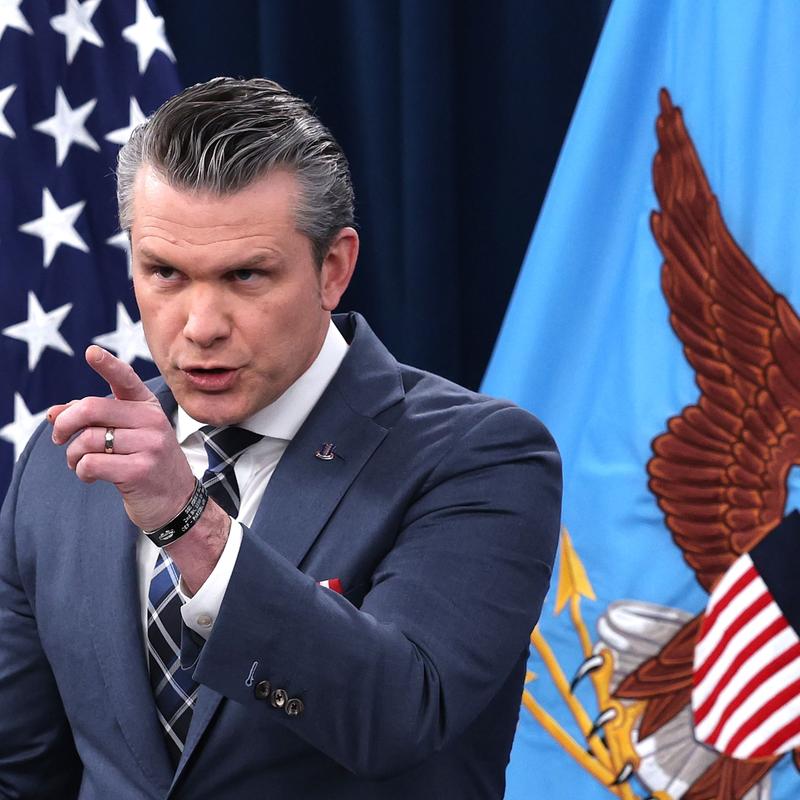
Pete Hegseth: A dishonest and anti-Trump press will stop at nothing to downplay progress, amplify every cost, and call into question every step.
Micah Loewinger: Defense Secretary Pete Hegseth is waging war abroad and scuffling with the press at home. From WNYC in New York, this is On the Media. I'm Micah Loewinger. Also on this week's show, when it comes to the Iranian regime's media output-
Mahsa Alimardani: -you have to hold two truths at the same time. US and Israeli bombs are killing Iranian civilians, and the regime will want to use this for propaganda.
Micah Loewinger: Plus, with the Strait of Hormuz under Iranian control, the world is cut off from its supply of black gold.
Samantha Gross: If this goes on and on, what I anticipate are spectacularly high prices at the pump. This is a bigger shock than the 1970s were.
Micah Loewinger: It's all coming up after this.
[music]
Micah Loewinger: From WNYC in New York, this is On the Media. Brooke Gladstone is out this week. I'm Micah Loewinger. This week, Defense Secretary Pete Hegseth took to the podium for his latest update on the war in Iran, but his remarks quickly turned to another domestic conflict.
Pete Hegseth: A dishonest and anti-Trump press will stop at nothing to downplay progress, amplify every cost, and call into question every step. They want President Trump to fail. Yes, there are reporters in front of me, but they are not our audience today. It's you, the good, decent, patriotic American people.
Micah Loewinger: Funny, because many of the outlets that face him in these press briefings are supporters of Donald Trump, having been handpicked by Hegseth to replace the traditional Pentagon press corps.
Pete Hegseth: The media here, not all of it, but much of it, wants you to think, just 19 days into this conflict, that we're somehow spinning toward an endless abyss or a forever war or a quagmire. Nothing could be further from the truth.
Micah Loewinger: Speaking of the truth, it can be especially elusive during wartime. It isn't uncommon for the relationship between America's top brass and the press to become strained when the country is engaged in active combat. In 2002, when reporters pressed Defense Secretary Donald Rumsfeld on the lack of evidence connecting Iraq to weapons of mass destruction, he delivered this infamous response.
Donald Rumsfeld: As we know, there are known knowns. There are things we know we know. We also know there are known unknowns. That is to say, we know there are some things we do not know, but there are also unknown unknowns. The ones we don't know, we don't know.
Micah Loewinger: Two decades later, Hegseth's disgust with the reporters seeking the facts is not about unknown unknowns. It's about knowns and how they're framed.
Pete Hegseth: People look up at the TV, and they see banners. They see headlines. I used to be in that business, and I know that everything is written intentionally. For example, a banner or a headline, "Mid-East War Intensifies," splashing on the screen the last couple of days. What should the banner read instead? How about, "Iran Increasingly Desperate"? Because they are. They know it, and so do you. Another example of a fake headline that I saw yesterday, "War Widening." Here's a real headline for you for an actual patriotic press. How about, "Iran Shrinking Going Underground"?
Micah Loewinger: Since the United States and Israel launched surprise airstrikes on Iran on February 28th, the list of countries who have launched strikes or been struck during the conflict includes the UAE, Qatar, Kuwait, Bahrain, Oman, Saudi Arabia, Jordan, Lebanon, Iraq, Cyprus, Azerbaijan, and the United Kingdom, with France and Germany reportedly in the wings. Seems pretty wide to me. Nevertheless, it was Hegseth's turn of phrase regarding a patriotic press, that was the classic golf ball kickstart of the White House Rube Goldberg machine.
[background noise]
Micah Loewinger: Down the inclined plane we go to Donald Trump.
News clip: The President disputed a Wall Street Journal report, claiming five Americans refueling planes had been struck in Saudi Arabia. The President wrote in part, "Yet again, an intentionally misleading headline by the fake news media."
Micah Loewinger: Trump didn't like the word "struck." Too strong, apparently. He says four of the five planes had virtually no damage and are already back in service. The fifth had "slightly more damage, but we'll be returning to this guy soon."
News Clip: He continued, "The lowlife papers and media actually want us to lose the war. Their terrible reporting is the exact opposite of the actual facts. They're truly sick and demented people that have no idea the damage they caused the United States of America."
Micah Loewinger: The clanking Rube Goldberg machine delivers us to the next pulley. Federal Communications Commission Chair Brendan Carr.
News clip: Carr wrote in a social media post that broadcasters must operate in the public interest, and those that are running hoaxes and fake news have the chance now to correct course before their license renewals come up.
Micah Loewinger: Now to the loop-the-loop.
News clip: President Trump quickly backed car and falsely accused outlets of coordinating with the Iranian government to spread falsehoods, going so far as to say that outlets should be "brought up on charges for treason for the dissemination of false information."
Micah Loewinger: All this talk of unpatriotic news makes it sound like the media are responsible for turning Americans against the war. Only around 25% support it. At a closer look, the actual coverage reveals a murkier picture.
Minnah Arshad: The New York Times published over 100 articles within the first four days of the Iran war.
Micah Loewinger: Minnah Arshad is a journalist who recently co-authored a report for the news site Zeteo on the Gray Lady's early coverage of the war.
Minnah Arshad: We looked at 103 of them. 18 of them mentioned Iranian victims, compared to 29 that mentioned victims from Iranian attacks. It's worth noting that Iranians have made up 97% of the victims in this war so far. That's a huge disparity in how casualties of different countries are covered.
Micah Loewinger: Arshad says The Times and its peers need to remember their mistakes from Gaza to Iraq and aggressively cover a war started on illegal grounds with a quickly growing human toll.
Minnah Arshad: It's a matter of the framing. It's a matter of which voices get highlighted and which do not. Time and time again, we see the hawkish voices, the pro-war voices, get more prioritization over the anti-war voices, even though polls show that most Americans do not agree with this war. We are the reporters responsible for holding our elected officials responsible, not just on war, but on all of the power that they hold. That's what patriotism looks like, standing up for your country and standing up to it.
Micah Loewinger: The domestic battle between the administration and a less-than-compliant press is just one front in the information war. The explosion of generative AI tools has inundated social media, casting doubt on photos, videos, and news reports emerging from Iran and the wider region. Mahsa Alimardani is the associate director of the Technology Threats and Opportunities Program at WITNESS, where she works on distinguishing visual truths in the age of AI distortion.
She wrote in a recent piece for Tech Policy Press that the Iran-Israel-US war may be the first conflict where "AI overwhelmed the information environment at an unprecedented scale," but what's accelerating the destruction of our shared reality is the deep decades-long distrust among Iranians, both in the diaspora and within the country, towards information coming from the Islamic Republic of Iran.
Mahsa Alimardani: You have basically seen the regime use this concept of the liar's dividend about how bad actors use the disbelief that comes from the prevalence of AI to call inconvenient truths lies. We saw so many of these cases during the January protests. We saw authentic protest documentation be accused of being AI.
Micah Loewinger: I want to hit on an irony about the state of this information battle, which is that Iran, more than ever, is deploying its media infrastructure to heavily document civilian casualties inflicted by strikes from the US and Israel. You told our producer that the Islamic Republic of Iran has been eagerly awaiting for this to happen for 47 years. What did you mean by that?
Mahsa Alimardani: It's part of the constitution of the Islamic Republic that they are the representatives of the oppressed. They have always angled ideologically to appeal to the Global South. Of course, Death to America and Death to Israel has been one of the key pillars of their identity ideology. The regime has never had more raw material to perpetuate this key pillar of their identity. You have to really hold two truths at the same time, which is US and Israeli bombs are killing Iranian civilians. The regime will want to over-document and use this for propaganda.
Micah Loewinger: Are you saying that the Iranian state is very careful about which casualties, which tragedies it produces proof for and which it chooses to hide or strike from the public memory?
Mahsa Alimardani: Precisely. This war started weeks after a really dark event in Iran's history, which was two days of unprecedented massacres against protesters. The regime did everything in their power to hide that, both from the infrastructure and technical layer to the offline physical repression. The last time I was on this show, we were talking about the difficulties of knowing the death tolls from the January massacres. That is a feature of what they do in the information space, not allow their own crimes to be documented. Now, weeks after that tragedy, you have these new tragedies. Of course, these victims are not being caused by them, but by the US and Israel. Of course, it's in their interests to share it with the world as much as possible.
Micah Loewinger: When you spoke to Brooke last month, Iranians were just emerging from a record-breaking internet shutdown provoked by those mass protests surging across the country in over 150 cities over severe inflation. Now, Iranians have been plunged back into yet another shutdown, barring them from partaking in the evidence-gathering and documentation of the war that's unfolding around them. What's the status of internet access right now? What are you hearing from friends and family in Iran?
Mahsa Alimardani: During the June war, when they shut down the Internet, and, of course, we know why they shut down the internet. They're afraid of an uprising. They shut it down, and they said the reason was for cybersecurity, that the enemy was attacking our infrastructure. If you actually looked at the technical reality, the civilian networks were not the same kind of infrastructure. There was no need for that. With this shutdown on the first day of the war, we had an internet shutdown again.
There was no on-the-record reason for why they were doing this until, actually, last week, we saw the spokesperson for the president declare that they would be giving privileged access to the internet to people who were going to get the message of Iran out to the world. A few days later, after that announcement, we saw the foreign minister on CBS. The CBS journalist grilled him.
Margaret Brennan: You're speaking to us via Zoom. The Iranian people don't have open internet access, but you do. Why?
Minister Abbas Araghchi: Because I'm the voice of Iranians, and I have to defend their right. This is why I have access to internet.
Micah Loewinger: Naturally, a lot of people are not buying what's coming from the Iranian state right now. This distrust has introduced a lot of issues into the information war. I want to talk about a specific example that you recently wrote about for The Atlantic. On February 27th, right before the US and Israel deployed their first wave of strikes on Iran, an independent labor union within Iran that identifies as anti-regime posted an AI-generated image showing military equipment stationed inside an elementary school in Isfahan, Iran. The school quickly posted a rebuttal, claiming that no such equipment was in the school, that it couldn't even fit inside the school. Fact-checkers later confirmed that that image posted by the union was, in fact, fake. What happened next?
Mahsa Alimardani: The next day, the first day of the war, there was a tragic incident where we now know, it was a US bomb that hit an elementary school in Minab. The death toll is somewhere around 170, and the majority of the 170 were children. I remember getting disinformation in all the group chats and networks I was in about this bombing. I was first told, "No, this was the IRGC. The Iranian Revolutionary Guards bombed the school. This is from Iranians."
I remember looking the story up and seeing, actually, the debunked AI photo from Isfahan linked because everyone was saying, "Well, it's a legitimate military target. It's understandable it was hit." This just added layers to the confusion in the information space. Then, of course, you have the element of the regime over-documenting it. They really used the occasion of the funeral and the burials as a state event.
Micah Loewinger: As you've written about, the funeral for those elementary school students itself became the subject of an information war. A diaspora account on social media claimed that a real photograph of the burial posted by Iran's foreign minister was actually an old image from a Jakarta cemetery, where COVID victims were buried in 2021. Tell me a little bit about how Iranians, both in and outside of the country, have been feeling about this televised funeral. Explain the ambivalence.
Mahsa Alimardani: There's this false narrative that the hatred towards the regime is often something that's expressed in the diaspora, but you genuinely do see these sentiments inside of Iran. There are thousands of parents who lost their children during the January massacres. Parents had to either pay exorbitant fees to get the bodies of their children, or they had to sign and say that their children were actually Basij security forces.
For Iranians who have been oppressed by these security forces for decades, it's truly a heartbreaking thing to do. Many of these parents were denied proper funerals. They were denied proper burials. To watch the regime make such a spectacle out of the deaths of these children is naturally something that would anger people living in that kind of grief and trauma.
Micah Loewinger: Efforts to try to identify AI-generated content and call it out has led to a new troubling phenomenon, something that investigative journalist Craig Silverman has called "forensic cosplay." Can you describe how this is playing out right now in the war?
Mahsa Alimardani: With this war, we've seen a newer phenomenon, which is just using visualizations of forensics analysis. People don't necessarily understand what a forensic visualization is or should mean, but they'll be like, "Okay, there's someone smarter than me who's trying to make a point." This looks scientific. We saw this happen in real time. New York Times posted a photo from the day that Mojtaba Khamenei's announcement was made, and people were on the streets. A very specific landmark in Tehran, where a lot of regime rallies happened. I didn't even see the photo as part of the article. I saw the photo as part of this forensics analysis the first time it came into my feed.
Micah Loewinger: If I understand this correctly, an X account with a very official sounding name, Empirical Research and Forecasting Institute, took a highly compressed image that had been originally published by The New York Times, showing this massive crowd in Tehran celebrating the announcement of Iran's new Supreme Leader, a real photograph, and then posted some kind of visual forensic that seemed to show that this compressed image, again from social media, bore the signs of AI. They were using something called "error-level analysis." What is that supposed to be, and why was it incorrectly applied here?
Mahsa Alimardani: Essentially, error-level analysis is supposed to look at compression information from a photo. It's not necessarily supposed to be able to tell if there's AI-generated content. It's supposed to be able to tell if something was Photoshopped. It does not work on a screenshot. This person had essentially taken the screenshot from Instagram and done the analysis, and it meant nothing. This went everywhere. Everyone was just saying, "The New York Times is perpetuating the regime's propaganda by sharing AI to fake that they have supporters in Tehran."
Micah Loewinger: Let's talk about another example. Following the strike on Nilufar Square in eastern Tehran on March 1st, a state-affiliated journalist posted authentic photographs of three victims walking away from the aftermath of the strike. It was a really dramatic photo. These pictures were later published in The Telegraph and The Guardian, but a user calling themselves a visual effects artist posted on X, accusing this real photo of being AI-generated by using this kind of technical-looking overlay heat maps. The technical-looking overlay, it turns out, was itself AI-generated. It wasn't proving or disproving anything. These posts went viral. Break it down for me.
Mahsa Alimardani: We, of course, got our forensics experts to assess this within our force. They basically came to the conclusion, this was likely generated by AI. The map and the legend on the heat map meant nothing, and it didn't communicate anything that a heat map was supposed to communicate. I received that tweet by multiple different trends telling me, "We don't think civilians are being targeted." It was sent to me as, like, "Look at how the regime is lying." If now forensics analysis is itself going to be doubted because we have these instances, this is now a new layer to the AI doubt. We are really going towards epistemic fracture in the information environment.
Micah Loewinger: Have you seen outlets or accounts or writers you think are doing a particularly good job sorting the real stuff from BS?
Mahsa Alimardani: There have been really incredible teams doing work overtime. I know some fact-checkers that aren't sleeping during this war. There's a really incredible journalist at BBC Verify, Shayan Sardarizadeh. You have this really great OSINT analyst, Tal. They're both on Twitter. Every time we get a case, I'm first, like, "Let me see if Tal or Shayan has done some analysis." Oftentimes, they're on top of it.
Micah Loewinger: What's at stake if we, as news consumers, become increasingly overwhelmed with these questions of real or fake?
Mahsa Alimardani: Just the fact that we are seeing this massive difference between June 2025 and March 2026 really speaks to the fact that this is a train going at full speed, and there isn't very many safety features on board. Hopefully, there will be some lessons learned. For example, the oversight board put out some recommendations for Meta to take action to ensure that AI-generated content during conflict wouldn't be infecting the information space so much. Meta now has 60 days to respond to the oversight board. We're watching to see what they're going to do. Are they going to actually invest in this, or are they going to deny responsibility and accountability?
Micah Loewinger: How are people in your community reacting to the war?
Mahsa Alimardani: I know one person who has refused to evacuate Tehran, even though their neighborhood is getting bombed pretty heavily. They feel hopeful that something good can come out of this war, that there is a hope that this regime will go after four decades. It is quite complicated to be living in a situation where you have bombs raining down on you. At the same time, the system has made you this desperate that this could be a potential source of hope for you. It's actually quite tragic.
Micah Loewinger: Mahsa Alimardani is the associate director of the Technology Threats and Opportunities Program at WITNESS, where she works on distinguishing visual truths in the AI age. Mahsa, thank you very much.
Mahsa Alimardani: Yes, thanks for having me.
Micah Loewinger: Coming up, fact-checking the administration's claims about Big Oil. This is On the Media.
[music]
Micah Loewinger: This is On the Media. I'm Micah Loewinger. As the US and Israel's war with Iran enters into its fourth week, the world has turned its attention to a narrow waterway at the entrance of the Persian Gulf.
Iranian Revolutionary Guard: From now on, all navigating through the Strait of Hormuz is forbidden.
Linsey Davis: The troubled waters of the Strait of Hormuz have quickly shifted much of the world's focus.
Marcus Moore: Iran vows to strike any ship linked to the US, Israel, or their allies that passes through here.
Clip: Come, come, come, come, come.
Micah Loewinger: Iran has struck at least 17 vessels so far, nearly shutting down the strait to any tankers that aren't carrying oil from Iran or one of its allies.
News clip: An interesting quote from the Qatari Foreign Ministry spokesperson saying that from day one, they had warned that this could be the potential fallout of any military action in Iran. He said, "This is the biggest I told you so in the history of I told you so's in the world."
Samantha Gross: The biggest disruption that you can cause in one place in the world is blocking the Strait of Hormuz.
Micah Loewinger: Samantha Gross is the director of the Energy Security and Climate Initiative at the Brookings Institution.
Samantha Gross: The majority of the export facilities from the big Gulf producers, Saudi Arabia, the United Arab Emirates, Qatar, Iraq, Iran, flow through this very narrow strait to get out to the rest of the world. Taking 20% of the world's oil supply offline all at once is just huge. There's no policy solution. There's no extra production that can come online to make up for a disruption that large.
Micah Loewinger: Well, that's not what I've heard from President Donald Trump. President Trump is really hammering this idea that it's more important to other countries if the strait stays open, because more of their oil supply comes from the strait.
President Donald Trump: We get less than 1% of our oil from the strait. Some countries get much more. Japan gets 95%. China gets 90%. Many of the Europeans get quite a bit.
Samantha Gross: Your listeners can't see me rolling my eyes. Oil is a global, fungible market. Even though we produce a lot more oil than we used to and are actually a net exporter of crude oil and oil products, those products and crude oil are priced on a global market. High prices in one place transform into high prices everywhere. That's why you're seeing gasoline prices rise a ton. Diesel fuel prices rise even more because we're paying the global price here. It's good for our oil companies that we produce so much oil here, but it still harms our economy and everyday people who just want to fill up their cars with gas.
Micah Loewinger: Okay, I have more questions about that. First, Trump is calling on countries around the world to help secure the Strait of Hormuz. Trump hasn't exactly been shoring up these alliances. There have been tariffs levied against our allies. There were those threats around seizing Greenland. No one's been jumping in to help. The messaging around this has been so all over the place. First, he said that numerous countries were going to help. An apparent lie. Then he said we didn't really need their help anyway, but also, we're going to remember that they haven't helped us.
President Donald Trump: Some are countries that we've helped for many, many years. We've protected them from horrible outside sources, and they weren't that enthusiastic. The level of enthusiasm matters to me.
Micah Loewinger: For what it's worth, French Finance Minister Roland Lescure told CNBC this week that his country was considering actually helping secure the Strait of Hormuz, but they just don't want to do it while there's a war going on.
Samantha Gross: I firmly believe that the Strait of Hormuz won't be really open until the shooting war is over. If you think about just how this conflict is evolving, it's very asymmetric. Iran cannot beat Israel and the United States militarily, but they do have a great big economic weapon, and that weapon is control of the strait. They're not going to stop using that weapon until we stop shooting at them.
Micah Loewinger: Just zooming out, it seems like the Trump administration really underestimated Iran's capability to shut down the strait. Last week, Defense Secretary Pete Hegseth said that Iran is-
Pete Hegseth: -exercising sheer desperation in the Straits of Hormuz. Something we're dealing with. We have been dealing with it and don't need to worry about it.
Micah Loewinger: The President has claimed that he saw this coming and that he doesn't care.
President Donald Trump: I knew about the strait, that it would be a weapon, which I predicted a long time ago, predicted all of this stuff."
Micah Loewinger: Reporting from The New York Times shows that the Trump administration was caught by surprise and that the administration massively miscalculated how Iran would respond. Reporting from The Wall Street Journal says that Trump was warned repeatedly by the Chair of the Joint Chiefs of Staff that Iran could shut down the strait in response to an American attack, that Trump acknowledged the risk, but told his team that Iran would likely capitulate before closing the strait, and that the US military would be able to handle it. I take it you and other energy analysts saw this coming a mile away.
Samantha Gross: Yes, and military analysts as well. You think about what's happening here. We assassinated the ayatollah and much of his family on the first day. This was existential for Iran right away. As soon as I understood the breadth and depth of these attacks, the Strait of Hormuz was the first thing I thought of. Thinking that they weren't going to do that was just silly.
Micah Loewinger: Let's talk about the economic impacts of all this. Right after the US and Israel's first attacks on Iran, you wrote that oil markets were somewhat nonchalant in response. By comparison, four years ago, oil prices spiked after Russia invaded Ukraine. Why do you think prices haven't gone up more yet?
Samantha Gross: I think markets have been hoping, optimistically, that the strait would open soon, and that they wouldn't quite feel the whole effect of this. As it goes on, you're seeing oil prices and, in turn, gasoline prices steadily rise as the market understands that we're still here and the strait is still functionally closed.
Micah Loewinger: How much more are we paying now, speaking on Thursday, than we were, say, a couple of weeks ago?
Samantha Gross: We are seeing gasoline prices in the US up more than $0.75. We're seeing diesel prices up more than $1.25. That's real money for US consumers. Then, in turn, because diesel fuel is really the fuel of industry, shipping, farming equipment, we're going to start to feel this over time in the prices of other goods and the prices of food and all the other things that you and I buy every day. This has the potential and, over time, it will flow through the entire economy. It's inflationary.
Micah Loewinger: Let's talk a little bit about the damage that's been done to oil infrastructure in the Middle East. The US recently struck Kharg Island, where 90% of Iran's oil passes through. How significant is that?
Samantha Gross: The US did indeed strike Kharg Island. In addition to being where Iran's oil export facilities are located, there are also some military facilities located on Kharg Island. The US was pretty precise in targeting the military facilities, but not the oil facilities. Targeting those oil facilities would be a tremendous escalation in the war against Iran. It would take them out of the game for quite some time. The problem with that is we're seeing all this tit for tat right now. Israel struck a large gas field in Iran. Iran retaliated by striking a large LNG processing facility in Qatar.
Micah Loewinger: LNG processing plant?
Samantha Gross: Yes, so we're really focused on oil in the United States because that's what affects our local consumers. In addition to being an oil crisis, this is a global crisis in natural gas supply, because fully 20% of the world's liquefied natural gas supply, that is disrupted as well. It's almost entirely from Qatar. Most of it is processed at one facility that, as we speak on Thursday, the Iranians attacked last night.
Micah Loewinger: Returning to oil. I am curious about this idea of offsetting the losses that we might be seeing right now. Trump's Interior Secretary, Doug Burgum, has said that oil from Venezuela will help soften the blow from the Middle East. He said--
Doug Burgum: Thank you, President Trump, taking someone like Venezuela, who, two months ago, was a sanctioned adversary. Now, they're a strategic ally with the largest reserve with no threat of the chokehold like we have in the Strait of Hormuz. Venezuelan oil can flow to America freely, and is starting to flow, will continue to flow.
Micah Loewinger: Part of Trump's justification for kidnapping the president of Venezuela was to get access to Venezuela's massive reserves of crude oil. Is Venezuelan oil flowing freely to America? Will this offset losses from the Middle East?
Samantha Gross: The Venezuelan oil industry, because of a decade of neglect, is held together with chewing gum and duct tape. They do indeed have the world's largest oil reserves, but it will take years to get a significant amount of additional oil flowing out of Venezuela. We have a timing problem. Might Venezuela help with overall oil supply? Yes, but several years from now. Not right now.
Micah Loewinger: On Thursday, Treasury Secretary Scott Bessent said that the administration is considering lifting sanctions on Iranian oil that is already on the water. [chuckles] I take it you don't think that's going to solve the problem either.
Samantha Gross: No, I don't. In fact, I think it's completely counterproductive. Iran has been letting its own ships through the Strait of Hormuz. It controls it. The only ships that are getting through are those carrying Iranian oil. By lifting the sanctions on that oil, what you're saying is it's okay to buy that oil. It's not going to be sold at a sneaky lower, avoiding sanctions price. It could theoretically fetch the global price for oil. Iran could sell oil it was already going to sell anyway, and potentially fetch a larger price for it.
Micah Loewinger: We're just hitting them where it hurts.
Samantha Gross: We are hitting them where it hurts militarily. We seem to frequently forget here in the United States that the world's largest and most powerful military can't fix everything, that there are other ways for countries to get back at us if they so choose, and Iran is finding them.
Micah Loewinger: You've said that this oil shock is potentially worse than what we saw in the 1970s. What do you mean by that?
Samantha Gross: We're losing more oil than we lost during the oil shocks of the 1970s, both in terms of absolute barrels and in terms of percentage of overall global production. This is a bigger shock than the 1970s were. It could get really bad. The one thing that's kind of helping us right now and will continue to help us is that markets are better integrated, more complex, better at moving oil to whomever is willing to pay for it in the world right now than we were back in the 1970s, but the shock itself is bigger.
Micah Loewinger: In the 1970s, there were national shortages. There were gas lines. Are you saying that's possible?
Samantha Gross: I don't anticipate gas lines. If this goes on and on, what I anticipate are spectacularly high prices at the pump. It depends on how long the strait is closed and how much damage is done to facilities because the markets see that. They understand that not just is supply gone now. It's not coming back real soon either if the facility is destroyed. That will continue to get factored into prices.
Micah Loewinger: I was reading a little bit about the oil shocks of the 1970s. One of the lessons that was taken away is that our country should invest more in renewable resources, become less reliant on fossil fuels.
Samantha Gross: Yes. You don't see these crazy spikes and blockages of solar energy or wind energy. Once you get those installations in, you're not paying for fuel. There's no way to get involved in a shortage. I think this does make clear the importance of renewable energy in our supply, not just for environmental and climate reasons, but for energy security reasons as well. I'm hearing colloquially that that is actually happening. Contracts that were sitting in wait are now getting signed, and that the market really is getting the message that renewable energy helps to keep you out of messes like this one.
Micah Loewinger: We've talked a lot about all of these narratives coming out of the Trump administration. When it comes to media coverage, how do you think journalists have done in covering and accurately describing what's happening and the consequences of all of it?
Samantha Gross: The FT especially has been great.
Micah Loewinger: The Financial Times.
Samantha Gross: They're focused on specific facilities that are getting hit, the level of damage to those facilities, what it really means, and going back to original sources to understand what's going on. I don't have eyes on the ground in Saudi Arabia or in Qatar, but they do, or they're talking directly to people who do. That's what I need to do. My deeper thinking about what it all means. I would caution listeners to look out for overly sensational coverage.
Really big claims, any claim that someone knows how this is going to turn out, I would question very strongly. We know it's going to get worse as it goes. If anyone is telling you they know where prices are going to go or they know how this war will end, I would question that very much. It's funny. I saw the headline, but I haven't read it yet. There's something in Financial Times this morning that the headline was, "This crisis is much worse than you think." I was like, "I hope they're not saying it's much worse than I think."
Micah Loewinger: Because then we're really screwed.
Samantha Gross: Oh, if it's worse than I think, yes. This is so serious, and it's getting more serious every day. We're still escalating. We're escalating. The Iranians are escalating. We're not headed toward an exit ramp. We're still barreling down the freeway, and that's scary to me.
Micah Loewinger: [sighs] Okay. [chuckles]
Samantha Gross: Sorry. I've been in a couple of meetings in the past 48 hours that have scared the pants off of me.
Micah Loewinger: Samantha Gross is the director of the Energy Security and Climate Initiative at the Brookings Institution. Samantha, thank you very much.
Samantha Gross: Oh, you're so welcome.
Micah Loewinger: Coming up, the President has accused the military's in-house newspaper of being too woke. This is On the Media.
[music]
Micah Loewinger: This is On the Media. I'm Micah Loewinger. Stars and Stripes, the venerated, independent, award-winning newspaper that has served the armed forces for roughly a century, is getting an uninvited makeover courtesy of the Pentagon, which says that it will shift the publication "away from woke distractions that siphon morale."
Last week, the paper reported that a Pentagon memo, effective immediately, enacted a variety of changes for Stars and Stripes, including no longer purchasing content like wire reports from the AP or comics, barring Stars and Stripes journalists from making Freedom of Information Act requests in their official capacity as Stripes reporters and a requirement that content "must be consistent with good order and discipline," a phrase borrowed from the Uniform Code of Military Justice.
That last rule, Editor-in-Chief Erik Slavin told NPR, could mean service members reporting for the paper are eligible to be court-martialed for what they write. When these changes were first teased by Pentagon spokespeople in January, Brooke spoke to Erik Slavin to get his thoughts on what's been pitched as an effort to bring the paper "into the 21st century."
Erik Slavin: It's difficult to say exactly what they're referring to. No other news organization that I'm aware of is on the ground in a lot of remote bases throughout Europe and the Pacific, providing really granular military news. We have used wire stories to round that coverage out because we can't be everywhere at once. We think that, for example, a soldier who's out in a very remote area in the desert might want to know what happened with the NFL. The wire service does that, and also with a number of stories that we don't have the bandwidth to produce. In terms of our overall military coverage, it is very, very focused on the military community, on families.
Brooke Gladstone: There was a story in The Daily Wire in which anonymous War Department officials said that Stars and Stripes stories would be written by active-duty service members and "50% of the website's content would be composed of War Department-generated materials." Now, to me, that sounds like PR. What does it sound like to you?
Erik Slavin: Well, we've had civilian staff since the 40s. We do have primarily civilian reporters, but we also do take on military reporters, somewhat like interns. Those civilian reporters take them under the wing and show them how to be journalists. As for the rest of that Daily Wire story, if you were to mingle PR with independent journalism, where it is indistinguishable, then that erodes credibility and fundamental mission of providing service members with independent news.
Brooke Gladstone: Now, a vital part, as you said, of Stars and Stripes' mission is covering things like the high cost of off-base housing or the plight of military families who need food stamps or investigations into sexual assault cases within the military. That's the stuff you cover, in a granular way, your readers are not going to find anywhere else. What does "woke distractions that siphon morale" mean to you?
Erik Slavin: I think you have a deeper morale when what you are printing, what you are posting, corresponds with the lived experiences of your readers. If they are looking around and seeing issues that need to be resolved, and you report on them, that feels like their issues and what they're thinking about has been acknowledged. I think that improves morale rather than just attempting to cheerlead.
Brooke Gladstone: Right.
Erik Slavin: There may be a place for that, but we think we can do more in reading the comments of service members who come to us and thank us for what we do. I think that's validated.
Brooke Gladstone: You have had something called the Code of Federal Regulations, which states that reporters must produce work that is "objective, credible, and editorially independent of the military chain of command and military public affairs activities." That has recently been removed by the Defense Department on the basis that it is "unnecessary," which leaves the paper operating, I guess, under an older Department of Defense directive from back in 1994. Why would they remove the Code of Federal Regulations?
Erik Slavin: This Code of Federal Regulations was being modernized. Last year, there was public comment. They were overwhelmingly supportive of the independent mission. Actually, many of them called for the expansion of that mission.
Brooke Gladstone: Being more independent, you mean? In what way or how?
Erik Slavin: The Defense Department has attempted to deny us the right to file under the Freedom of Information Act, which just about anyone on Earth can do. They have said that we are a federal organization and cannot do that. We have argued against that. We have found alternate ways to make those FOIAs in some places, but oftentimes, they flat-out have rejected that. At the moment, there is a Department of Defense regulation still in effect, which says that Stars and Stripes cannot be subject to news management or censorship by military or government officials, so that is still in place.
Brooke Gladstone: Then they can't be supplying 50% of its content directly from the Pentagon.
Erik Slavin: That is true, but that is also a Department of Defense regulation. The Department of Defense can change its own regulations, so that Code of Federal Regulations was a greater backstop to support the independence of the organization. That was rescinded without any notification.
Brooke Gladstone: A little history. In the midst of the Civil War, Stars and Stripes was started by some Union soldiers who'd captured an area that included a printing press. They went ahead and made their own paper. This, of course, during a war, is so fraught that the Lincoln administration suppressed some 300 newspapers critical of the war. Then, after the war, Stars and Stripes went dark for a while, I think. Can you pick it up from there?
Erik Slavin: Sure. It reappeared in World War I. The first copy that I've seen from World War I had a big picture of Pershing. It was under President Wilson. Then it went dark again, as you said, but it has been continuously printed since 1942 in Europe, again, from multiple locations as Allied Forces gained ground, and printed in 1945, beginning in Asia. From there, it's been printed continuously in multiple countries throughout the world. It has always had some measure of independence. There have been trouble at various times in attempts to impose censorship. General Eisenhower was very forthright during World War II, said, "This is the soldier's paper, and it should not be censored."
Brooke Gladstone: You say that this came as a complete surprise, but did you get any pushback this past year with the Defense Department under Pete Hegseth? Surely, given the coverage you've done, we cited your coverage of service people being harried by ICE and even detained. You didn't hear anything?
Erik Slavin: No, it is not a new thing for Stars and Stripes to come under fire. That happened in 2020. The Secretary of Defense announced that they were going to cease funding for Stars and Stripes.
Brooke Gladstone: Why?
Erik Slavin: The answer they gave in a press conference is that it did not fit their conception of putting out their message, which is not what Stars and Stripes is for anyway. A number of people in Congress had a problem with that. A number of people among the general public, some former generals and admirals, came out and said that they didn't necessarily agree with everything we ran, but thought that we were important to have ultimately between Congress and even the President, who tweeted out, we are going to keep Stars and Stripes. We continue to survive. The idea that someone would decide to make changes or otherwise target our independence, it's not a new idea. Again, we were not anticipating this.
Brooke Gladstone: We talked about some of the examples of the paper's noteworthy work, but I wonder if you could just pick out past and present, some stories that really stand out for you.
Erik Slavin: Dee Spearman is somebody that I will always remember. He was a very young sailor who was aboard the USS Arleigh Burke, 2022, I believe, and he fell overboard and he died. At the time, there was a very short release regarding his death. Our reporter stuck with this for two years. She continued to ask for documentation, even when documentation wasn't coming very quickly. She did the interviews. She talked to the family members.
Ultimately, what we found in some of the Navy's reports and from accounts from people aboard the ship was that Dee had fainted at least four times aboard the ship, twice when he was helming the ship. He was sent to work alone on the top deck of the ship. There were improper lifelines. Just a number of issues related to that that really made you question, "Okay, was proper procedures followed, and did he have to die? From that reporting, I would hope that the Navy may have learned something about how to handle these types of situations. I think the family gained at least a little bit of closure, knowing that their son's story was told.
Brooke Gladstone: Over the last year, we've seen the Pentagon bearing down pretty hard on the press. Hegseth demanded that reporters sign a pledge, promising to never divulge or gather information that the Pentagon hasn't authorized for release. That includes unclassified information, or else they would have to turn in their badges. The Pentagon press corps pretty much, as a body, did just that. They walked out, and they were replaced by [sighs] lackeys, funders like MyPillow Man, right-wing influencers like Laura Loomer. Is reining in Stars and Stripes just another attempt to control the narrative, most particularly for people into the armed services? What do you think they're trying to do?
Erik Slavin: I would love to know what they're trying to do. I really would, Brooke. I would love to sit down with them and have a discussion about what it is they want. I'm happy to talk about our mission, talk about the things that we do for our readers and for the military community. I don't know what we are doing that they disagree with because they haven't told us, but everything we do is for the service member. We try to give them well-rounded news so that they can participate as citizens in a democracy while also explaining to them what the US Armed Forces are doing and why they are where they are. That's what we do. That's what we're going to keep trying to do as long as we possibly can.
Brooke Gladstone: There haven't been any instructions that have come down to you. Do you have something to respond to, or are you just going to keep on keeping on?
Erik Slavin: We are going to keep on keeping on because we have no real alternative. Hopefully, we can sit down and have a conversation that is not on social media, and we can work out whatever differences we might have, and we can preserve Stars and Stripes as an independent news organization.
Brooke Gladstone: Erik, thank you very much.
Erik Slavin: Thank you.
Brooke Gladstone: Erik Slavin is the editor-in-chief of Stars and Stripes.
[music]
Micah Loewinger: That's it for this week's show. On the Media is produced by Molly Rosen, Rebecca Clark-Callender, and Candice Wang. Travis Mannon is our video producer. Our technical director is Jennifer Munson, with engineering from Jared Paul. Eloise Blondiau is our senior producer. On the Media is produced by WNYC. Brooke Gladstone will be back very soon. I'm Micah Loewinger.
Copyright © 2026 New York Public Radio. All rights reserved. Visit our website terms of use at www.wnyc.org for further information.
New York Public Radio transcripts are created on a rush deadline, often by contractors. This text may not be in its final form and may be updated or revised in the future. Accuracy and availability may vary. The authoritative record of New York Public Radio’s programming is the audio record.