
Social Media Goes to Court
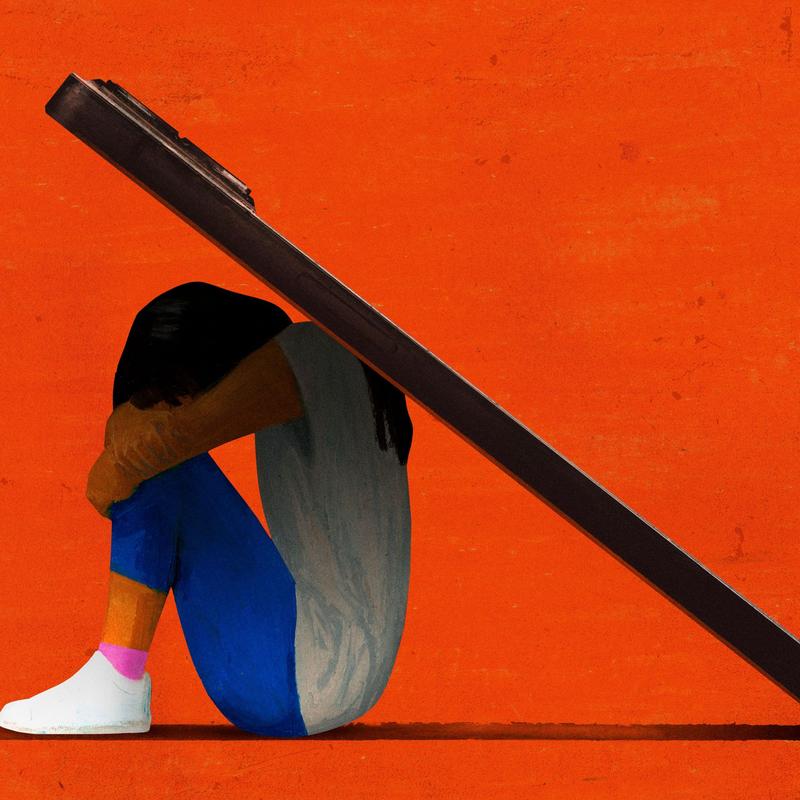
David Remnick: Talk about the right book at the right time. Two years ago, a book called The Anxious Generation came out, and it was an instant bestseller. Jonathan Haidt, a social psychologist teaching at New York University, laid out a very stark thesis that Generation Z, the kids born with smartphones in their hands, have been harmed profoundly by those phones and the social media programs on them, harmed emotionally and intellectually by the addiction mechanisms programmed into the technology.
Now, some readers scoffed initially, calling it the latest panic over new technology, and some academics have said that Haidt doesn't quite prove the negative effects he attributes to social media, but for a huge number of people, The Anxious Generation nailed it. The book has now spent nearly 100 weeks on the bestseller list, and more important, it's helped to galvanize a movement.
It inspired the world's first national law to verify the age of social media users. It also encouraged school districts to restrict the use of phones. You see that happening all over the country. There have also been lawsuits in California that are aiming to pin liability for harms on the social media platforms themselves. I spoke with Jonathan Haidt when The Anxious Generation first came out two years ago, and he joined me again the other day.
Jonathan, I really wanted to have you back. We had a wonderful conversation a couple of years ago, and you've done a lot of work since then. I've done a lot of thinking about it, too, I must admit, and I think I'm not alone. Your book has been cited as part of the inspiration for some new laws that are trying to shield children from social media, and a trial has just started in the state of California against social media companies. That seems really significant. Talk me through what's going on in California.
Jonathan Haidt: That's right. These companies have-- they were given blanket immunity for action back in the '90s. Section 230 of the Communications Decency Act said we can't sue Meta or TikTok because of what someone else posted on Meta or TikTok.
David Remnick: As a First Amendment idea?
Jonathan Haidt: It was actually done to incentivize the companies to moderate, because they were afraid. If they moderate, if they take anything down, now they're responsible for every single decision, so Congress said, "You know what? You can go ahead and take down porn. Don't worry. No one can sue you if you leave something up." They wanted to give them more freedom of action. It was a good idea originally, but the courts have interpreted so widely that you have all these parents with dead kids. In many cases, it's just crystal clear. The kid got sextorted on Snapchat and was dead that night.
You have kids who, a happy 11-year-old girl, she gets on Instagram, and a few weeks later, she's developing an eating disorder. You have all these parents whose kids have been killed or damaged, and not one has ever gotten justice, not one has ever even been able to face Meta in court. Meta has never faced a jury. None of these companies have ever faced a jury because they keep saying, "Oh, Section 230. You can't touch us." Now, how insane is it that the makers of the largest consumer product in the world, that is the one that most children use, that seems to be harming and killing a lot of them, can never be held responsible for their actions?
David Remnick: Do you have any numbers for this?
Jonathan Haidt: In terms of sextortion, we know one number from Snap was that they were getting 10,000 reports of sextortion from their users in 2022. That wasn't 10,000 a year, that was 10,000 a month. A month, so 100,000 reports. As they said themselves, this is probably the tip of the iceberg because most people don't report. Also, again, the kids, the boys who kill themselves, they don't report either. With AI automating sextortion, it's going to go way up. When we look at harms to mental health, we tend to find 20% to 30% of the girls are saying, "It harmed my mental health." That puts you up over 10 million right there. That's just in the US.
If we look at the harms to mental health, what we try to argue in this paper is the specific harms that we go through, the direct harms and the indirect harms, are at such a scale that this could plausibly have caused those big increases in 2012 in mental illness.
David Remnick: What's happening in California?
Jonathan Haidt: What's happening in California is that of the thousands and thousands of parents who are suing, it can't be combined into a class action suit, because a class action suit requires that all the plaintiffs have been harmed in the same way. In this case, the stories are all a little different. What the justice system is doing is they've created what's called a multidistrict litigation in which all-- it's several thousand cases, will be heard by a single judge, a single court in California. Now, of course, that's impossible.
The idea is the two sides argue about which cases to consider. They pick bellwether cases. Those cases go to trial in front of a jury, and then, based on what those jury trials are, it'll be clear which way everything has to go. That's where we are. There are so many members of Gen Z and young people who are advocating for reform, and so they're sitting in on the courtroom.
David Remnick: What's the desirable outcome?
Jonathan Haidt: The desirable outcome is that a jury, which decides questions of fact, decides that, in fact, social media is addictive, and it was designed to maximize engagement. They use various tricks to basically addict kids.
David Remnick: When you say tricks, what do you mean?
Jonathan Haidt: Oh, have you ever noticed when you-- on an iPhone, when you pull down, like you want to check your email, you pull down, and then it bounces up, and you get new ones?
David Remnick: Yes.
Jonathan Haidt: That was literally copied from slot machines. Literally. I mean, these guys, they took a course at Stanford called Persuasive Design in the early 2000s. One of the founders of Instagram took the course, and they used behaviorist principles.
David Remnick: I met with some leaders of Apple, and I raised a couple of these, just in conversation, raised a couple of your main points.
Jonathan Haidt: What did they say?
David Remnick: Turn it off. Ration your time.
Jonathan Haidt: Oh, yes.
David Remnick: Be more logical about how you use it. It's a great machine. You just have to-- They were, I have to say, pretty blase about it.
Jonathan Haidt: That's right. As a social psychologist, my rule is if one person is doing something bad or stupid, that person might be bad or stupid, but if all of us are doing something that seems bad or stupid, it's probably a bad situation that's making us all behave this way. We have a lot of experience with addictive products. We know a lot about gambling, how it ruins people's lives. Not everyone's susceptible, but a lot are. Same with alcohol, same with cigarettes. We have a lot of experience with addictive substances. The rule number one of addictive substances is we don't let companies give them to kids.
We say, "Adults, we're going to trust you to regulate, and 10% of you can be severely damaged, but that's your choice." My God, we don't say that about kids.
David Remnick: Do you think your subject, your obsession of late, is related to something that concerns me very much, which is the decline of reading?
Jonathan Haidt: Oh, yes.
David Remnick: We see all this information, these statistics about the number of people who have or have not read one book in the past year.
Jonathan Haidt: Yes. This, actually, I now believe, is the biggest damage. When I was writing The Anxious Generation, I focused on the mental health damage because that's where the evidence is best. Certainly, it was three years ago. I mention attention fragmentation. I mention addiction, but I don't have a lot on it. Okay, the book comes out, and now everyone begins talking about they can't pay attention anymore. It's not just kids. It's adults are beginning to say that they can't pay attention. Then we start hearing, as you say--
David Remnick: I'm telling you, it's hard for me.
Jonathan Haidt: Everyone I talk to.
David Remnick: I'm a professional reader. As I told you before we went on the air, I have to take my phone and put it in the kitchen so that I can, in the other room, read manuscripts, read a book. God forbid. It strikes me as the rise of the phone, and all it implies is the greatest experiment in human consciousness, in a sense,-
Jonathan Haidt: Absolutely.
David Remnick: -that hasn't been thought through.
Jonathan Haidt: Absolutely.
David Remnick: It's just speeding 60 miles an hour into our lives and carrying us along.
Jonathan Haidt: With effects far beyond what we can imagine. Let's talk about a few of them. First, to understand why this is. The key neurotransmitter here is dopamine. Everyone's heard of dopamine. Dopamine is not exactly a reward neurotransmitter. It's better thought of as the neurotransmitter of motivation. If you eat a potato chip, it tastes really good, and then that makes you want another.
David Remnick: Another potato chip. Sure.
Jonathan Haidt: Want another. Okay. Keep your eye on-- Dopamine is wonderful, and we want our kids to experience a lot of slow dopamine. Slow dopamine is your kid is trying to build a tree house, and at first, he fails, and he makes some progress, which feels really good, and so he's motivated to work harder. Then he fails again, and then eventually, he finishes. Boy, what satisfaction that is. That's how you raise an adult, is you give them a lot of experience of slow dopamine. They learn to set goals and pursue them.
Here's how you undermine that. Make available to every child, from the age of two, hand them an iPad. What the child will quickly learn unconsciously is they're looking at something, and within eight seconds, they will know. "This is kind of interesting, but it's not. Swipe. Oh, wow. This is so funny. Oh, this is great. This is great." Quick dopamine, quick dopamine. They go someplace else. This is the experience that young people have had since birth now. Kids are given iPads routinely when they're in their strollers. What happens? I had a conversation about this with my students at NYU.
David Remnick: This is not just crabby college professors whining about their students not reading Middlemarch in a week.
Jonathan Haidt: No, this is the subversion of the ability to pay attention on a species-wide level. As one of my students said, because I showed her that Atlantic article about students aren't reading books anymore, and she said, "Yes, it's true." She said, "I pick up a book, I read a sentence, I get bored, I go to TikTok." Again, you've been on this book for eight seconds, and it's not that interesting, but the thing in my pocket is a lot more interesting. Quick dopamine. Quick dopamine. This is what we've done.
This is even worse for the boys, because for the boys, it's video games, it's porn, it's vaping, it's gambling, it's sports betting. For boys, it's open season on their dopamine systems. This is going to make it very hard for them to develop executive function, follow goals, be useful as employees or spouses.
David Remnick: You came in today, and you put in front of me a paper that you've said is the most important research you've done. It's called Social Media Is Harming Young People at a Scale Large Enough to Cause Changes at the Population Level. At the New Yorker, we wouldn't call that a good print title. It would be a good SEO title, but tell me what this report is all about. You and your co-author, Zachary Rausch, have published this year.
Jonathan Haidt: Sure. The defenders of social media, especially Mark Zuckerberg, will say, whenever they're questioned, they say-- actually, well, here. Here's a quote from Mark Zuckerberg when he was questioned under oath in the US Senate, January 31st, 2024. He says, "Mental health is a complex issue, and the existing body of scientific work has not shown a causal link between using social media and young people having worse mental health outcomes." His claim in multiple places is it's just a correlation, and you can't prove that it's causation.
What Zach and I have done is we have laid out seven different lines of evidence. We're trying to reframe the argument as one that can actually be solved. What Zach and I have done is we have reconceptualized this in a way that I think will make a lot of sense to people. We do have ways of knowing if A caused B in the law and in social science. We have lots and lots of studies, surveys of young people. What do they say? Do the young people think that social media is great for their mental health? Absolutely not. What we do, this is line one, what the victims say. In Exhibit A, we present a bunch of surveys of young people. For example--
David Remnick: These are surveys done by whom?
Jonathan Haidt: Pew, Gallup, Common Sense Media, many international outlets as well. We cover international research as well. Pew, which is probably the main source of evidence here, 2024, they found 1/3 of girls say it makes them feel worse about their lives. 50% say it harms their sleep. It all comes back to this question of correlation versus causation. I laid out line one is what the victims say. They say he did it. Line two is what the witnesses say, and that's the parents, the teachers, the psychologists, the psychiatrists. They all say, they have very negative views of this. They see it up close. They say, "This is causing anxiety disorders. This is harming my patients."
Then the third line is what the perpetrators say. We have quote after quote from inside the company. I'll just read a couple very briefly.
David Remnick: Sure.
Jonathan Haidt: From TikTok, an internal research report. "Compulsive usage correlates with a slew of negative mental health effects like loss of analytical skill, memory formation, contextual thinking, conversational depth, empathy, and it correlates with increased anxiety." It goes on and on. They know that they are hurting kids. Meta. "There are reasons to worry about self-control and use of our products."
David Remnick: Who is speaking here?
Jonathan Haidt: A member of Meta's core data science team and a senior data scientist at Meta, having a conversation. Let me see. "Without providing much more value. How to keep someone returning over and over to the same behavior each day? Intermittent rewards are most effective. Think slot machines." They are trying to hook children.
[MUSIC]
David Remnick: I'm speaking with Jonathan Haidt, the author of the bestseller, The Anxious Generation. We'll continue in a moment. This is The New Yorker Radio Hour.
[MUSIC]
David Remnick: This is The New Yorker Radio Hour. I'm David Remnick. I've been speaking today with Jonathan Haidt, the author of The Anxious Generation. Now, Jonathan Haidt wasn't the first social scientist to look at how the advent of smartphones as a near-universal technology was affecting all of us and affecting us profoundly, but his conclusions in The Anxious Generation really touched a nerve, and he told me that he's essentially taking a break from new projects in order to devote himself to advocating for change. I'll continue my conversation now with Jonathan Haidt.
Let's talk about another country where something has been done about this. Late last year, Australia enacted a new law requiring age verification for social media users. I think that's the first national law of its kind.
Jonathan Haidt: Yes, it was.
David Remnick: What does this verification look like and how is it working?
Jonathan Haidt: The Australia bill was very carefully drafted. They commissioned a former Chief Justice of the Supreme Court, Robert French, to figure out how it would be done. It specifically says it's up to the companies to do it. It's their responsibility. It specifically says the companies cannot only ask for a government ID. They have to offer an alternate way. There already were dozens of companies that offer alternate ways.
David Remnick: Wait, wait, how does it work?
Jonathan Haidt: The law tells the companies, "You guys figure it out, and you can't just say, 'Show me your driver's license.' You have to offer something else." There are dozens of companies that offer that service. The idea is you want to open an account on Instagram. Let's say you go to Instagram, you put in your birthday, it then kicks you over to a page which says, "Here are four ways that you can validate that you're old enough."
David Remnick: It's not an honor system. "Yes. I'm 18. On we go."
Jonathan Haidt: That's right. Until December 10th, which is when it went into effect, the world was on the honor system. Porn. "Are you 18?" "Yes." You're in. That began to end on December 10th.
David Remnick: Why did this happen first in Australia?
Jonathan Haidt: In Australia, it just so happens that the wife of the premier of South Australia read The Anxious Generation soon after it came out. She said to her husband, Peter, Peter Malinauskas, "You've got to read this book, and you've got to effing do something about it." He did. He called up Robert French and said, "How could we do this?" They did it.
David Remnick: How is it coming along in Australia?
Jonathan Haidt: Here's what we know. Julie Inman Grant, their eSafety commissioner, put out a press release three or four weeks ago. She said all 10 of the covered platforms have complied. They took down 4.7 million accounts from the 2.4 million Australian kids in that age range. Of course, some are getting around it with VPNs, although I heard from someone who's studying it, VPN usage went way up at first, but it came way back down. Because the kids, they want to check their social media use. They want to check it 30 times a day. If you have to load up a VPN, it's a bit of friction.
Of course, kids are still getting around it, but as Julie pointed out, we're trying to change the norms of a nation, the norms of childhood. We won't really know the full effect for 10 or 20 years.
David Remnick: How does it affect schools and phones?
Jonathan Haidt: There's two things. One is locking up the phones in the morning, a phone-free school policy. That has magical effects, transformative effects. Some schools don't implement it well, they don't enforce it well, and then there's cheating, but in schools that enforce it reasonably well, the results are always spectacular. The thing that you always hear is we hear laughter in the hallways again. The lunchroom is so loud. Kids are laughing. I spoke to--
David Remnick: That sounds too good to be true. Do we know this to be the case?
Jonathan Haidt: First of all, it's very hard to find an account anywhere of one that backfired, and that would be newsworthy. There are a lot of efforts to measure going on. Angela Duckworth at Penn is doing a major assessment, and she showed me some preliminary data in which the schools that use lockers that really took the phones away for the day, that use special phone lockers, they got the best results. Teacher reports, academic outcomes. The ones that used Yondr pouches got good results. Not as good.
The ones that use a backpack policy, which a lot of schools do, unfortunately, say, "Keep it in your backpack. Don't take it out." Which, of course, look, if you're a cocaine addict and you're told-
David Remnick: I don't think that's backpack, yes.
Jonathan Haidt: -you can keep your cocaine with you all day long-- Yes. It does seem to be working incredibly well.
David Remnick: The biggest argument against the Australian policy or bringing the Australian policy to the United States is a First Amendment argument. Explain the First Amendment argument, and, obviously, why you disagree with it.
Jonathan Haidt: Of course, the First Amendment is that Congress shall make no law restricting the freedom of speech. The companies argue that any kind of regulation, they have a lot of organizations with nice sounding names, Internet Freedom or whatever, they argue that any kind of regulation is going to stop somebody from speaking, and therefore violates the First Amendment. The law already says that you have to be 13, because this isn't about who can say what. The laws are written about at what age you can sign a contract. It's about contract law. Right now, the law says a company has to-- you have to be 13 before a company can take your data without your parents' knowledge or consent.
The Australian law says, first of all, 13 was too low for a child to sign a contract. They have to be 16. Oh, and guess who has to enforce the age limit? It's not the child. It's the company. I don't see any First Amendment--
David Remnick: The way a liquor store needs to see a driver's license.
Jonathan Haidt: That's right. It can't be up to the parents to keep their kids out of liquor stores and strip clubs. It has to be the person at the door.
David Remnick: How do we maintain some of the real connection and community that young people do find online?
Jonathan Haidt: Thanks for asking that, because this is one of the main arguments is thank God for social media. How could they ever connect if they didn't have social media? How could they find information, to which I say, yes, kids need to connect. The best way to connect is in person. The second best way is by telephone, or Zoom, or FaceTime. The worst way to connect is by posting something and having it be public, and having people comment on it. That seems to be counterproductive. That seems to cause anxiety. That does not make people feel connected.
David Remnick: We've discussed what's happening in Australia. What's it going to take for anything like that to come to the United States? What's the position of the administration?
Jonathan Haidt: Two things. First, as soon as my book came out, mothers jumped into action, pressed for political action. We got huge amounts of reform in the states. Most states have taken action on phone-free schools, on regulating social media. Here in New York, our governor, Kathy Hochul, has been great on all these issues. Huge amount of action at the state level, huge amount of action around the world. There's only one place that I know of where nothing is happening, and that's the US Congress.
Now, what's the role of the administration? Many people assume, because the tech moguls have been buddying up with President Trump, many people assume, and I saw this all over Europe, people are afraid to regulate social media because they think that Trump will come after them and put tariffs on them. Here's the thing that I want everyone to notice about this. Yes, Trump and Elon Musk will be very upset if you try to do content moderation and say what counts as hate speech, but if you're protecting kids, they actually have shown a lot of signs of support.
The only thing America has ever done to protect kids is the Take It Down Act, which was pushed by Melania, and the Kids Online Safety Act, the only act that ever almost made it to law a year or two ago. Donald Trump Jr. tweeted support of it. Linda Yaccarino, the CEO of X, tweeted support of it, and Elon Musk amplified her tweet. The Trump administration, I think the people in the Trump orbit.
David Remnick: Those seem like baby steps, though.
Jonathan Haidt: Well, passing KOSA would be huge because we've never done anything to protect kids, ever. If we could do something ever in the US Congress--
David Remnick: Do you see a potential of a coherent Trump administration-led piece of legislation analogous to what's going on in Australia?
Jonathan Haidt: Raising the age would be a bigger step, and so that might take a while longer.
David Remnick: Have you ever talked to anybody in the administration?
Jonathan Haidt: I've talked with several-- not directly with Trump, but with people in the Office of the Vice President. We have some contacts with people in and near the administration.
David Remnick: What are those conversations like?
Jonathan Haidt: They're interested in it because, again, everyone has kids. Everyone sees the threat. Parents everywhere see this as the biggest threat.
David Remnick: You have the same kind of conversations on the Democratic side?
Jonathan Haidt: Largely, yes. Largely, yes. The Democrats are--
David Remnick: You're saying largely.
Jonathan Haidt: Yes. What happens is Meta puts out a set of talking points to inflame the right, and that is censorship, censorship, censorship. They have a set of talking points to inflame the left, and that is that social media is a lifeline for LGBTQ kids. That is not true. The internet was a lifeline for them, kids who were isolated, often in rural areas. When the internet came in, now they could find information, they could find others. There were all kinds of ways. They were not isolated. The internet's amazing. Social media is just a small part of the internet, and it's an incredibly toxic part.
It's true. Zach Rausch and I have an article in The Atlantic with Lennon Torres, who's a trans activist. Lennon talks about what happened to her when she was transitioning. We have data showing that LGBTQ kids, they do use social media more than any other group. They're also much more likely to report having been harmed by it. Social media is not a lifeline for LGBTQ kids. The internet is.
David Remnick: Speaking of that, you cite online predatory behavior and bullying as major issues you're trying to combat, but statistics that have been around suggest that the internet is not the only culprit, or even necessarily the main culprit. For instance, the very large majority of exploitation cases involve a culprit the child knows in real life. This is from Michael Hobbs. Is there a risk of ascribing too much harm to the internet and making it just the singular monster in our midst?
Jonathan Haidt: Well, it certainly is true that there are other sources of harm, and that's always been true, that it's a man who is somehow tangentially related to the family. I wouldn't say that this is everything, but this is where the predators went. When you and I were young, people began to talk about sex predators hanging around parks, and there were. There were those threats, but they've all moved on to Instagram. There's an article in The New York Times a number of years ago. It's really dangerous to hang out near a playground. You could be arrested and put away for life, but on social media, you have complete anonymity. You can do what you want. If your account is shut down, you just open up 10 more with different names.
David Remnick: I sense another book coming from you, Jon.
Jonathan Haidt: I think things are moving too fast for another book. I may not write another book. I'll just write articles.
David Remnick: It sounds to me, though, interestingly, you've gone from subject to subject over it in your adult and academic life, but this seems like now the work of a lifetime.
Jonathan Haidt: Yes, this is what I'm going to do for the rest of my life, because this is the biggest--
David Remnick: What does it mean?
Jonathan Haidt: What it means is that I was supposed to-- I have a contract to write a book on democracy called Life After Babel: Adapting to a World We May Never Again Share, about what social media is doing to liberal democracy, how it may be incompatible with it. I'd love to write that book, and I might still write it, but by the time I write it, everything could be so radically different in our country.
David Remnick: How would you summarize it?
Jonathan Haidt: I would summarize it by saying that democracy is a conversation. When that conversation was in the Agora in Greece, they had one kind of democracy. When that conversation was during the Gutenberg era, where it took place in print and in places like The New Yorker and CBS News, it was a different kind of conversation. That was the glory period of liberal democracy, during the Gutenberg era. The best societies humans have ever made. Now we're out of the Gutenberg era. We're into the network era. We will never again know what's true. It'll never be possible to have a shared reality.
David Remnick: That's not the fault of Donald Trump. He's a symptom of it, you're saying?
Jonathan Haidt: He is the first person who knew how to navigate the new world and to create his own reality.
David Remnick: To exploit it.
Jonathan Haidt: That's right. If not for Twitter, he could not have become president, but he is, just as it is said that both John Kennedy and Ronald Reagan were extremely adept at the age of television. Neil Postman writes about this, the great 20th-century media theorist.
David Remnick: Amusing Ourselves to Death.
Jonathan Haidt: Exactly. In the same way, when that conversation moves onto Twitter, what happens to it? Read Federalist 10. Where the Founding Fathers worried about people's ability to get pulled off into nonsense and craziness, and the ability of a demagogue to inflame the passions. They tried to design safeguards for it, but in the social media age, those safeguards are gone. I'm extremely alarmed about the future of American democracy, unless we can get a handle on what the technology is doing to us, unless we can greatly strengthen our democratic institutions.
David Remnick: That genie can't go back in the bottle either.
Jonathan Haidt: Can't go back in the bottle. That's why the subtitle of the book is Adapting to a World We May Never Again Share.
David Remnick: Thanks so much, Jonathan.
Jonathan Haidt: Thank you, David.
David Remnick: Jonathan Haidt's Anxious Generation has spent nearly 100 weeks on the bestseller list. He's a professor at New York University's Stern School of Business.
[MUSIC]
Copyright © 2026 New York Public Radio. All rights reserved. Visit our website terms of use at www.wnyc.org for further information.
New York Public Radio transcripts are created on a rush deadline, often by contractors. This text may not be in its final form and may be updated or revised in the future. Accuracy and availability may vary. The authoritative record of New York Public Radio’s programming is the audio record.