
How Debate Took Over the Internet. Plus, a Case for Confronting the Past.
Taylor Lorenz: If you can create these viral clips of people saying extremely shocking things, you will succeed.
Brooke Gladstone: Social media runneth over with vicious political debates that make bank, but at what cost? From WNYC in New York, this is On the Media. I'm Brooke Gladstone.
Michael Olinger: And I'm Michael Olinger. The YouTube channel Jubilee says it wants to bridge political divides, but its format looks more like a firing squad.
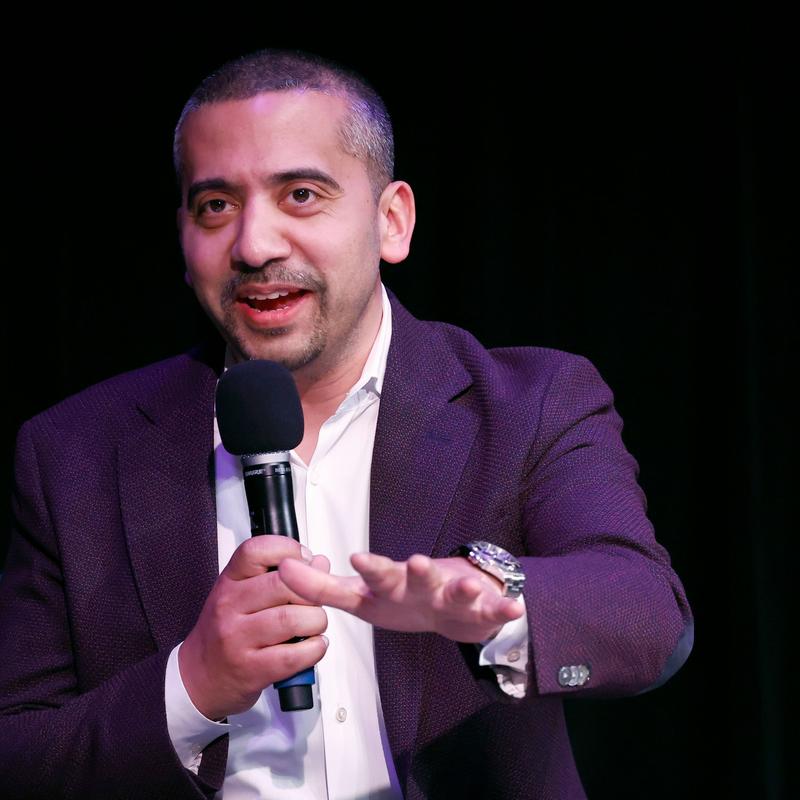
Mehdi Hasan: If Jubilee had come to me and said, "You'll be debating one guy who says he's a fascist and another guy who tells you to get out of the country," I'd have said, "I'll pass, thanks, I'm washing my hair."
Brooke Gladstone: Plus, you can't rise above what you can't face, so deal with it.
Bryan Stevenson: I'm not interested in talking about these things because I want to punish America. I want to liberate us. There's thriving democracy waiting for us, but we can't get there if we don't have the courage to be honest about the things that have held us back.
Michael Olinger: It's all coming up after this.
Brooke Gladstone: From WNYC in New York, this is On the Media. I'm Brooke Gladstone.
Michael Olinger: And I'm Michael Olinger. Towards the end of last year, several legacy media shops vowed to invest in good old healthy debate. C-SPAN launched a new show called Ceasefire.
Narrator: In a town where partisan fighting prevails, one table, two leaders, one goal: to find common ground. This fall--
Mehdi Hasan: Newly in charge at CBS, Bari Weiss also pledged to nurture dialogue.
Bari Weiss: I can make one promise to you, and it's this: you will not agree with everything you hear tonight or in any of these other broadcasts. That is exactly the point. Because the premise of a democracy is that we persuade each other with words and not violence, and that the only way to get to the truth is by talking to one another.
Michael Olinger: Weiss made those comments last year before she interviewed Erica Kirk, the widow of far-right personality Charlie Kirk, who was shot and killed while taking questions at a college campus event last year.
Erica Kirk: Thank you for having me. I was very grateful when you had reached out. Charlie always enjoyed being able to have dialogue on both sides.
Michael Olinger: Kirk built his following by filming heated debates with students, encouraging countless other content creators to do the same.
News clip: Tonight, we focus on a group of men inspired by the work and legacy of Charlie Kirk, now hitting the road, traveling to college campuses to have civil political debates with students.
News clip: The debaters would decide to take their tour stop to Tennessee State while wearing MAGA hats, and the students let them know they were not welcomed.
News clip: All we did was set up a table.
Michael Olinger: In a segment that first aired over the summer, I explored how political debates have become one of the major ways that people engage with the news. There was that nearly five-hour Israel-Palestine debate back in 2024 on Lex Fridman's podcast.
Mouin Rabbani: Was Palestine the only spot of land on Earth?
Benny Morris: Yes, basically that was the problem. The Jews couldn’t immigrate anywhere else.
Mouin Rabbani: What about the United States?
Michael Olinger: There's Piers Morgan's YouTube channel, Uncensored, which routinely devolves into shouting matches between pundits.
Alan Dershowitz: He just called me a pervert. He will be sued now for defamation, and we will be able to resolve this in a court of law. I guarantee you that he will be sued for calling me a pervert. The woman who falsely--
Mohammed Hijab: In my understanding, you are a pervert because you are--
Michael Olinger: Some of these debates are clearly designed for sensationalism and partisan polemics. Some are more educational. Some even try to crown a winner, like the Munk Debate, a semiannual Canadian event that recently hosted Ezra Klein and Kellyanne Conway.
Kellyanne Conway: The Golden Age of America is upon us. I see the small businesses that feel they can survive and thrive with less regulation, with lower taxes, with more energy independence.
Ezra Klein: No, I don't think we're in a golden age. I almost don't think it needs to be argued this heavily. Are we even in a decent age?
Michael Olinger: These spectacles, of course, are hardly new. For precedent, you could point to the televised Gore Vidal-William F. Buckley debates of 1968, which were ostensibly rarefied policy discussions that still went off the rails.
Buckley: Now listen, you queer. Stop calling me a crypto-Nazi, or I’ll sock you in the goddamn face.
Vidal: Let's stop calling names.
Michael Olinger: Or early panel shows like CNN's Crossfire, which in 1982 famously hosted the KKK's national leader.
Tom Braden: Wait a minute, Mr. Wizard. You believe in the final solution, which is Black repatriation to Africa?
Bill Wilkinson: I'm not going to be cut off.
Tom Braden: I'm not going to be shut off either. You're running around on a bedsheet. I don't have the bedsheet.
Michael Olinger: At least in terms of scale, pure metrics, nothing to date has transfixed viewers quite like Jubilee, a YouTube debate channel that The Atlantic compared to the Jerry Springer Show with Gen Z appeal.
News clip: You have no idea what you're talking about.
News clip: They don't all have to--
News clip: You think 300,000 minors are lost in America? Are you crazy?
News clip: I'm saying that--
[laughter]
Taylor Lorenz: Millions, tens of millions of people watch Jubilee. They've got billions of collective views at this point. Jubilee is a YouTube behemoth.
Micah Loewinger: Taylor Lorenz is a tech journalist who writes the User Mag newsletter. She's been following the meteoric rise of Jubilee. Whether you love it, hate it, or you've never heard about it before, Jubilee has become an undeniably important forum for changing hearts and minds. Its founder, Jason Y. Lee, came up with the idea for the company after the election of Donald Trump in 2016.
Taylor Lorenz: Jason was surprised by what happened with the election, and also just trying to make sense of what was happening with the country.
Jason Y. Lee: I saw huge polarization on both sides. It was very jarring for me.
Micah Loewinger: Jason, speaking with Taylor Lorenz on her podcast Power User.
Jason Y. Lee: I felt like there was just this huge white space in the center for young people, which was about empathy, about dialogue, about nuance, which, unfortunately, at that time, and unfortunately now, it felt like we weren't seeing. I had this crazy idea at the time, where like, "Could we create a media company that is not about featuring just the left side or just the right side, but featuring true human voices and finding some kind of middle ground there?" I decided to raise a small round of capital and launch Jubilee Media.
Micah Loewinger: He ended up raising $650,000, telling investors that he thought filming tough conversations could be hugely lucrative, and he was right.
Jason Y. Lee: One of our first big shows that we created was a show called Middle Ground. What it would do is it would bring together two "opposing sides," but rather than just squaring off for a Fox or CNN-style debate or kind of everyone yelling at each other, we said, "Is there a way for us to find middle grounds between conservatives and liberals, or between Christians and atheists, or even between flat-Earthers and round-Earthers?"
Flat-Earther: I'm what you call a Globe denier. This is a brilliant opportunity to speak. We've been suppressed, censored by mainstream media. Alternative media is just a thing of beauty for me.
Micah Loewinger: This is one of three flat-Earthers who debated three scientists in what's become the most popular episode of Middle Ground, with 31 million views.
Round-Earther: My point is that these experiments clearly show that the Earth is a globe, and you don't need to go outside the globe to see it's global.
Flat-Earther: It's a conclusion. It's a theoretical--
Round-Earther: You told me you want the evidence.
Ben Smith: The critique of you guys, which you've seen, is like, "Are you kidding me? You're putting a flat-Earther out there, as though this is a reasonable point of view?
Micah Loewinger: Semafor's Ben Smith interviewing Jason Lee on the Mixed Signals podcast.
Jason Y. Lee: I think that the flat-Earther one is the one that we had to discuss quite a bit about, like, "Hey, where are the bounds by which we wouldn't go?" One of the principles we talk about a lot at Jubilee is what is this idea of what we call radical empathy. For example, there was a woman who was really incredible. She lost her husband, and when her husband went on his deathbed, he became like a full-on flat-Earther.
News clip: My husband actually brought home this movie, talking about how the moon landing was fake.
Jason Y. Lee: Once he had passed, I think that she feels like this is part of her way to connect with him. Again, does that make me believe that the Earth is flat? Absolutely not, but do I understand or have some sort of empathy towards that experience? I'm like, "Yes, I do."
Taylor Lorenz: I think Jason is naive. I think that it is a monster that Jason does not realize he's created. I think he is deluding himself into thinking that it's a lot less harmful than it is.
Micah Loewinger: Taylor Lorenz.
Taylor Lorenz: I think it's more of like "YouTuber brain."
Micah Loewinger: What is "YouTuber brain"?
Taylor Lorenz: YouTube rewards rage bait. Mostly, the entire Internet rewards rage bait. That's what algorithms reward. If you can create these viral clips of people saying extremely shocking things, you will succeed. If you're making millions and millions of dollars, it's really hard to change course and say, "Actually, I want to make less money."
Micah Loewinger: Jason Lee did not respond to our request for an interview. If he had, I would have asked him about the channel's most successful format, the one that's generated quite a bit of controversy in recent weeks. A show called Surrounded.
Taylor Lorenz: Which is this round robin debate-style video where it's 1 person in the middle and then a group of 20 people that disagree with them around them.
Charlie Kirk: Hello, everyone. I am Charlie Kirk, founder of Turning Point USA, and I am surrounded by 20 woke college kids.
Ben Shapiro: I'm Ben Shapiro, and I'm co-founder of The Daily Wire and host of The Ben Shapiro Show. Today, I'm surrounded by 25 Kamala Harris supporters.
Taylor Lorenz: The Ben Shapiro episode was the fifth-most-viewed piece of political content on YouTube during the election.
Micah Loewinger: Democrats and nonpartisan experts have also starred in Surrounded videos, though they tend to get fewer views.
Pete Buttigieg: I'm Pete Buttigieg, and today, I'm surrounded by 25 undecided voters.
Dr. Mikhail Varshavski: I'm Dr. Mikhail Varshavski, better known as Doctor Mike across social media. I'm a board-certified family medicine physician who makes content online, improving health literacy. Today, I'm surrounded by 20 vaccine skeptics.
Micah Loewinger: That Doctor Mike video, which has 10 million views, is interesting for a few reasons. The way the format works is that the high-profile person in the middle, in this case, Doctor Mike, starts each round of the debate by stating a prompt.
Dr. Mikhail Varshavski: My next claim is that RFK Jr. is a public health threat.
Micah Loewinger: Then, on the count of 3, the 20 anti-vaxxers can race to a seat in the middle to challenge him, leading to this exchange.
Anti-vaxxer: How is it that he's a villain? How are we a villain if some of these vaccine creators and scientists are the ones saying we should not get them?
Dr. Mikhail Varshavski: Is there anything I could say today that would change your mind-- [crosstalk]?
Anti-vaxxer: I'm just asking your opinion.
Dr. Mikhail Varshavski: And I'm asking you a question.
Anti-vaxxer: Probably not because I actually read and study.
Dr. Mikhail Varshavski: I would like to give you my knowledge, my experience, and what I've seen in the hospital system, but if you're telling me right now, no matter what I say, you're not going to change your mind, is there any value to that?
Micah Loewinger: That clip pretty much sums up the entire one and a half-hour video. Every time Doctor Mike attempts to debunk medical misinformation, his opponents cut him off or ignore him, talking about how they'd done their own research and didn't trust mainstream science. One comment under the video that received 143,000 likes reads, "This didn't feel like a debate; it feels like 20 people venting as if it's therapy." After the video came out, Doctor Mike revealed that it was his idea. He pitched this video to Jubilee.
Dr. Mikhail Varshavski: I was watching Jubilee and saw a 20-versus-1 episode, and I said, "Wow, wouldn't it be a good idea if it was a doctor versus anti-vaxxers?"
John Oliver: The only accurate way to report that one out of four Americans are skeptical of global warming is to say a poll finds that one out of four Americans are wrong about something.
Micah Loewinger: John Oliver, speaking on his HBO show in 2014.
John Oliver: A survey of thousands of scientific papers that took a position on climate change found that 97% endorsed the position that humans are causing global warming. I think I know why people still think this issue is open to debate, because on TV it is.
Micah Loewinger: He then brings out two people for a mock debate: Bill Nye, who believes climate change is real, and a denier who doesn't. The problem here, Oliver says, is that a split-screen TV debate implies that these two positions are equal.
John Oliver: Wait, wait, wait, wait, wait. Before we begin, in the interest of mathematical balance, I'm going to bring out two people who agree with you: a climate skeptic and Bill Nye. I'm also going to bring out 96 other scientists. [laughter] It's a little unwieldy, but this is the only way you can actually have a representative discussion.
Micah Loewinger: A mathematically balanced debate about COVID-19 vaccines would look the same way because an estimated 97% of medical scientists say those vaccines are safe, and yet Jubilee flipped it. 20 so-called skeptics were pitted against 1 expert because that's more provocative. There are other ways the channel's producers stack the deck for drama. Take the February episode of Surrounded, titled 1 Conservative vs 25 LGBTQ+ Activists.
Stassia Underwood: I saw that they were casting for a Jubilee video, so I sent in my application, and that's pretty much how it started.
Micah Loewinger: Stassia Underwood is a 26-year-old activist who's received a lot of attention online since appearing in that Jubilee video.
Stassia Underwood: My intention was to hopefully meet some more trans women. I knew that it was a huge opportunity. I knew that it could bring me a lot of exposure, negatively and positively.
Micah Loewinger: Did the producers tell you anything about who you'd be speaking with? Just that they'd be conservative.
Stassia Underwood: I had no clue. I definitely wasn't expecting it to be somebody that was so hateful.
Michael Knowles: My next claim is that transgenderism should be eradicated from public life entirely.
Micah Loewinger: The conservative in the middle turned out to be Daily Wire host Michael Knowles. Stassia sprinted for the chair in the middle.
Michael Knowles: Hello.
Stassia Underwood: Hello.
Micah Loewinger: Which she says was scripted to make it look like she was competing with other people.
Stassia Underwood: My first thought was that it was absurd because transgenderism isn't real. We are transgender people. How are you going to get people to stop being trans?
Michael Knowles: I think we're going to tell boys that they're not girls, that they're boys.
Stassia Underwood: We're going to tell boys that they're not girls, and they're going to listen.
Michael Knowles: Yes, basically, yes.
Micah Loewinger: Really?
Michael Knowles: Yes. That's what we've done for most of history.
Stassia Underwood: Pardon. That's amazing because that happened to me, and I can promise you to God that I didn't listen.
Michael Knowles: Yes, well, because we live at a time that is affirming the transgender delusion.
Micah Loewinger: What was the kind of digital afterlife of the video? How did it affect you specifically?
Stassia Underwood: I knew that it was going to be viral. I didn't know that I was going to go viral. My video is, right now, currently still sitting at like 14 million views on the TikTok page on Jubilee's. My clip was the most viewed of the whole segment. I got so many hate comments, but I was expecting that. That wasn't really what took me by surprise. It was The Daily Wire posting me, making sure that it ended up on certain sides of the Internet, but also, I definitely received more of a following on my social media. I have been invited to do multiple other shows. I was on Piers Morgan Uncensored. There has been some huge things that have come out of this.
Micah Loewinger: Do you feel like all of the hate that you got, was it worth it?
Stassia Underwood: Yes. I think yes, and I think no. I think I could have gone without the death threats.
Micah Loewinger: Would you still have participated in the debate if you'd known about the prompts and the identity of Michael Knowles ahead of time?
Stassia Underwood: I would not have participated. Not with Michael, but I chose to go on Jubilee. I could have walked out. That's something that we all have discussed with each other recently is like, "We probably should have walked out at a certain point when he was saying things like the eradication of trans ideology," but we all sat there, and we all participated. I think it's all dependent on what you're willing to put up with and what you're not.
Brooke Gladstone: Coming up, Micah speaks to a Jubilee participant who feels he was hoodwinked by the organizers.
Michael Olinger: This is On the Media. [MUSIC]
Brooke Gladstone: This is On the Media. I'm Brooke Gladstone.
Michael Olinger: And I'm Michael Olinger. When I reported the piece about the YouTube debate channel called Jubilee last summer, I spoke with another guest on Surrounded who feels he was misled by Jubilee and is now reflecting on whether participating was worth it.
Mehdi Hasan: I'm Mehdi Hasan. I'm a journalist and the editor of Zeteo. Today I'm surrounded by 20 far-right conservatives.
Michael Olinger: Mehdi is a natural fit for this kind of thing. Back when he had an MSNBC show, he was known for his tough interviews. He also literally wrote a book about debate called Win Every Argument. I began by asking him which of the previous Jubilee videos made him want to jump in the ring.
Mehdi Hasan: I watched a lot of the right-wing ones. Most of the Jubilee videos are right-wingers versus woke kids or liberal students, or Harris's supporters. There's only been a couple of "progressives" who have done it. Sam Seder, a good friend of mine at The Majority Report, did it. Sam is the one who told me it's worth doing it, worth going into this lion's den. It's a new audience. It's a younger audience. They need to hear our arguments.
Micah Loewinger: Who approached who? How was it presented? What was the conversation like before you showed up at the studio?
Mehdi Hasan: Jubilee approached me. They pitched it as 25 Trump supporters, MAGA supporters. The name changed over time. It ended up being 25 far-right conservatives. To be fair to them, that should have been a tell to me. Which people self-identify as far-right?
Connor Estelle: I'm for defending the traditional demographics of this country, which is majority white.
Micah Loewinger: This is Connor Estelle, who began his debate with Mehdi Hasan, saying he didn't care if Donald Trump defied the Constitution.
Mehdi Hasan: How would Connor's America look? What would it look like?
Connor Estelle: Well, quite frankly, I think we would deport people who shouldn't be here, whether--
Mehdi Hasan: I didn't ask about deporting. What does the government look like?
Connor Estelle: I would say, quite frankly, it's under a benevolent leader such as Franco.
Mehdi Hasan: Where does he come from?
Connor Estelle: It could be a kind of aristocratic class, could be someone who--
Mehdi Hasan: Who picks the autocrat?
Connor Estelle: Frankly, the people. We could hold a vote on it.
Mehdi Hasan: Isn't that democracy?
Connor Estelle: Well, sure, you can have a vote to get to that scene.
Mehdi Hasan: Then no more votes afterwards?
Connor Estelle: Absolutely. 100%.
Mehdi Hasan: Wow, wow. If that autocrat kills you and your family, you're fine with that?
Connor Estelle: Well, I'm not going to be a part of the group that he kills because that's the whole thing.
Mehdi Hasan: How do you know? He starts going on about General Franco, and I'm thinking, "Wow, this is kind of insane stuff. General Franco, who murdered many innocent people, thousands of people, in the White Terror." He starts quoting Carl Schmitt. You're quoting a Nazi theoretician. Then I'm thinking, "Whoa, where are we going again?"
Connor Estelle: I frankly don't care being called the Nazi at all.
Mehdi Hasan: I didn't say that. I didn't actually say that. I said, "Are you a fan of the Nazis?"
Connor Estelle: Well, they persecuted the church a little bit. I'm not a fan of that.
Mehdi Hasan: What about the persecution of the Jews?
Connor Estelle: Well, I certainly don't support anyone's human dignity being assaulted. I'm a Catholic.
Mehdi Hasan: You don't condemn Nazi persecution of the Jews?
Connor Estelle: I think that there was a little bit of persecution [crosstalk], which is bad.
Mehdi Hasan: We may have to rename this show because you're a little bit more than a far-right Republican.
Connor Estelle: Hey, what can I say?
Mehdi Hasan: I think you say, "I'm a fascist."
Connor Estelle: Yes, I am.
[laughter]
Mehdi Hasan: Then I kind of realized that, "What am I doing here? I don't debate fascists." I've had a very strong, consistent, anti-fascist platform since the day I became a public figure, a broadcaster. It's easy clickbait, but I try and avoid climate deniers and election deniers, simply because I think journalists should have some attachment to reality. I'll be honest with you.
If Jubilee had come to me and they didn't, but if they'd come to me and said, "You'll be debating one guy who says he's a fascist and another guy who tells you to get out of the country," I'd have said, "I'll pass, thanks. I'm washing my hair."
Micah Loewinger: There was one YouTube commenter who put it this way, "It's never been easier to understand the rise of Nazism in 1930s Germany." That comment got 162,000 upvotes under your video. What do you make of this idea that there's some kind of educational or even journalistic value in platforming this stuff?
Mehdi Hasan: I get it, and it's appealing to some people, but there has to be a red line. What are we going to do now? Is Jubilee going to have 1 Jewish person versus 20 Holocaust deniers? Where do we draw the line?
Micah Loewinger: [laughs] I think that literally, a Jubilee producer told a writer at The Atlantic that they had considered that topic.
Mehdi Hasan: Oh, wow. I didn't know that. I was just being sarcastic. I guess this is where we are.
Micah Loewinger: Are you happy with how the video turned out?
Mehdi Hasan: That's a tricky question.
Micah Loewinger: Are you having you did it?
Mehdi Hasan: I don't know the answer to that latter question. I'm reserving judgment on that. I'm going to wait and see. I'm not going to be fake-modest. Clearly, millions of people watched that. Millions More people now follow me in Zeteo. In terms of grabbing attention, that worked. That was one of the reasons I did it. I'm not going to lie to you. Of course, the idea of appealing to a younger audience who probably have never heard of Zeteo or me was appealing. Clearly, that worked. People now have heard of me who have not heard of me. In that sense, it worked. Now people can say that's cynical, that's self-serving, whatever.
Micah Loewinger: After the video came out, Connor, the self-described fascist, did his own little podcast tour.
Host: You are in some serious trouble in your personal life over this, am I right?
Connor Estelle: That is correct.
Host: What happened?
Connor Estelle: Well, unfortunately, I lost my job as a result. No one really is to blame for that. It's just the manner in which you're canceled for voicing any heterosexual Christian moral belief.
Micah Loewinger: He ran with the cancel culture story and raised nearly $40,000 on a crowdfunding site. A huge boon for a guy who, to that point, like some of the other Jubilee participants, had been struggling to break through as an aspiring right-wing influencer. What do you make of the argument that any good that came of your appearance, the millions of teenagers who didn't know who you were but now do, what do you make of the argument that that is all negated by the exposure that these aspiring right-wing influencers got, these people who need to be canceled in order to get famous in their circles? Is the juice worth the squeeze here?
Mehdi Hasan: No, it's a very good question. I don't know the answer to that question. I think it's a very fair criticism, and that's why I reserve judgment on the whole thing to see what the longer-term fallout is than just a week of 10 million views, but more like, "What is the longer-term fallout for some of these influencers?" It's a two-point process. One is, should Jubilee exist? Because it already does, regardless of Mehdi Hasan. If it does exist, should someone like me, who knows how to debate, go on and debate these freaks?
Micah Loewinger: In addition to the views on the actual Jubilee YouTube video, these debates have this long afterlife as video clips. I've often seen each side of the debate more or less declare victory with their own communities. Is there something about just the way that social media is wired, what the algorithms reward, that undermines the very idea that a side can win with a persuasive argument?
Mehdi Hasan: That's a great question. It's something I've struggled with a lot, which is, you can win a debate, as I have, and then see the other side clip something completely out of context to make it look like that was the moment. People don't watch the whole hour and a half. They watch 2 minutes in their feed or 30 seconds in their feed. It is a problem, no doubt about it.
I'm not sure what the solution is. I don't think we should stop debating issues because people could spin it the way they want. One of the reasons I did Jubilee again, and time will tell, is I would argue that most people, most normal people who watch something like that will come away going, "Wow, A, those guys are crazy and extreme. B, Mehdi clearly won that debate. C, we need to worry about our country."
Micah Loewinger: In your book, you respond to this idea of we're living in a post-truth culture, which is a kind of resounding conclusion that many people came to after the 2016 election, but you cite some data to back up the idea that people's minds can still change. After this latest election, after the dark turns we've seen in our politics since you wrote that book, do you still believe the facts can change minds?
Mehdi Hasan: Yes, but not for a lot of Americans. The debate is not whether it could change minds; the debate is, how many minds can it change? I think that audience is a shrinking audience. I have to be honest with you. I think that audience grows smaller by the day, but look, I do believe people's minds can change. Just look at the polling. Trump has just won an election.
That's deeply depressing for someone like me. Having said that, he's also the most unpopular president at this point in his presidency in living memory. Why is that? Because people's minds have changed since the election. People have either seen him do bad stuff, or have felt him do bad stuff, or have accepted the argument from those of us in the media or Democrats that he is doing bad stuff.
His numbers have plummeted on the economy, on immigration, on multiple issues. I do think that's an interesting test. What happens in the midterms and the next presidential election? If we have free and fair elections again in this country, it'll be interesting to see how many minds have been changed. It's a dwindling number, for sure, but it's still a number that's worth reaching out for and persuading.
Micah Loewinger: Mehdi, thank you very much.
Mehdi Hasan: Thank you.
Micah Loewinger: Mehdi Hasan is editor-in-chief and CEO of Zeteo.
Brooke Gladstone: Coming up, yes, there is hope for restoring and preserving the whole American story.
Michael Olinger: This is On the Media.
[MUSIC]
This is On the Media. I'm Michael Olinger.
Brooke Gladstone: And I'm Brooke Gladstone.
[MUSIC]
Last spring, President Trump ambushed the world's largest museum complex with an executive order labeled Restoring Truth and Sanity to American History.
News clip: Part of the executive order reads, quote, "Over the past decade, Americans have witnessed a concerted and widespread effort to rewrite our nation's history, replacing objective facts with a distorted narrative driven by ideology rather than truth."
News clip: President Trump fires a broadside at one of America's leading cultural institutions, the Smithsonian, saying wants to deny funding for what he calls improper ideology.
Brooke Gladstone: The order singled out an exhibit about race and sculpture at the Smithsonian American Art Museum for observing that societies, including ours, "have used race to establish and maintain systems of power, privilege, and disenfranchisement." This summer, Trump posted on Truth Social that, "The museums throughout Washington, but all over the country, are essentially the last remaining segment of woke. The Smithsonian is out of control." That was all caps. While some of the attempts by the White House to eradicate DEI at federal agencies and institutions have faded from the headlines in the last few months, the president has not left the battlefield because he really hates slavery. Talking about it, that is.
Donald Trump: We want the museums to talk about the history of our country in a fair manner, not in a woke manner or in a racist manner.
News clip: Donald Trump said that one of the reasons for his crackdown on Smithsonian museums is, "everything discussed is how bad slavery was."
News clip: Apparently, desperate to forget what happened.
News clip: President Donald Trump has ordered the removal of information on slavery from national parks. That includes removing this historic photograph called The Scourged Back. It shows the scars on the back of a formerly enslaved man named Peter. Abolitionists released the photo in 1863.
News clip: The National Park Service is switching up its free admission days. Here, the agency says, "You will no longer get in free on MLK Day and Juneteenth." The new list for the 2026 year does add a notable new free date. It's June 14th. It is Flag Day and President Trump's birthday.
News clip: National parks across the US must clear their gift shops of any items promoting diversity, equity, and inclusion. That is the order from the Trump administration as it expands its crackdown on DEI.
Brooke Gladstone: Not sure what counts as DEI swag, but anyway, this is all part of the White House effort to root out what it calls improper ideology. What do these assaults on museums, memorials, and parks imply for our collective understanding of history, especially the darkest parts?
Bryan Stevenson: There's no ideology in documenting the history of slavery or lynching or segregation.
Brooke Gladstone: Bryan Stevenson is a public interest lawyer and founder of the Equal Justice Initiative, a human rights organization based in Montgomery, Alabama. Later, he led the creation of the Legacy Museum and the National Memorial for Peace and Justice, and the Freedom Monument Sculpture Park, all of which commemorate our nation's history of slavery and racism. It seems the president is hell-bent on running away from a disgraceful past.
Bryan Stevenson: I don't think it's just the president. We've never fully addressed the legacy of slavery. Never.
Brooke Gladstone: This interview, my favorite of 2025, first aired in April.
Bryan Stevenson: The African American History Museum and Culture in Washington that was the target of some of these orders didn't exist until 2015. We're in the early days of trying to create an honest record about the history of so many parts of our society. We opened our national memorial in 2018. It was the first time there was a comprehensive memorial in this country about the history of racial violence and lynching. For many Americans who grew up with no conversation, nothing in the cultural landscape, this is new.
It's just we're now getting to a full account of this history. It's not ideological. It's not intended to be disruptive in the way that many are reacting to it. I'm not interested in talking about these things because I want to punish America. I want to liberate us. I actually think there's something that feels more like the kind of thriving democracy that we seek waiting for us, but we can't get there if we don't have the courage to be honest about the things that have held us back.
Brooke Gladstone: Trump's order claims that the Smithsonian's "rewrite" of history, he calls it, deepens societal divides and fosters a sense of national shame. Conservatives often use national shame as a kind of a cudgel. What about the children? If they learn about our racist past, they'll hate themselves, or maybe they just don't believe that slavery actually left that legacy you referred to, the inability to amass generational wealth because of housing redlining, or bars to higher education. Trump's first big lawsuit in the '70s, a loser of a case he was forced to settle, involved keeping Black renters out of his father's apartment blocks.
Bryan Stevenson: We have a 9/11 memorial in this country. We built it almost immediately after the tragedy of that day.
Brooke Gladstone: We were the victim then, we weren't the perpetrators.
Bryan Stevenson: Hear me out. What I'm trying to say is that we saw value in acknowledging the suffering that people experience in this country on the day of that tragedy. Now, we're not good in this country of memorializing the things that we have done wrong, but it doesn't mean that we don't believe that memorialization is important. I think that's an important distinction to make. Because if we believe it's important for ourselves, then we have to believe that it's important for us to do when we're on the other side of a mistake. We haven't applied it historically because we haven't had to.
Brooke Gladstone: I think that Trump and the Heritage Foundation that created Project 2025, they all believe very strongly in the power of monuments and in the power of history, which is why they're working so hard to extirpate those memorials to parts of history that they would prefer we don't remember. I know from having spoken to you before that when you were developing your own museums, which powerfully present our history of slavery and racism and the continuing impact, you drew inspiration from how the memory of the horrors of the Holocaust was preserved, not just in curricula, but on the streets of Berlin. Nowadays, however, plenty of people in an increasingly right-leaning Germany have started to grouse. They don't like it at all.
Bryan Stevenson: Well, I don't think we should think that memorialization will save us from all of the challenges that are created when you're in an era governed by the politics of fear and anger. When people allow themselves to be governed by fear and anger, they start to tolerate things they wouldn't otherwise tolerate. They start to accept things they wouldn't otherwise accept. How far you will go, how much pain and suffering you will create, is dependent on how much you still know and understand.
If you know and understand that there was a Holocaust in Germany, then maybe there will be some constraints on what happens in that country that honestly we don't have in this country, because we haven't done that same kind of reckoning. It's not a guarantee, but there's a consciousness about the harm of that history, that even those people are careful, many of them, to not be completely identified by that era. That's what I'm saying we haven't done yet.
Brooke Gladstone: According to Nate Freeman, writing in Vanity Fair, the Smithsonian Institution is firewalled from changing administrations because Congress appoints the Smithsonian's governing regents, who can serve years, sometimes decades. It's got some insulation. Legally, it might be harder for Trump to have his way, at least with the Smithsonian, than again Congress. How successful is he likely to be?
Bryan Stevenson: There will be tremendous resistance on institutionalizing narratives that are false or that are incomplete. We've seen that already. Immediately, when this order went out about what DEI is and the hysteria around DEI, a base in Texas said, "Oh, we can't talk about the Tuskegee Airmen because they were Black air pilots who did extraordinary things in the first half of the 20th century. We can't show a film about the first women who were pilots because they thought that was advancing DEI."
Brooke Gladstone: Anything that doesn't involve white men.
Bryan Stevenson: Yes, but people quickly reacted to that. There was an effort to take Jackie Robinson's history off of a website, and that's what I mean. People want the symbols of achievement and freedom, but they don't want the story that makes these achievements so meaningful, and that's not sustainable. I think there will be tremendous resistance to portraying a history that is false. That doesn't mean that it won't happen.
Which then means that we have got to create institutions in this country that allow that truth-telling to take place. You will never silence those of us who feel called-- I'm going to use that word-- to talk about the legacy of slavery. I do believe we owe to the 10 million people who were enslaved in this country the truth of their story. My parents had to deal with the constant humiliation and degradation of Jim Crow segregation. I am a survivor of an era where being Black meant that you were disfavored, the last to be picked, presumed dangerous and guilty.
The truth of all of that history is in me. I think without memory and memorialization, we get to pretend in this country that the crime of that bigotry did not exist. That's why I believe the real story here is, will the administration, through these orders, stop the truth-telling of a generation of people, Black, white, young, and old, who are now committed to reckoning with this history? I think the answer to that question is, no, they will not.
Brooke Gladstone: You told me years ago when I visited your then-new museum that you saw as a child the integration of the schools, and you thought, "Wow, the way to justice is through the courts." You won multiple landmark cases at the Supreme Court to, say, expand the rights of condemned prisoners. You worked tirelessly to fund the Equal Justice Initiative, and you created all of these landmarks and memorials. What do Trump's actions mean in connection with the work that you have been doing all these years to reinforce our collective memory of the worst horrors our country has ever committed? Has it made you rethink your approach in any way?
Bryan Stevenson: No, not at all. If anything, it's reinforced it. I still believe in the rule of law and began my career focusing on using the courts to expand rights for the most disfavored people in our society. We would not have been able to shield the intellectually disabled from execution if we didn't have a court committed to human rights. I realized 15 years ago that we were going to have to get outside the courts and begin this narrative work to move forward, that we were going to have to commit to truth-telling because the environment outside the court was causing retreat inside the court, and we see that today.
People used to say, "Why are you spending time on a museum and a memorial, on a sculpture park, when there's so much need for legal work?" I said, "It's because we have to create this outside environment." I've learned from history the civil rights movement didn't succeed just through activism on the streets. There were lawyers in the courts winning these decisions that created the new opportunities. Those lawyers didn't win by themselves.
There were people engaged in storytelling and narrative work that helped to create that moment. We're in a moment like that today. I do not believe that we should be hopeless about our capacity to move forward. In fact, I'm almost at one level provoked by that, because I think that hopelessness is the enemy of justice. I never used to talk about my enslaved great-grandparents, never, never acknowledged that my people came from Caroline County, Virginia.
Brooke Gladstone: You didn't? When did you?
Bryan Stevenson: I started probably about 10 or 15 years ago. It's only when I'd gotten in my 40s that I began to appreciate that lineage. Nobody in my family had gone to college. There were people near me that had outhouses and no functioning septic systems. I always thought of that as something that held me back, or that was shameful in some ways. As I got older, I began to appreciate all that they had given me. My great-grandfather learned to read, even though it was against the law in Virginia in the 1850s for an enslaved person to learn to read.
He risked his life to learn to read because he had a hope of freedom, and he wanted to be ready for freedom. In the 1850s, he didn't know that a Civil War was coming a decade later. He used that hope to develop that skill. After emancipation, my grandmother said he would read to formerly enslaved people who didn't know how to read. Once a week, he'd read the whole newspaper to them so they would know what was going on. My grandmother, even though she worked as a domestic her whole life, she was a reader, and she insisted that her children be readers and her grandchildren be readers.
My grandmother would greet me sometimes when I went to her house with a stack of books. I'd have to read something before she let me into the house. My mom went into debt when we were children to buy us the World Book Encyclopedia because she knew we didn't see hope outside the door, where there was so much poverty and despair, but we could read about it in those books. I owe the enslaved who learned to love in the midst of agony. I owe the terrorized and the trauma. I owe the segregated and the disfavored for the justice that we are still seeking, more than to give in to an executive order. I'm disheartened by some of what I see, but I am in no ways dissuaded.
Brooke Gladstone: You gave a speech at Monticello earlier this month for Thomas Jefferson's 282nd birthday, in which you said, "It's easy to lose hope right now, but hopelessness is the enemy of justice." In my lifetime, we've never been in such a period of retrenchment. There's always two steps forward, one step back, but this is just a great leap backwards. What are you hopeful for, specifically? Where do you draw that hope from?
Bryan Stevenson: Well, I don't know that I agree that we've never seen this before. Listen, in the 1960s, after we passed the Civil Rights Act of 1964 and the Voting Rights Act of 1965, there was nothing but resistance.
Brooke Gladstone: Yes. The world didn't change on a dime, but there were great leaps forward legally before they became entrenched societally. Now we're seeing those things being uprooted. Argue with me. Tell me I'm wrong.
Bryan Stevenson: Well, I think you are. [laughter] At the end of the Civil War, 4 million Black people were emancipated. There was a moment where we believed we were going to have this new, beautiful America. Those four million enslaved people chose reconciliation. They chose citizenship to build a better America. For a short period of time, they voted. They built churches and schools. It was a glorious period. Then it all collapsed. The US Supreme Court preferred states' rights over the constitutional rights guaranteed by the 14th Amendment of equal protection or the 15th Amendment.
They were disenfranchised for a century. When you think about the glory and the hope of emancipation and the collapse of all of that, and then this era of terror, violence, speaking through the country that would force millions of Black people to leave lands that they owned, it was a period of greater retrenchment than what we are seeing now. Then, after decades of struggling to stop that lynching violence, Black soldiers went to France during World War I. They went to Europe during World War II. They fought courageously.
They came back in their uniforms, and they were targeted for lynching violence because they represented a threat to this racial order. Then, after passing these civil rights laws in the 1960s, we saw the formation of a new system of control characterized by mass incarceration. We became the nation with the highest rate of incarceration in the world. It didn't happen until 2000, 35 years after the civil rights laws were passed, that one in three Black male babies born in this country became expected to go to jail or prison. I don't think it's true that we haven't had to deal with retrenchment and reaction to forward progress.
Brooke Gladstone: I stand corrected.
Bryan Stevenson: Well, the reason why I am hopeful is because what we're now seeing is the formation of a new narrative struggle. When you're enslaved, you have to focus on freedom. When you're being terrorized and lynched, you have to focus on security. When you're disenfranchised and you don't have any opportunities for education and other businesses, you have to focus on civil rights. Now we're at a moment where we are in the beginnings of a narrative struggle.
The reason why I'm hopeful is that earlier, even in my career, we didn't have thousands of committed journalists and professionals and storytellers and filmmakers and writers who could participate in this narrative struggle. We have never been better situated to win the next phase of this struggle toward a just America than we are right now. While I'm worried, I just can't accept that this is unprecedented. In fact, without some of the optics of 2020, these narratives wouldn't be resonating.
It took seeing Black people and white people out on the streets protesting against police violence, seeing people coming together, corporations committing millions of dollars to support racial justice and equity, saying, "Black Lives Matter." It took that to trigger the kind of counter-narrative that we're seeing now. Without that step forward, we wouldn't see this backstep now.
Brooke Gladstone: Amidst all of these attacks on the federal agencies that protect our health, that protect human rights, that uphold constitutional protections, and much more, you refuse to despair.
Bryan Stevenson: Those institutions are being assaulted, they are being challenged, they are being attacked. I don't think this battle is over. I really don't. I think there will be another day. What I hope is that there are people involved in those institutions who are even now trying to think about what they will do to restore, to recover, to re-engage, to reconnect with the communities and people across the globe who have been so dependent on those services. I hope that if the government-funded institutions no longer become places where you can get an honest history, that people will support the private institutions that will take that up. I boldly claim that we didn't take a penny of state or federal funding in creating our sites.
Brooke Gladstone: It's remarkable, given how gorgeous it is.
Bryan Stevenson: Thank you. The truth is we were never offered a penny of state or federal funding. We've had over 2 million people come to our sites, many of them skeptically.
Brooke Gladstone: How do you know?
Bryan Stevenson: Well, because they tell us. They'll say, "I didn't want to come, but now I'm totally aware of things I didn't understand." We see extraordinary things come out of that. Beautiful things. We have a collection of 800 jars of soil in our museum. We collect these soils from lynching sites. People who are involved in erecting markers collect the soil, put it in a jar that has the name of the victim, the date of the victim, and then they bring it back to the museum.
An older Black woman was digging soil at a site in west Alabama. She was afraid because it was on a dirt road in the middle of nowhere. As she was about to dig, a big white man in a pickup truck drove by and stared at her and made her anxious. Then he drove by again and stared some more. Then he parked his truck, got out, and walked toward her. She was terrified. Then the man asked, "What are you doing?" She was going to tell him that she was just getting dirt for her garden.
Then she said, "Mr. Stevenson, something got ahold of me. I told that man I'm digging soil here because this is where a Black man was lynched in 1937." She just looked down and started digging. The man surprised her by asking, "Does that memo you have talk about the lynching?" She said, "It does." Then he asked, "Can I read it?" He started reading while she started digging. After he finished reading the memo, he said, "Would it be all right if I helped you?" She said, "Yes."
The man got down on his knees, and she offered him the implement to dig the soil. He said, "No, no, no, no, no, you keep that. I'll just use my hands." She said he started picking up, putting it in the jar, and throwing his hands into the soil. She said there was something about the conviction with which he was putting his whole body into this that moved her. She went from fear to relief to joy so quickly, she couldn't help it. Tears were running down her face. The man turned to her, and he said, "Oh, ma'am, I'm so sorry. I'm upsetting you."
She said, "No, no, no. You're blessing me." They kept digging, and they were getting near to filling the jar. She looked over at the man, and she noticed that he had slowed down. His face had turned red. Then she saw that there was a tear running down his face. She reached over and put her hand on his shoulder. She said, "Are you all right?" That's when the man turned to her, and he said, "No, ma'am." He said, "I'm just so worried that it might have been my grandfather who helped lynch this man."
She said they both sat on that roadside and wept. She said, "I'm going to go back and put this jar of soil in the museum in Montgomery." Then the man said, "Ma'am, would it be all right if I just followed you back?" She said, "Sure." She called me on the way back. She said, "Mr. Stevenson, I want you to come to the museum and meet my new friend." I was there when these two people, who met on a roadside in a place of pain and agony and violence and bigotry, came in and together did something beautiful by putting that jar of soil in that exhibit. I'm not naive.
I don't believe that beautiful things like that always happen when we tell the truth, but I do believe that we deny ourselves the beauty of justice when we refuse to tell the truth. I've seen too much beauty come out of truth-telling, too much restoration, too much redemption to believe that truth-telling doesn't have a kind of power that is greater than the fear and anger that is prompting these orders, prompting some of this retreat. I worry about people who are already surrendering and waving white flags, and running for cover. I just don't think that's the way we're going to get to the other side.
Brooke Gladstone: Bryan, thank you so much.
Bryan Stevenson: My pleasure.
Brooke Gladstone: Bryan Stevenson is a public interest lawyer and the founder and executive director of the Equal Justice Initiative, a human rights organization in Montgomery, Alabama.
[MUSIC]
Micah Loewinger: That's it for this week's show. On the Media is produced by Molly Rosen, Rebecca Clark-Callender, and Candice Wang. Travis Mannon is our video producer.
Brooke Gladstone: Our technical director is Jennifer Munson, with engineering from Jared Paul. Eloise Blondio is our senior producer, and our executive producer is Katya Rogers. On the Media is produced by WNYC. I'm Brooke Gladstone.
Micah Loewinger: I'm Micah Loewinger.
Copyright © 2026 New York Public Radio. All rights reserved. Visit our website terms of use at www.wnyc.org for further information.
New York Public Radio transcripts are created on a rush deadline, often by contractors. This text may not be in its final form and may be updated or revised in the future. Accuracy and availability may vary. The authoritative record of New York Public Radio’s programming is the audio record.