
How a Prison Fire Helped Create CBS News
Micah Loewinger: Hey, it's Micah. Before we get into Brooke's interview for the midweek podcast, I want to tell you about a brand new original series that the team and I have been working on for months. It drops on Friday. Here's the trailer. Storms, floods and fires are ever more extreme, and yet the Federal Emergency Management Agency is fighting for its life.
President Trump: I've never been a big fan of FEMA. FEMA's very expensive and it really doesn't get the job done.
Micah Loewinger: How did the agency tasked with saving America become so despised?
Clip: FEMA's a disaster.
Clip: FEMA's a dirty word.
Clip: So distrusted.
Clip: People are waking up in droves to the FEMA camps.
Micah Loewinger: And defunded.
Clip: We could see the next Katrina-level disaster based on the stripping away of FEMA that we have seen.
Micah Loewinger: Can the agency survive the stories that have been told about it? Can we survive without FEMA?
Clip: Whenever there's a disaster, the first thing people say is, where's FEMA?
Micah Loewinger: American Emergency: the Movement to Kill FEMA is a brand new On the Media series reported by me, Micah Loewinger. First episode drops May 1st. See you then.
[music]
Brooke Gladstone: This is On the Media's midweek podcast. I'm Brooke Gladstone. In late March, CBS News Editor in chief Bari Weiss and President Tom Cibrowski sent out a memo that said they were shutting down CBS News Radio.
Tony Dokoupil: CBS News Radio provides material for an estimated 700 stations across this country, but no more. The service is scheduled now to come to an end on May 22nd. CBS News says the change is coming as the world moves on to digital sources and podcasts. It first went on the air September of 1927.
Brooke Gladstone: In the memo announcing the closure, Weiss and Cibrowski wrote that, "CBS News Radio served as the foundation for everything we have built since 1927." Historian A. Brad Schwartz, author of the book Broadcast Hysteria and a forthcoming biography of the legendary CBS broadcaster Edward R. Murrow, says that's not exactly accurate. He wrote a recent piece for the Columbia Journalism Review about a largely forgotten on-the-spot radio broadcast in 1930 that changed the trajectory of CBS and yet is largely lost to history. Brad, welcome to the show.
- Brad Schwartz: It's great to be here. Thank you for having me.
Brooke Gladstone: What's the real story?
- Brad Schwartz: For one thing, the company that we now know as CBS, the Columbia Broadcasting System, didn't begin as a news medium. It didn't have anything like a news division or a news organization when it started broadcasting in 1927. It goes on the air about a year after the National Broadcasting Company, NBC, which is the first major network. It's the dominant force in American broadcasting, certainly, for the first decade or two.
Brooke Gladstone: Had far outrun baby CBS, its arch rival. It's the unreachable star.
- Brad Schwartz: Absolutely, because it has the backing of the Radio Corporation of America. It has the blessing of the US Government. It is intended to be essentially the American version of the BBC, structured differently, but starts in a very similar way. Whereas CBS is this upstart company. It's formed by a stock promoter and a talent agent, concert manager, who are really trying to compete with NBC in terms of talent, in terms of entertainment. You see, that's what they're promoting from 1927 and struggling to. The early reviews of the first performances don't make you want to tune in again.
Brooke Gladstone: You quote one reviewer in your piece as saying that, "Its three hour premiere declined in quality with astounding speed and that no one not paid to listen could have survived it."
- Brad Schwartz: That's right. I left out the fact that they were, I believe, at least 15 minutes late getting on the air in the first place because there were storms and there were technical difficulties, and they were in a studio that didn't have clocks. Back in those days, broadcast journalism, as we think about it today, certainly didn't exist. You would have people reading bulletins off the news wire or literally just they'd buy a newspaper and read the text on the air.
Brooke Gladstone: In fact, CBS at least technically executes a great leap ahead of NBC. What happened here was that there was a prison fire in 1930 in Columbus, Ohio. The prison had a broadcasting facility and it was right near where the cells were burning. Can you pick it up from there?
- Brad Schwartz: This prison, by the time of the prison fire in 1930, is almost 100 years old. It had held Confederate prisoners of war during the Civil War. It's a very old facility near downtown Columbus. During what appears to have been an escape attempt, a couple of inmates would later confess to setting an incendiary device in a cell block that was unoccupied, but was next to an occupied and overcrowded cell block.
Brooke Gladstone: Just to be clear, these prisoners who were trying to escape, they set up this incendiary device in this abandoned building in order to create a distraction, right?
- Brad Schwartz: Correct.
Brooke Gladstone: But they got the timing wrong. They set it so that everyone would be at dinner, but it didn't actually catch fire until they were all back in their cells, locked individually. There wasn't any automatic unlock.
- Brad Schwartz: Exactly. These cells, which would contain probably three or four inmates, are individually locked. Yes, these Inmates hoping to create a diversion so they can escape during dinner. The incendiary device doesn't work as intended. By the time the fire catches in this building under construction, everybody's locked up.
Brooke Gladstone: The abandoned building was being reconstructed?
- Brad Schwartz: It was a construction site. The prisoners who were in the cell block that was occupied, that burned, were, in many cases, working on the construction project.
Brooke Gladstone: The untold story here, perhaps even more than the first time a live unplanned event was broadcast, was the broadcaster Otto Gardner, a prisoner in that flaming Ohio penitentiary who fellow inmates knew as the Deacon. Tell me about him.
- Brad Schwartz: Otto Gardner was originally from Virginia. He's African American, and he comes north to Ohio at some point. This is, of course, the period of the great Migration. He's living in Youngstown in 1917 when he murders his wife and her sister-in-law, shoots them both on a crowded streetcar in front of a lot of witnesses. He's convicted of first degree murder, pleads guilty, is sent to the Ohio Penitentiary in 1918. It appears, as best I've been able to tell from the evidence, that he experiences a religious conversion within the prison. He, at some point, obtained a degree from the Moody Bible Institute, I'm fairly certain by correspondence, because they even in the '20s had radio correspondence courses.
Moody had its own radio station, and a lot of prisoners in the Ohio Penitentiary had radio sets in their cells like crystal receivers. By 1929, 1930, he is known within the prison as the Deacon because of his religious degree, but also because he is working as the secretary of the Protestant chapel in the prison, which is in a building that's located right next to the cell blocks that are going to burn in April 1930. One of his duties in this job in the Protestant Chapel is managing a radio station, a broadcasting station facility that WAIU, the CBS affiliate in Columbus installed there to broadcast musical performances by the prisoners. This was a regular program that began in early 1929, was quite popular regionally, apparently.
Brooke Gladstone: People all over were tuning into the prison radio to hear these prisoner performers.
- Brad Schwartz: Yes, one duo in particular. There was an inmate, Harry Dawson, I believe, who wrote a song, I'm Just a Black Sheep, and it became a regional hit.
Brooke Gladstone: We can't find it.
- Brad Schwartz: Neither could I. I'm sorry. He and his partner were known as the Black Sheep. People would write mail to the prison. You look at the newspaper coverage, you see indications of like, "If you like this performance, write to the governor." These were popular broadcasts, and it appears that because Gardner was the secretary of the Protestant Chapel, he was responsible for managing what they referred to as the radio station, and he almost certainly did some broadcasting as well.
He was acting as an announcer in some capacity on at least a few of these programs. When the fire breaks out, not only do they have broadcasting facilities, but they have prisoners, and one in particular who have microphone experience, which makes a big difference when you're covering an event like this.
Brooke Gladstone: You said that he knew the difference between addressing an in person audience and addressing a radio audience.
- Brad Schwartz: Yes, that's a big factor that I think is going to make this broadcast as impactful as it was, because the craft of broadcasting that is developing in the 1930s, particularly politicians, are still orating, they're still talking as if to a full lecture hall. You see people like fdr, you see people like Edward R. Murrow, they're the ones who understand this is a conversation. You are addressing a singular imagined spectator, not a theater full of people.
Brooke Gladstone: This is before Murrow's big moment and Roosevelt's. This was April 21st, 1930. The fire breaks out. You described how it started. Describe what transpired after it started. The tragedy of it, the horror of it.
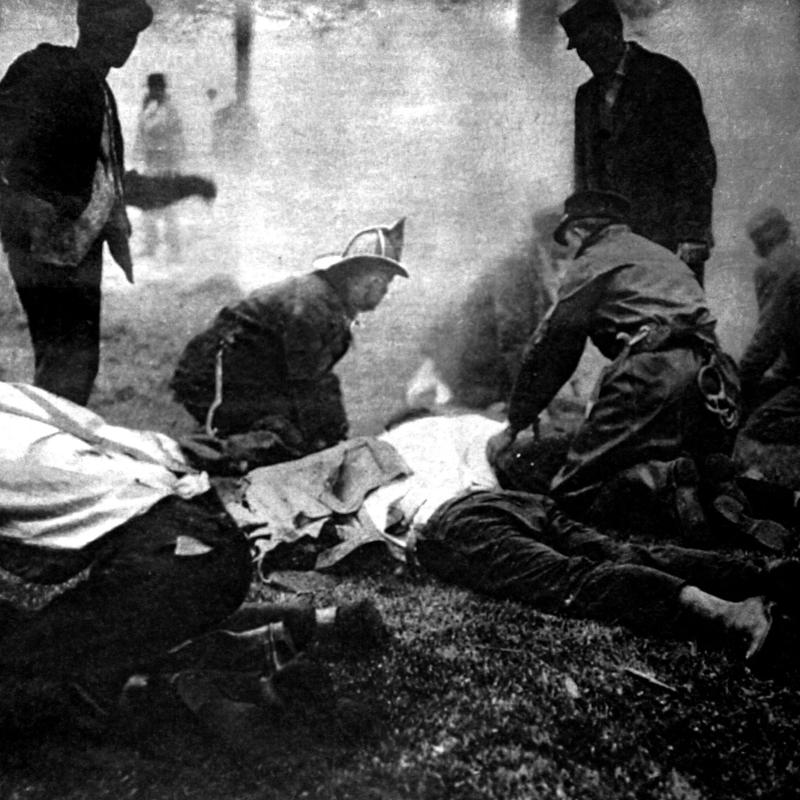
- Brad Schwartz: It's iron bars and stone walls, so it's essentially like being inside a brick oven. When they eventually were able to clear the burned building, they found men with their heads in the toilet trying to get away from the heat, but it's the heat in the smoke that overcome you before the fire actually reaches those cells. Once people smell the smoke and the cry of fire goes out, the first concern of the prison officials, and the warden in particular, is to avoid a prison break. They show much less concern for the lives of the people inside the burned building.
While the warden and most of the guards are trying to secure the complex and bring the National Guard in, a few prison guards, but mainly other prisoners, are unlocking the cells, are breaking the locks off with hammers, are doing whatever they can to get each individual door open and get their fellow prisoners out. There was some saving done by the prison officials, but certainly the inmates who survived this and left accounts, like Chester Himes, who became the famous novelist and wrote a story and later a novel about this. He marvels at how the people who are considered to be the worst of the worst, convicted of murder and every crime in the book, are risking their own lives to save their fellow prisoners.
Brooke Gladstone: We talked a bit about Otto Gardner, but how did WAIU, that local CBS Columbus radio station, work with the network to get the eyewitness account of the fires. Technically, how did they pull it off, because there's a story there?
- Brad Schwartz: Because WAIU is located on an upper floor of the only skyscraper at that time in Columbus, what is now the LeVeque Tower, they can see the smoke coming up from the prison, which is right near downtown. They actually break the news locally while they send someone over, their station manager, Fred Palmer, to the prison. Within an hour or two of the breaking of the news, they have Palmer reporting in by telephone. They can't put him on the air directly yet, but he can tell an announcer on the other end of the line what he's seeing, and then the announcer can repeat what he's saying over the air, which is, again, about as close as you could get given the technical constraints.
Once Palmer is able to get inside the prison, about a couple hours after the fire has started, and he gets to the chapel and he sees that the radio facilities have survived and are in working order, they are able to patch in, certainly using a phone line with the WAIU transmitter. Now they're broadcasting locally direct from the scene of the disaster. Meanwhile, the WAIU officials are getting on the phone with CBS in New York saying, "We have something. Can you clear your schedule?" This requires getting long distance phone lines because this is before you could send a remote broadcast easily through the air.
The fire breaks out around 5:00, 5:30 PM. By 11:15, the Columbia Broadcasting System in New York is ready to take this local broadcast from Columbus and send it out to 72 affiliates nationally, who, if you're listening to your radio at that hour, you have no idea what you're about to hear because this hasn't been scheduled. Certainly in the local Columbus coverage area, there are reports that people thought this might be some drama. They thought it might be a skit, because this is just such a new type of reporting that people didn't quite know how to take it.
Brooke Gladstone: Fred Palmer has this set up now. Who does he put on the air to speak to the nation? An unlikely national broadcaster, perhaps for the mainstream media.
- Brad Schwartz: Deacon Gardner. He's not identified by name in the broadcast. He's identified by number, convict X46812. That's what is in all the newspapers the next day. It's difficult to know exactly why Palmer did this. The accounts get very sketchy in that period between the fire and when they actually go on air. Palmer left some reminiscences, but I haven't found him ever talking specifically about why he put a prisoner on the air.
My supposition, they seem to have wanted a prisoner's perspective. Of course, we know Gardner was very eloquent. We know he was experienced with the microphone. We don't have a recording. The newspaper accounts conflict in some details, so we don't know who spoke first. I think it's likely Palmer came on as the announcer and then handed it over to convictx46812. What is very clear from all the accounts is that the voice everybody remembered was Gardner's.
Brooke Gladstone: 322 prisoners died in the fire, the deadliest prison disaster in US history. Deacon Gardner was at the microphone delivering the first breaking news report in CBS history. Tell me what we know about Gardner's use of the mic.
- Brad Schwartz: What's remarkable when you look at the press accounts is that the structure of what he's saying is so similar to a report that you would hear later from Murrow in World War II during the London Blitz, for example.
Edward R. Murrow: I'm standing on a rooftop looking out over London. At the moment, everything is quiet.
- Brad Schwartz: Gardner starts by describing what he's seeing, because he's in the chapel building, which has windows. It's right next to the scene of the fire. He starts with the objective information, when the fire started, how it spread, what the estimated death toll was at that time, where the main loss of life was on the top floors, paints this word picture of what the prison looks like. Again, I'm reminded of Murrow, particularly when he's reporting from Vienna after the Nazi's march in 1938.
Edward R. Murrow: This is Edward Murrow speaking from Vienna. It's now nearly 2:30 in the morning and Herr Hitler has not yet arrived. No one seems to know just when he will get here, but most people expect him sometime after ten o'clock tomorrow morning. It's, of course, obvious after one glance at Vienna that a tremendous reception is being prepared.
- Brad Schwartz: Like all the radio reporters who were operating from Nazi-occupied countries at that time, he has to pick his words carefully because the Nazi's control the microphone. He can speak more frankly from Britain than he can from Germany. There are things he doesn't say in that moment that he says later. The same thing is going on here, whereas Gardner knows he is on the air at the pleasure of the prison officials. We know from other sources that there is a great deal of unrest in the prison, apparently attempts at escape or rumblings of what might become a riot. This would proceed over the succeeding days.
In the moment, Gardner is emphasizing that nobody's trying to escape, everybody's well behaved, the nurses don't feel that they're in danger. The press accounts, there's some conflict in who said what. The one thing, all the newspaper accounts that reported on this, from the New York Times to papers in Canada, what they agree on is that more than once Gardner referred to his fellow prisoners as brothers, specifically in the context of talking about how they saved each other. He makes this comment. "After seeing the things they did and the bravery of them, I am glad and proud to call them brothers." Because it shows up in all these news reports, you can tell that's the thing that really landed with the audience.
Brooke Gladstone: Yes. The Kansas City Star declared that, "Radio for the first time in history gave millions of listeners eyewitness accounts of a catastrophe at the time of its happening." The Kentucky Post called Gardner a radio hero for his intensely dramatic account. The Chicago Defender reported that Gardner startled America, thanks to his vivid and amazing description.
- Brad Schwartz: I can't help comparing it to Murrow's reports during the Blitz, specifically because so much of the content of those reports is about the character of the people that he's seeing. In this case, the British.
Edward R. Murrow: I saw many flags flying from stars. No one ordered these people to put out the flags. They simply feel like flying the Union Jack above their roofs. No one told them to do it, and no flag up there was white. I can see one or two of them just stirring very faintly in the breeze now.
- Brad Schwartz: It's making an argument to American listeners that they can take what a lot of people outside of Great Britain thought they couldn't, the Blitz. Gardner is doing the same thing. He is looking at these prisoners seen as the worst of the worst. The castoffs from society. He's not talking about his experience directly. I actually know very little about what his personal experience of the fire was. He is talking about the collective. He's commenting on the brotherhood, the sense of solidarity that they demonstrated in risking their lives to save each other. That's really remarkable.
Brooke Gladstone: You say that William Paley was known for taking credit for stuff he didn't do. Let's talk about Paley for a moment.
- Brad Schwartz: His memoir that came out in the 1970s. The title is As It Happened, but the joke was it should be As It Didn't Happen. At the time of the prison fire in April 1930, he's 28 years old. He had acquired control of the CBS network about a year-and-a-half earlier, right around the time he turns 27. He didn't found the network, even though he identified himself as the founder and later years. He had bought this failing company that had never turned a profit. Even by the point of the prison fire, it had still not technically ever shown a profit, although that was turning around. He comes in from a family business in Philadelphia, successful cigar company founded and run by his father and uncle.
He got interested in radio really because he's in charge of the advertising for that concern, and sees in the mid to late '20s what an amazing advertising medium, this new thing called radio is, how great it is at selling. In the moment, he's very conservative in the sense that he doesn't want to risk what he has. He's slow to see the promise in television, even though he would claim differently. He's even has to be forced into getting into radio in the first place. The same is true with news. Even when he has this minor phenomenon on his hands with this prison fire broadcast, he's still reluctant to capitalize on it, as best we can tell.
Brooke Gladstone: Although, ultimately, you suggest that Paley sends Gardner a $500 check and a thank you note, presumably to allow CBS to take credit for what the local station had done.
- Brad Schwartz: Yes, exactly. This is really one of the only reasons we know Gardner's name, because he's only identified on air and in the initial news coverage as convict x46812. Then within a day it goes out on the Associated Press and the other news wires that the president of CBS, William S. Paley, is send this Otto U. Gardner a check for $500 and a thank you note again commending him for this historic broadcast that he's made. Paley, one of his first actions when he took over CBS around about 1929, retained the services of Edward Bernays, who was the inventor of public relations, who was a propagandist during the First World War.
Brooke Gladstone: And incidentally the nephew of Sigmund Freud, who really wasn't crazy about his nephew.
- Brad Schwartz: Yes, but Bernays was a big believer in what he called created news. There's other examples of him in this '29, '30 period ginning up stories that turn out not to be true. The whole idea that if you can get the press to report on your company, that's better than buying advertising because it's cheaper. People regard that with less skepticism because it's not an advertisement, it's a news story. The idea of sending Gardner a $500 check gets CBS in newspapers around the country and keeps the story alive literally for weeks.
Brooke Gladstone: It demonstrates specifically that the public really wants up to the minute news.
- Brad Schwartz: Somebody who works at the public relations firm of Edward Bernays, who used to work at the New York Times, whose name was Edward Kloberg, he had an editor at The Times, someone who really internalized and believed in the principles of journalism specifically as practiced at The Times. Now he's working in public relations and he's making an argument to Paley saying that this broadcast demonstrates that there is a public demand for news delivered in this way over the air that will be filled by someone.
Paley is reluctant. Newspapers at this time are still the dominant news medium in the United States. Broadcasting depends on them not just for news content because newspapers are doing the reporting, but radio also depends on the press for advertising because radio listings in the newspapers, that's the only way people are going to know what's on the air. Paley fears, as would turn out to be the case in later years, that the more radio becomes a competitor to newspapers in terms of delivering original reporting, there's going to be friction. This could lead to problems between radio and the press that would break out in the '33, '34, what they call the press rad war.
In this moment, Ed Kloberg is urging Paley to move forward. To say that if CBS doesn't satisfy this demand for news, if NBC doesn't satisfy it, it will be satisfied by someone. Within four months of this broadcast, Paley has hired Ed Kloberg to be an executive vice president, basically putting him in charge of news. By the end of that year, Kloberg has hired Paul White who is a wire service man from way back. The two of really start to build the news division, what we now know as CBS News. It's not its own journalistic organization. For a few more years they referred to it as public affairs and special events.
In 1935, when Ed Kloberg hires a young man in his mid to late 20s, claiming to be in his early 30s, named Edward R. Murrow, he joins this special events division not as a journalist. He has no reporting background. He's never worked on a newspaper. He is booking speakers for the CBS network in this organization where he's surrounded by all of these news people. He then credits Ed Kloberg above everyone else for establishing the ethic, the integrity, the standards of CBS News.
Brooke Gladstone: Getting back to the fire, CBS had started promoting itself as the news network. As you wrote, Gardner became a footnote, misremembered, if remembered at all. Paley's memoirs falsely describe an inmate who seized the microphone and began broadcasting the roar of the flames and the screams of the dying. What happened to Gardner?
- Brad Schwartz: He's transferred to the less secure Prison Farm facility in the years after the fire, as a lot of prisoners were to relieve overcrowding because of the reforms, I think, that take place after the fire. Even though he has a life sentence, he's paroled in 1947.
Brooke Gladstone: He stays in prison for 17 more years after the fire, though, right?
- Brad Schwartz: Correct. Then once he gets out of prison in 1947, by now, he is an ordained minister, so he continues to do this ministry to the incarcerated, particularly through song. One of the Black newspapers in Ohio, the Ohio State News, catches up with him two years after his release. This would be now in '49. It's the only news source that I've been able to find in the years after the fire recognizing him as this--
He's referred to in the headline as the hero of the Ohio penfire, talking about the broadcasting that he did and then interviewing him and saying that he's turned his life around. Again, he doesn't talk much, if at all, about his own experience in the fire. He's putting the focus back on ministry toward the incarcerated and doing what he can to improve the lives of his brothers, as he called them, still behind bars. At the time of his death in 1967, he's buried in the same cemetery in Columbus where the unclaimed bodies went and were interred after the 1930 fire.
Brooke Gladstone: You say that the early years of CBS is just a black hole because CBS either doesn't care to preserve its history, or maybe it wants to make sure that some people don't see parts of its history. With CBS News Radio being shut down and the entire team being laid off, are you worried about the archives that will just lose more of this history? Or how much history is there left to lose?
- Brad Schwartz: The paper history of CBS's early years, as far as anybody has been able to determine, is lost and was destroyed probably sometime in the 1980s. I have several colleagues who are involved with the Radio Preservation Task Force at the Library of Congress. I've been involved with them as well. The Library of Congress is specifically concerned with preserving the audio history, because radio, one of the things that makes scholarship about broadcasting so important is that, especially in the 20th century, radio was the soundtrack of American life. So much went on the air without being recorded. We're talking about the national network level. If you get down to local radio, college radio, so much is gone.
You do have, if you're talking about a network like CBS, interviews with newsmakers of all kinds, just the work of all these journalists, for decades now, by this point. CBS, they have never cooperated, as far as I'm aware, with making the archived audio available at a facility like the Library of Congress. I'm not directly involved in these efforts, but I do know that there is a great deal of concern about what will happen to the record of all of that work. For scholarship and just for the interest of the general public in what the 20th and early 21st century sounded like, that would be an irreparable and immeasurable loss.
Brooke Gladstone: You say that CBS's new leaders invoke Murrow's legacy without seeming to understand what created it. What do you mean?
- Brad Schwartz: There is, especially at CBS, throughout broadcasting writ large, a tendency to look back to those days, to refer to Murrow with words like integrity and standards and all of those things that are true but become cliched and lose their meaning the more times we use them. From having lived vicariously through much of his career, by this point, I'm struck by how in those early days when he and CBS are first breaking through in the late 1930s.
Brooke Gladstone: Murrow?
- Brad Schwartz: Murrow, yes. With these broadcasts from Europe, the Anschluss in 1938, the Munich crisis later that year leading up to the start of World War II. One of the things that audiences and critics are responding to is that they know that even if the text of the reports that Murrow is giving are objective, the way he is communicating information, the details he is focusing on, communicate an editorial comment on what he's witnessing.
He is perceived as being critical of, opposed to the Nazi government at a time when NBC, because it was older, because it had long standing relationships with European governments, including Germany before the Nazis, there was a perception that their commentators were moderating what they were saying--
Brooke Gladstone: Pulling their punches?
- Brad Schwartz: Exactly, in order to maintain access. Murrow and CBS, because of who Murrow was and what his beliefs were, but also because this is the young upstart company can be seen as more critical, there is a reservoir of trust that's built up, and particularly going through the war years because people are, in the United States, experiencing World War II on the home front through the radio, primarily through CBS in large part. They know that Murrow was in Vienna in 1938.
Edward R. Murrow: They lift the right arm a little higher here than in Berlin. The Heil Hitler is said a little more loudly.
- Brad Schwartz: They know he was in London in 1940. As the bombs were coming down.
Edward R. Murrow: Far away in the distance I can see just that faint red angry snap of anti aircraft bursts against the steel blue sky.
- Brad Schwartz: That he's over Berlin and the bomber. That he is at Buchenwald in 1945 bringing one of the first word pictures people have of the conditions in the Nazi concentration camps.
Edward R. Murrow: Men crowded around tried to lift me to their shoulders. They were too weak. Many of them could not get out of bed. I was told that this building had once stabled 80 horses. There were 1,200 men in it, five to a bunk. The stink was beyond all description.
- Brad Schwartz: People know him. They know what his values are. They know that he is always first and foremost concerned with the preservation and promotion of democracy around the world, but especially in the United States. He wrangles with CBS leadership throughout the war about how much he is able to communicate those beliefs, how directly he is able to say what he really feels about the situation in Britain or anywhere else.
Brooke Gladstone: We all know he ran into problems in his coverage of McCarthy as well in the '50s. I want to know about your observation that CBS's new leaders invoke his legacy without seeming to understand what created it. What is it you're seeing at CBS today?
- Brad Schwartz: Murrow's viewpoint was no one can escape their background, their experience, their reading, their education. All you can do is be upfront about where you're coming from, tell the audience what you've seen and let them take it or leave it. That's how he had practiced reporting since World War II. I see increasingly, especially at CBS, but I would say throughout broadcast journalism, this invocation of Murrow as the patron saint of broadcast journalism in the United States without acknowledging or recognizing that he came from a values based position where he was an advocate for democratic values as he understood them.
Brooke Gladstone: Brad, thank you very much.
- Brad Schwartz: Thank you.
Brooke Gladstone: A. Brad Schwartz is a historian currently working on a biography of Edward R. Murrow.
[music]
Locked in the cells of a prison
A prison much too small
Convicts jammed and crowded within that cold gray wall
Brooke Gladstone: Thanks for listening to our midweek podcast. Be sure to check out the big show on Friday. It usually posts around dinner time. This is going to be a special one.
[music]
Iron bars all around them
Living a life of hell
All kinds of men thrown together
Some that were bad from the start
Others who got into trouble
Men really good at heart
Some of them only waiting for death to bring the end
Copyright © 2026 New York Public Radio. All rights reserved. Visit our website terms of use at www.wnyc.org for further information.
New York Public Radio transcripts are created on a rush deadline, often by contractors. This text may not be in its final form and may be updated or revised in the future. Accuracy and availability may vary. The authoritative record of New York Public Radio’s programming is the audio record.