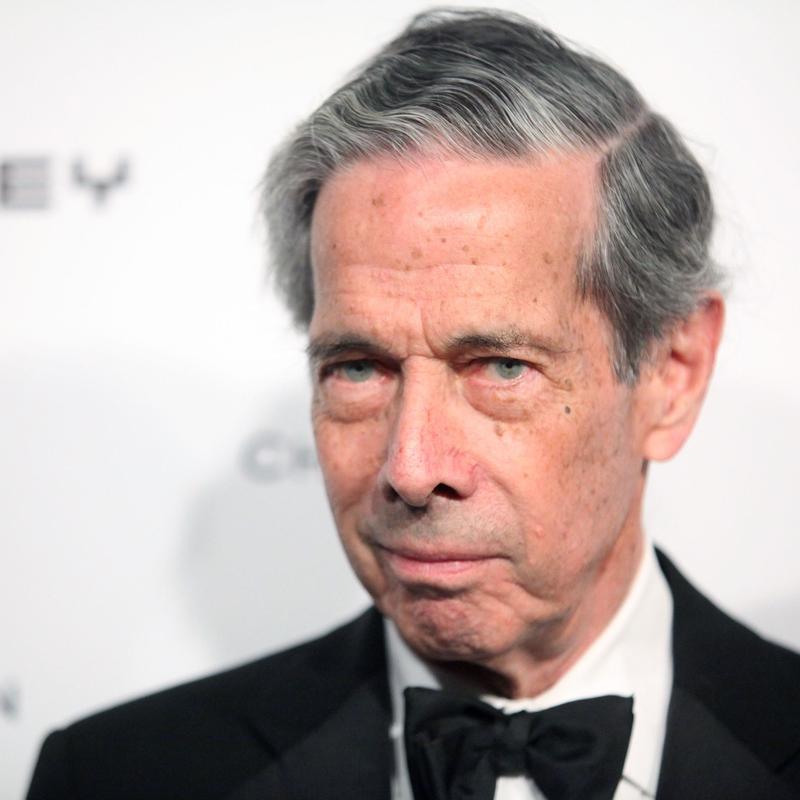
David Remnick: "Old age is no joke, but it can feel like one. You look everywhere for your glasses until your wife points out that you're wearing them." I'm reading from a piece by Calvin Tomkins published in this week's New Yorker, and it's called Becoming a Centenarian. He goes on, "I turn 100 this year. People act as though this is an achievement, and I suppose it is, sort of. Nobody in my family has lived this long, and I've been lucky. I'm still in pretty good health. No wasting diseases or Alzheimer's, and friends and strangers comment on how young I look, which cues me to cite the three ages of man: youth, maturity, and you look great. It was a piece of fiction. Calvin Tomkins, Tad to his friends, first contributed to The New Yorker when he was a journalist of 32. He contributed short pieces for a while, but over his many decades at The New Yorker, Tad developed a specialty, writing about visual artists.
Not so much as a critic, but as both a master of the profile form and as an endlessly curious viewer, always eager to understand what drives an artist, what makes an artist original. Tad Tomkins practices the form at a level that nobody else can touch.
Calvin Tomkins: I knew nothing about contemporary art. I had not intended to write about art or artists. It just happened that way. It took hold of me the early '60s. It was a very interesting moment in contemporary art. There had been a log jam with abstract expressions, and the critics thought this was what art could be and was the new work that was coming out of Rauschenberg, Cage, and, of course, Duchamp. I had the feeling that the period we were in was very much like it must have been in Paris in the '20s.
David Remnick: His first of these profiles was of the sculptor Jean Tinguely in 1962.
Calvin Tomkins: Tinguely had recently done his first piece in the US, Homage to New York, a crazy, huge, unbelievable machine with many moving parts. The whole purpose, as he said, was to destroy itself in the garden of the Museum of Modern Art. The idea that art could be that funny and that destructive just thrilled me. Then, in fairly quick succession, I did John Cage, Bob Rauschenberg, Merce Cunningham, Nam June Paik.
David Remnick: Now, what's extraordinary is that Tomkins' fascination with artists didn't end with the great men of his own generation. He kept going to shows over and over, meeting young artists, asking questions, and writing profiles. In recent years, he's been writing about people whose influence in the art world is just peaking now. Simone Leigh, Salman Toor. The experimental video artist Ryan Trecartin. Just a year ago, as Tomkins turned 99, he profiled Rashid Johnson, who's about half his age. Tad has never lost his passion for the new, for the thrill and risk of starting over again and again.
Calvin Tomkins: I don't know what I'm doing. I never have known what I'm doing. It's writing a game. There's no lessons that are of any use at all. You just have to keep trying, keep pushing out the words.
David Remnick: This year, Tad Tomkins decided to chronicle the experience of turning 100. It's in the same year as The New Yorker magazine itself turned 100. "I'm starting a month and a half in," he wrote in February, "because the journal idea didn't come to me until yesterday. January was a preview of the next four years, which may well end up being the worst in American history. Tad goes on to say, "I'm not going to spend much energy groaning about Trumpery in these pages. Plenty of capable people do that every day, and I don't have the time."
This has been from Sydney, Australia, to Providence, Rhode Island, to Los Angeles, a week of misery, of tragedy. The 100th birthday of a wonderful person like Calvin Tomkins does too little to erase that. I do think reading his diary is because it's so full of life, so full of decency and character, a small inspiration of the kind that we all need. You can find Becoming a Centenarian at newyorker.com.
Copyright © 2025 New York Public Radio. All rights reserved. Visit our website terms of use at www.wnyc.org for further information.
New York Public Radio transcripts are created on a rush deadline, often by contractors. This text may not be in its final form and may be updated or revised in the future. Accuracy and availability may vary. The authoritative record of New York Public Radio’s programming is the audio record.