What Resistance Means to Governor J. B. Pritzker
David Remnick: One thing we've heard a lot since last November is how unpopular the Democratic Party has become, unpopular even with many of its traditional supporters. The Democratic sweep last week surely tells us a little bit about the mood of the country, about the mood of the voters ten months into Donald Trump's campaign to remake America. The election of Zohran Mamdani, somebody who was virtually unknown a year ago, also shows that voters will respond to a clear message from the Democrats, whether it's a moderate in Virginia or New Jersey or a Democratic socialist in the city of New York.
I spoke with Mamdani at length a few weeks ago, and if you're curious about what it means for a democratic socialist to be mayor of America's largest city, I'd suggest you listen to that interview. It's in the podcast of The New Yorker Radio Hour. In particular, I asked Mamdani about how Donald Trump has threatened to punish the city if he's elected. What Mamdani told me is this. "What Donald Trump most often respects is strength. It's someone who's willing to stand up and fight back." Well, sure, but standing up to Trump, whether in the courts or on the streets, is a very complicated matter and varies from place to place. A case in point is JB Pritzker, the governor of Illinois. He's one of the administration's most outspoken critics these days.
Governor Pritzker: They are abusing people on the ground here. They're overstepping the boundaries of what civilian law enforcement are supposed to be doing. No one is holding them accountable. It's kind of shocking that the president doesn't understand that or see that or understand that if people are throwing tear gas at innocent bystanders in neighborhoods that he might live in, that he would also be upset and, frankly, would be protesting.
David Remnick: Trump and his circle think that Pritzker ought to be in prison. Pritzker, in his turn, has suggested that Trump has dementia. Now, truth be told, the governor seems to relish sparring with the president. Meanwhile, ICE and Border Patrol have targeted the city of Chicago, which is overwhelmingly Democratic, with aggressive sweeps from neighborhood to neighborhood. They refused to pause the raids, even during Halloween.
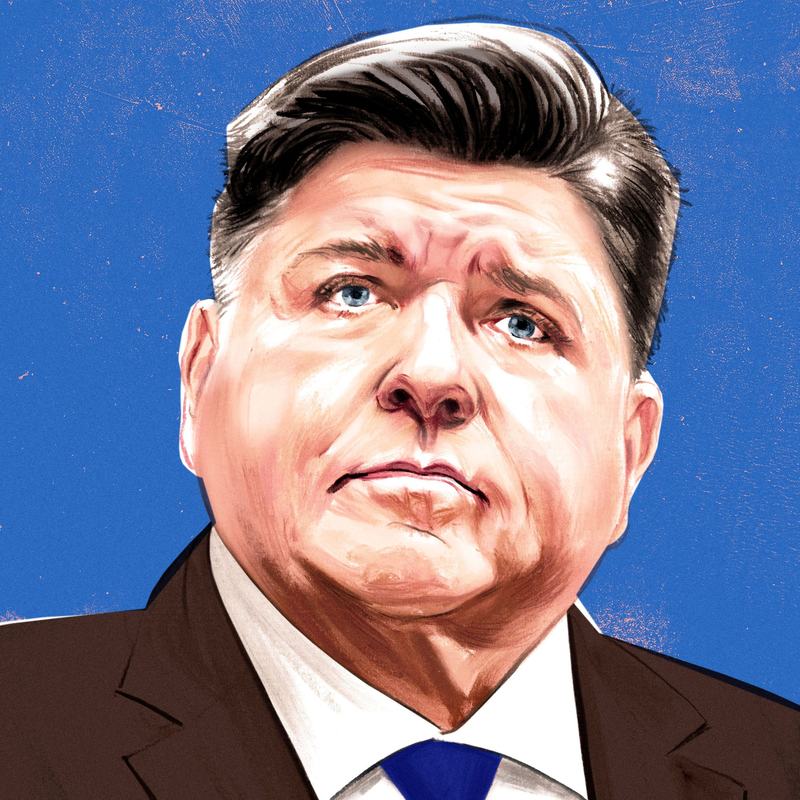
JB Pritzker comes from the sixth-richest family in America, as ranked by Forbes magazine. The governor's office is his first elected position. He spoke the other day with our reporter Peter Slevin, who covers Chicago and a lot of Midwestern politics for The New Yorker. Now, Peter, the ICE actions in Chicago have been intense, and Trump is threatening to send in the National Guard. How does this compare to what we saw in Los Angeles earlier this year?
Peter Slevin: I think, if anything, David, it's more intense. ICE and Border Patrol agents are all over, not just the city, but the suburbs. They are conducting sweeps with big guys in camouflage uniforms and masks and carrying military rifles, sweeping up people wherever they can.
David Remnick: You had a chance to sit down with Governor Pritzker after an event. Tell me, what was the event, and where were you?
Peter Slevin: We were downstate. We were in the small town of Taylorville, Illinois, on a soybean farm, not too far from Springfield, the state capital. Pritzker was in Springfield in part to register for reelection. He's seeking a third term in 2026, ahead of a likely presidential run in 2028. This day, he was talking about farm policy. He was hammering Donald Trump on tariffs and on the bailout for Argentina, saying that farmers are losing out as well. This is an effort by Pritzker to point out that he's not just talking about ICE, the Border Patrol, and activities in Chicago that are getting so much national attention, but in fact, has a critique of Trump's broader agenda.
Governor Pritzker: Whatever happened to America First? That's what we heard from Donald Trump throughout his campaign. America First. Argentina is now selling the soybeans to China that Illinois farmers used to sell. Instead of supporting Illinois farmers, Donald Trump is supporting Argentine farmers.
David Remnick: Let's listen to your conversation now with Governor Pritzker of Illinois.
Peter Slevin: I'd like to start with what is going on in these weeks since federal agents have shown up in Chicago, have shown up in the suburbs. What you're seeing, what you're hearing.
Governor Pritzker: Well, I appreciate your recognizing that it isn't just the city of Chicago that's been invaded by ICE and by the Customs and Border Patrol. It has been a very trying time for the people of Illinois as a result of Donald Trump's desire to cause mayhem on the ground so that he can bring in National Guard or military troops into American cities. They seem to be trying out everything new in Chicago.
We've seen CBP and ICE agents dropping tear gas in communities where people are just standing on the sidewalk holding signs and protesting. Outside of the ICE facility in Broadview, where there are regular protests, many people are yelling whatever it is they want to yell. They're holding up signs, but they're not doing anything illegal. Yet, we've seen pepper pellets fired at people in the crowds. We've seen rubber bullets fired at people. They're getting hurt, injured. Then the ICE officials claim that, oh, they were attacked somehow, but we have video.
One of the reasons, Peter, that we have video is because I've asked all Chicago residents if they have a phone in their pocket that has the capability of gathering video, they should turn on their phone and film everything. Because, look, first, I think it's a bit of a deterrent. If ICE knows that they're being filmed, they might not perpetrate the kinds of activities that they are now, which are so offensive and illegal in many cases. We also are capturing evidence. Evidence so that we can take them to court. Evidence so that later, when perhaps there'll be a Congress that might hold them accountable, that we could actually do something to push back.
Right now, they have federal immunity. It's quite difficult for a state to hold people accountable because of that federal immunity, so we're doing everything that we can, other than that. So far, the courts are helping us. The federal courts are helping. I've been very pleased with that. We've got people who know their rights on the ground, so people are not getting dragged away if they stay in their own homes. ICE is not allowed to burst in your door and take you away if all they have is a detainer and not a judicial warrant.
Peter Slevin: You've called it an invasion, and you've said that some of what they're doing is illegal. You referred to racial profiling. You've said that it is unconstitutional. In what ways is it those things? In which ways do you see it that way?
Governor Pritzker: Well, racial profiling is unconstitutional. You cannot do what they are currently doing. You're not supposed to be allowed to do it. It is unconstitutional to just look at somebody and say they're brown skinned or black skinned, and therefore, we are now going to detain them, or tackle them, or throw them in the back of a car and take them away and disappear them. That is what's happening. It's happening to U.S. citizens. Just to remind everybody. They're not grabbing people that they know to be undocumented. They're just looking at somebody and assuming because you're brown skinned, there's some likelihood that you might be undocumented. They're grabbing these people, they're harassing them, they're abusing them. Then later, after a couple of hours of being detained, they're let go, oh, because they're a US Citizen. This is not the country that any of us thought we were going to have in 2025.
Peter Slevin: I imagine you were pleased with what Judge Sara Ellis said yesterday. She had another hearing with one of the local heads of the Border Patrol, Gregory Bovino. She recalled an event from last weekend when there was tear gas thrown in a neighborhood on Chicago's north side. She pointed out that there were kids who were tear-gassed on their way to celebrate Halloween. She said, "I can only imagine how terrified they were," the judge said, "These kids, you can imagine their sense of safety was shattered on Saturday, and it's going to take a long time for that to come back." She seems really rather skeptical, and she's asked Gregory Bovino to show up every night in court to describe what the Border Patrol is doing on the streets of Chicago and in the suburbs. What are you seeking from the courts? What are you hoping the courts will do?
Governor Pritzker: Well, remember that the way Trump has organized ICE and CBP now, they are like a secret police. They wear masks. They do not carry or show their badges or their names. They are in unmarked cars. They're grabbing people without telling you who they are and throwing those people into their cars and taking them away. Like I said, later, you find out that it wasn't somebody who was undocumented, and certainly most often, was not somebody who has a criminal record or has committed a crime.
Donald Trump did this under the guise that he was going after the worst of the worst. I think many people voted for him, thinking, "Great, you're going to get the worst of the worst violent criminals off the streets of our big cities." That's not what they're doing. They attacked a building in Chicago in South Shore. There were 130 people in that building. They came in the middle of the night with a Black Hawk helicopter, dropped people from those helicopters onto the building. By the way, you would assume that this building must be full of gang members and violent criminals. That wasn't the case.
In fact, out of 130 that live in the building, the 4 people that they had identified ahead of time turned out they're not Tren de Aragua, the gang that they said they were going after. Indeed, what did they do, the 130 people? Most of them were either zip-tied, put in the back of a U-Haul, held for hours during the middle of the night. Children were traumatized in the process. Now, you can imagine that after days and days, indeed weeks now, it's been three months, of people being oppressed by these ICE and CBP officers, that people now, they've sort of put themselves in a position where they can push back. What are they doing? They're buying whistles.
There's a kind of whistle that is being sold at many of the local stores because everybody wants one; there's a big demand for them. What are they doing with the whistles? People who live in neighborhoods, when they see their neighbors, there might be a white suburban mom, soccer mom, but when they see somebody who is being harassed by CBP and ICE, they're coming out into the street and blowing their whistles so that everybody will know, "ICE is here. Be careful, stay in your home. Stay away. They might be throwing tear gas at you. They might tackle you." This is happening all across the city of Chicago.
It's shocking to me that the rest of the country is not paying attention to what's happening all across the neighborhoods of Chicago and the suburbs, and frankly, the rest of the state of Illinois.
Peter Slevin: There's a real battle over narratives, isn't there? The administration, on its social media challenges, putting out videos, allegedly about Chicago, not always about Chicago, as you've pointed out.
Governor Pritzker: Right. They've been lying.
Peter Slevin: You had the Department of Homeland Security in court just this week, saying that, 'rioters and terrorists have opened fire on officers, thrown rocks, bottles, and fireworks. Their lives are on the line to arrest murderers, rapists, and gang members.' How do you fight back against the narrative that they're creating?
Governor Pritzker: The misinformation. The misinformation that they are pushing, the only thing that we can do is have everybody video everything because it's easy to go produce a video that produces disinformation, misinformation for the public. It's not so easy to push back on a live video that somebody who happened to live on a street is holding up their phone and showing and posting online. Actually, we've created, as you may know, an accountability commission now. Headed by two former federal judges, very well respected ones.
This commission is gathering the evidence and information, including videos, including testimony, so that we have a record of what's going on because people are incredulous. It's hard to believe, in fact, that this could be happening in the United States, and yet it is. We want to make sure we're capturing all the information. It allows people to go to court, as happens with the court that Judge Ellis is in, and actually push back. What have they done?
Well, Judge Ellis has required that ICE and CBP have to wear body cams now so that they can prove whether something happened or didn't, the way they claim that someone was killed. A man was killed, Silverio, in a Franklin Park community. They said that the ICE agent had been dragged and seriously injured, and they put out a press release. The press release claims that there was serious injury. Later, the officer himself said, "No serious injury," and yet they killed the man. They killed the man for committing this crime. This is just one example. People have been shot.
What I'm concerned about now is that we're going to see ICE and CBP shooting at our local and state law enforcement. Remember, our job here is to manage to push back on crime, to make sure that we have safe communities with our local law enforcement. They've now come in with these invaders who are wearing uniforms and automatic weapons, and they're marching down the streets, sometimes in downtown Chicago, scaring people, and even now, firing their weapons at people. I am very afraid that this is going to end up in a clash between our law enforcement and federal law enforcement, because they are breaking the law, the federal law enforcement.
What do you do if you're a local law enforcement official, local police officer, Chicago police officer? What do you do when someone right in front of you is breaking the law? You're supposed to arrest them. I think there could be something really dangerous and terrible that could happen.
Peter Slevin: Let's talk for a minute about crime and the various reasons that President Trump and others have said they are sending these federal agents to Chicago. While violent crime has declined significantly in Chicago in the last few years, there's still an awful lot of people getting killed in Chicago, 345 this year. Your argument is, yes, Chicago would like federal help, but not this particular approach, which you've said you don't think is helping at all.
Governor Pritzker: I want to just make sure that you have the bigger picture, that actually, what the administration claims in court is the reason for being in Chicago is not what the President is saying, and yet the President claims he's trying to fight violent crime. On the ground, what they're claiming is that, no, they're just trying to protect their facilities and just to go after undocumented people so they can be deported.
So which is it? It's clear that the President wants to create an environment in which people believe that everywhere you go in Chicago, you are going to be shot or killed. That's just not true. I might add to you that violent crime is at a low that we haven't seen since 1965. We're doing very, very well. For the last four years, homicides have been cut in half. The homicide rate has been cut in half. We're proud of the work that we're doing. It's been because at least I have invested in state law enforcement. We have more Illinois State Police than we had before I took office six and a half years ago, and we've invested in Community Violence Interruption, a program that works, and we've proven that it works.
You know what Donald Trump is doing? He's taking money away from police. He's literally taking FBI, DEA, and ATF- which we work with all the time- he's taking them out of their departments and moving them over to ICE. They're not enforcing crime or helping us catch bad guys. They're doing what I was describing earlier, that ICE is doing, and he's taken away those Community Violence Interruption grants that come from the federal government. This is not somebody who actually wants to reduce crime, and he's not helping us reduce crime. In fact, he's creating mayhem on the ground because you know what he wants?
He wants troops on the ground in American cities. The only way he can get that done is by proving that there's some sort of insurrection, revolution, or rebellion that's taking place on the streets of Chicago. He tries to prove that by putting up cameras, creating mayhem, and then showing that to the public and claiming this is what's going on.
Peter Slevin: Donald Trump thinks you should go to jail. Stephen Miller thinks you ought to be arrested. JD Vance was asked about this and said you violated your fundamental oath of office. "That seems pretty criminal to me," he said. Are you worried about going to jail? How do you respond to that?
Governor Pritzker: It's funny about this administration and the President and his sycophants. It seems like when they're talking about somebody in an outlandish and outrageous fashion, accusing them of something, it's usually because they themselves have committed those offenses, and they don't want you to look at them; they want you to look at somebody else. That's what it's all about. There's absolutely no reason to go after the governor of California, the mayor of Chicago, the governor of Illinois. We've not done anything except that we're political opponents of his. Guess what tyrants do when they have political opponents? They try to jail them.
Peter Slevin: So you're not carrying your toothbrush every day as you go out and about?
Governor Pritzker: I'm doing what I need to do, which is push back every single day. I hope more people will join me in that.
David Remnick: Governor JB Pritzker of Illinois speaking with The New Yorker's Peter Slevin. Now, Peter, Governor Pritzker is talking a lot about pushing back against Donald Trump. If anything, even more than Gavin Newsom or Karen Bass did when this was all going on in LA. What kind of real authority does a governor have against the federal government in an extraordinary instance like this?
Peter Slevin: The fact is, he doesn't have much authority. He spoke at the 'No Kings' rally in Chicago in front of tens of thousands of people, and he said, "Donald Trump, stay the hell out of Chicago." Well, the fact is, federal officers are in Chicago, and they're allowed to be here. There's very little the governor himself can do on that front. One thing he has done is stop the National Guard from being deployed here by filing suit. That suit is now in front of the US Supreme Court, where Illinois authorities are saying there are no conditions under which Donald Trump can call out the military to operate on US streets. The administration, on the other hand, is saying without them, our federal officers are not safe.
David Remnick: Now, if I'm not mistaken, Peter, the district court Judge, Sara Ellis, is very significant in this whole drama. What cases is the state of Illinois winning, and what cases are they not winning against the administration?
Peter Slevin: The district courts have acted quite favorably toward the plaintiffs in various lawsuits against these actions by the federal government. One case filed just recently was filed by people on behalf of detainees in the facilities where those who are arrested are being detained. Just the other day, District Judge Robert Gettleman called conditions at the detention center unnecessarily cruel and ordered the government to improve conditions there for the detainees. What he said was that people shouldn't be sleeping next to overflowing toilets. They should not be sleeping on top of each other.
Judge Ellis has been quite interesting in all of this. She has been very skeptical of the use of force by federal agents, saying that it seems out of proportion to the supposed threats that civilians are posing to some of these efforts. In fact, Gregory Bovino, who's the Border Patrol leader who's become the face of these sweeps in Chicago after similarly doing so in Los Angeles, she brought him into court and she said, "What is it that you're doing and why aren't you wearing body cams, and how is it that these agents are not even identifiable by name or by by number?" She ordered ICE and the Border Patrol to halt their rough treatment of protesters and journalists. She said Bovino had been making things up when he said he had been hit by a rock before he lobbed a tear gas canister into the crowd, and she said it was time for federal agents to respect the constitutional rights of the protesters.
David Remnick: Now, Governor Pritzker, in your conversation with him, makes very clear that he sees this as, among other things, a case of unconstitutional racial profiling. What backup, if any, is he getting from the Supreme Court?
Peter Slevin: Well, on the contrary, what we're seeing from the Supreme Court in the shadow docket was Justice Kavanaugh saying that forms of racial profiling are acceptable. Saying that, in fact, people who are picked up because of how they speak or how they look, well, if they have no reason to have been picked up, they'll be released rather quickly. You have, at the same time, Kristi Noem saying, "Oh, of course not. There are no U.S. citizens being picked up. We are doing all of this above board." The fact is that that is simply untrue. Reporters have found US citizens who have been picked up who should not have been picked up, and in fact, have been detained, and some are still detained.
David Remnick: Now, one thing I noticed was that Pritzker was boasting about hiring more cops in Illinois. That's not what we heard from Democrats a few years ago. That wasn't the rhetoric of the party. Is that a response to the old 'defund the police' rhetoric we heard five years ago, which was so damaging to the Democrats, or is it something else?
Peter Slevin: I think it is a response to the idea of defunding the police, which, as we know, was rarely about actually taking all the money away from any particular police department. The fact is, JB Pritzker and the mayor of Chicago have a very serious crime problem in the city. There are still hundreds of people a year being murdered, many hundreds more being shot, even though those numbers have improved, and they need help. Interestingly enough, Pritzker has said to the Trump administration, "Send us more crime-fighting help. Send us FBI agents, send us DEA agents," but as Pritzker would say, "Don't pretend that National Guard or these federal agents are actually doing anything to reduce violent crime in this city."
David Remnick: To the contrary, is there any possibility that we might see maybe one of the worst things happen? A confrontation between federal agents and Chicago police?
Peter Slevin: So far, that has not happened. Pritzker has deployed state police in Broadview, for example, which is where a detention center is, where, in fact, just the other day, a number of politicians were charged with federal crimes, the allegation being that they were resisting ICE officers. Pritzker has been very clear that those officers are there to create a safe space, he would argue, for those peaceful protesters, and yet at the same time, they can also be used to prevent the protesters from attacking in any way those federal agents.
[music]
David Remnick: Peter Slevin, live from the 'hellhole' of Chicago.
[laughter]
David Remnick: Peter Slevin, thanks so much.
[music]
Peter Slevin: Glad to be here. Thanks, David.
[music]
Copyright © 2025 New York Public Radio. All rights reserved. Visit our website terms of use at www.wnyc.org for further information.
New York Public Radio transcripts are created on a rush deadline, often by contractors. This text may not be in its final form and may be updated or revised in the future. Accuracy and availability may vary. The authoritative record of New York Public Radio’s programming is the audio record.