Zadie Smith on Politics, Turning Fifty, and Mind Control
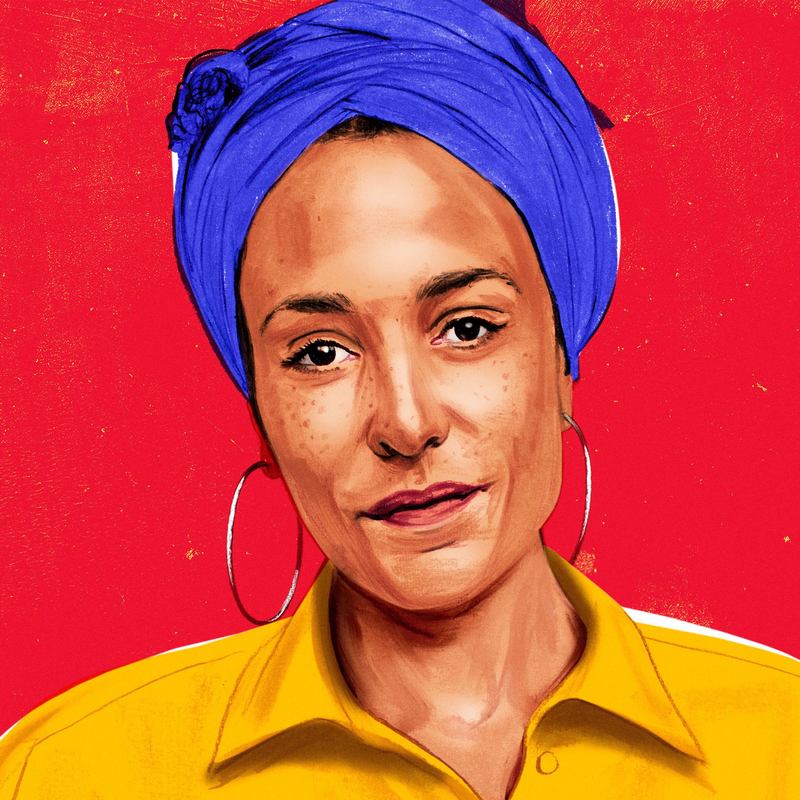
David Remnick: A new novel by Zadie Smith isn't just a book. It's a real event. Everyone who cares about fiction reads it and talks about it. That's been true since her very first novel, White Teeth. From page one of that book, you heard a new voice, a bold and original voice. A 25th anniversary edition of White Teeth just came out this year. It's a classic by now, which seems astonishing to say, but if you only know Zadie Smith as a novelist, you're actually missing out because she also writes some of the very, very best essays out there. She thinks with enormous nuance about the way we live now and how to read about literature, technology, gentrification, politics. There's really not a topic that wouldn't benefit from her insight. Zadie Smith's new book gathers some of those essays from the New Yorker and elsewhere in a collection called Dead and Alive. This year marks the 25th anniversary of White Teeth. Some novelists, they begin with some warm-up books, some imitative books, and then they find their stride and they become themselves.
White Teeth was this blazing white hot debut. Somewhere along the line in this book, you indicate that you don't completely recognize this Zadie Smith that is behind White Teeth. What do you mean?
Zadie Smith: I think it would be really strange to feel very close to your 25-year-old self when you're 50. I think for anybody that would be a strange relation. I have nothing but warm feelings. First of all, I'm grateful to that girl because she wrote a book which enabled my life. It gave me license to write as I like, when I like, which I don't think I would have had without that kind of initial hit. I love the energy of that book, as I love the energy of all debut novels. As you get older, you have a different kind of feeling about the world.
It gets quieter inside. I am quieter inside than that person. She was really like-- I always think of it like Gene Kelly running into New York like, "Gotta Dance." That was my vibe, age 24, and I'm just not there anymore. I have lots of excitements, but yes, a little less energy for sure.
David Remnick: Zadie, when John Updike was alive and living in Beverly Farms, Massachusetts, he lived in a captain's house, and it had three little offices. One was used for writing novels, one was used for paying bills and correspondence, and one was for writing essays. He jumped from room to room to room.
Zadie Smith: Oh, wow.
David Remnick: I don't imagine with real estate prices being what they are, you have three studies.
Zadie Smith: No, no. It all happens in the same chaos, pretty much.
David Remnick: Now you've published a book of essays, and not for the first time. What role does the essay have in your writing life? What are they for?
Zadie Smith: I think it's about spending a lot of time listening, because I'm not often in the thick of things, in the way people are these days.
David Remnick: When you say you're not in the thick of things, what does that mean?
Zadie Smith: I think I keep up. I'm basically living in 2003, in terms of my media diet. I listen to things, I read things, I watch television, but I'm not in this daily diet of constant information. Everything that I do, I guess, is a bit slower or feels slower to me.
David Remnick: You're not posting, you're not doom scrolling?
Zadie Smith: No, no.
David Remnick: You don't feel obliged to respond to the political outrage of the moment?
Zadie Smith: Oh, I feel plenty of outrage, but I think about individual human capacities and what a human brain is designed to take in, or what my brain can take in. I'm like the slow food movement of writing. It just takes me a minute to think.
David Remnick: Zadie, one of the most important essays in this book, I think, is called Fascinated to Presume: In Defense of Fiction. It's about the question of representation, which has been a focus of so much talk in the literary world in recent years. In other words, who gets to tell what story, how much a fiction writer is allowed to imagine about people different from himself or herself? Wasn't that the anxiety you were responding to?
Zadie Smith: Partly of speaking for others, of speaking in the place of others? I don't think those are ridiculous concerns. What I was trying to untangle in that essay is different kinds of discourse. Because I thought the language of representation, for example, political representation, was seeping into an area where it's not a point-for-point relation. The voice of fiction doesn't come from a single legal entity who can be stood up in court and defended. The voice of fiction is diffuse anyway.
David Remnick: Zadie, let me read to you a passage from the same essay. "The old and never especially helpful adage, write what you know, has morphed into something more like a threat. Stay in your lane. This principle permits the category of fiction, but really only to the extent that we acknowledge and confess that personal experience is inviolate and non-transferable. It concedes that personal experience may be displayed very carefully to the unlike us, to the stranger, even to the enemy, but insists it can never truly be shared by them. This rule also pertains in the opposite direction. The experience of the unlike us can never be co-opted, ventriloquized, and so on."
Zadie Smith: The one thing about talking about essays is you find yourself saying the same thing, but worse, without the commas. One thing I would add to it is partly it's my pride. I really noticed, like for instance, when I was on tour with On Beauty, that nobody, not one person in any interview ever said to me, "Writing Howard is an act of cultural appropriation. Howard is a kind of white middle-aged professor." My pride is hurt by that. I am hurt by the idea that there's nothing you can take from a white man; there's no way you can appropriate from him.
I apparently don't have the power to do it. Anyone can take anything from me at any second. I'm meant to be vulnerable like a child in front of any reference to myself. I find that offensive, to be honest. If I'm going to appropriate, I hope that I should be able to appropriate from a middle-aged white man that I'm able to take him, make him, create him. That's part of my MO as a novelist. It just struck me that the conversation only ever went in one direction. I understand the argument is that such a person has power, and you can do nothing to harm him.
In that novel, I was trying to harm him; I did my best. He's ridiculed in parts, and he's silly in parts, and more than anything, he's human. That is my job. That's where fiction lives. If someone's saying to you, and sometimes I would have this reader say to me, I don't like that idea of fiction, I don't enjoy that kind of fiction. What are you going to do? Arguing with them? If you don't like that kind of fiction, that's cool. You don't have to read it. There's plenty of other kinds of fiction to read.
Science fiction or the kind of autofiction that stays very close to the human person who's writing it. Those are all options. My fiction may indeed be out of fashion, and that happens in fiction.
David Remnick: How do you mean?
Zadie Smith: Trends pass, that there are periods in fiction-- I don't know if you try and read novels from the '70s, that always interests me. There's a certain kind of overwrought, '70s, often American novel, actually, which is almost unreadable now because it's so close to its moment, to its time, to the various psychedelics that were being taken, that it's literally almost in a different language. That happens. I think that happens to every generation of fiction. I'm always trying to move forward.
I wouldn't write On Beauty again now, just because I get bored easy. I'm always trying to look for a new form, a new way of approaching something. I love the life in that book, the people in that book, the variety of them. I think there are readers who love that kind of fiction.
David Remnick: I think you know, because I complain to you all the time about this, that I love when you write your essays for The New Yorker and weep into my pillow when I discover you somewhere else. One of the best essays you wrote for The New York Review of Books was your response to the film Tár, about an imperious conductor in Germany. You write this. It was really interesting. "I'm the one severely triggered by statements like, Chaucer is misogynistic or Virginia Woolf was a racist.
Not because I can see that both statements are partially true, but because I'm of that generation whose only real shibboleth was, is it interesting into which broad category, both evils and flaws, could easily be fitted, not because you agree with them personally, but because they had the potential to be analyzed just like anything else." What were you responding to in the cultural air there, beyond just the film itself?
Zadie Smith: I think it's just a sensibility thing. I think when I was writing that Tár essay, I was reading all of Virginia Woolf's diaries. That's a lot of Virginia. That took me from September till Christmas. There's so much in Virginia to object to. She can be absolutely atrocious, an unbelievable snob.
David Remnick: How do you mean?
Zadie Smith: She can be such a snob; she can be racist at times. She is oddly apolitical, given that Leonard is out there every day working for the socialists, and Virginia's mostly picking mushrooms or thinking about some reviews or the next novel. There's very few things about a person which makes me turn away completely. There's so much to love in Virginia, so much to value, so much vulnerability, so much sadness, so much heroism. Such an extraordinary feminist. A beyond icon. I need another word for it.
She created a mode of thinking in me and so many other women, and then there are all these blind spots. As a human--
David Remnick: What's the mode of thinking? Forgive me for interrupting, but what does that mean?
Zadie Smith: Virginia thought structurally, like the essay A Room of One's Own. It's one of my favorite essays that's ever been published. When she goes to, I believe it's King's College, my old college, she's walking through it on the way to have dinner at a women's college. She sees in King's College the structural advantage that men have, that the meal in the men's college is delicious, and there are many courses, and there's a lot of wine, and there is free time, and there is all of this money, superstructure supporting the genius of men.
Then she goes to the women's college only recently opened, and finds it narrow and cold, and hardly any food, and hardly any wine. She understands that this is not an accident, [chuckles] that the structural situation you make around people to allow or disallow their flourishing is everything. She is a feminist, but it's not of an individual kind. It was always structural. She understood that. When she makes that early comparison between Shakespeare and his imagined sister, in her mind, Judith, that's a central question.
If a woman with the same amount of genius, with the same talent, with the same verve is born at the same moment, what happens? She was able to think in that kind of global way. It's not about Judith. It's about the situation into which she's born, which, of course, is now as obvious to us as the sky is blue, but was a new idea and one which really struck me when I first read that essay.
[music]
David Remnick: I'm speaking today with the writer Zadie Smith. We'll continue our conversation in just a moment. This is The New Yorker Radio Hour.
[music]
This is The New Yorker Radio Hour, and I'm speaking today with the writer Zadie Smith. Smith's new book, Dead and Alive, collects her essays on a number of topics, including politics. I really love reading Zadie on politics because while she's certainly on the left, she's the kind of thinker who is capable and even insists on letting multiple facts and multiple arguments enter the picture. What you experience when you read her is someone thinking, someone coming to their convictions, and she's never writing out of a sense of fear or the Amen chorus.
I wanted to hold off on politics as much as we possibly could, but you raise Virginia Woolf's politics, and it reminds me of this moment in an essay called Trump Gaza Number One. You say this, and it's as near to a credo, a political credo, as I think you've come, if you'll forgive me for saying so, just this little passage. "The pressing job of the left right now is to expose this illusion, to insist that this is, in fact, one world we are living in, one in which universal regulatory measures capable of protecting all human life are still possible.
To do this, we must need transnational institutions which, however imperfect, persist through time and can't be unilaterally destroyed by the group of ideological gangsters presently occupying the White House." Now, you've written a lot about politics, but you rarely use the words like should and must and so on. That kind of mode of political writing is usually not yours.
Zadie Smith: No, that's true.
David Remnick: You don't write for posters. Can you flesh this out a bit and tell me about the moment at which this was being written and what you're getting at here?
Zadie Smith: I think what I've learned the past few years, which I didn't understand when I first came to America, is the gulf between-- It's a kind of historical consciousness gulf about what the left means. I was thinking about it when I heard you interview Mamdani, where you were dragging him over the coals a bit about this phrase democratic socialist.
Zohran Mamdani: The focus of our campaign has been on housing, it's been on childcare, it's been on public transit, and in some senses--
David Remnick: Forgive me for interrupting. What you're saying is anything that's a necessity, housing, food, education, should not ever be given over to market instability or prices? It has to be there, and it has to be free.
Zohran Mamdani: No, I think that it has to be a fixture in each and every person's life.
Zadie Smith: I was swimming at the time, so you were in my ears.
[laughter]
I was listening to this. I was thinking--
David Remnick: I don't have that kind of headphone, yes.
Zadie Smith: It's so odd to me that his politics are considered in a New York contest radical, where what you are describing is basically the very least that we imagined in 1946, all over Europe, that social compact that he was trying to describe, of decent housing, equal and free education and free health care is what I grew up in. I grew up in a context where even somebody like Churchill, his phrase cradle to the grave, that is the phrase of a Tory in 1943. It's always amazing how far from what I would call the very least we could do, we have moved. To call someone like him a communist is mind-blowing from a European perspective.
David Remnick: This is Trump's phrase for him, yes.
Zadie Smith: To hear democratic socialism described as if it is radical left politics, when to me it's not even far from the center, that is continually surprising to me. I guess when I was writing the Trump Gaza piece, I was just trying to re-establish, are we talking about the same thing? On the left, are we talking about the same thing? Because these things to me, which are basic, without which a human society can't flourish, the name democratic socialism to us in Europe is just what was until the arrival of Thatcher and Blair and everything that came after it, that was what we call government around here.
I'm always trying to remember that about my American audience, that they've no reason to know that. They've never lived in it, apart from the small pockets of what I would call an attempt at social justice after the New Deal. It's always new as a concept in America, but it's kind of an old one here.
David Remnick: All I was drilling down on and not to get in a defensive crouch is what is the difference in his mind between democratic socialism or being a social Democrat, or being a liberal who believes in high social spending? There are shades of difference, and it's worth exploring.
Zadie Smith: There are shades of difference, and I guess I was surprised from my little British perspective about how much defense in the American context you have to make about ring-fencing these areas of human flourishing away from the market. I'm always surprised.
David Remnick: It barely exists here.
Zadie Smithth: It barely exists in America.
David Remnick: I completely agree.
Zadie Smith: That's what I learned living in New York.
David Remnick: I'm not sure it exists to such a great degree beyond the healthcare system in Britain.
Zadie Smith: No, it's been a 20-year project of unpicking it. I'm always trying to remind myself and to remind other people. It's not a fantasy. It is possible. Of course, the dark knowledge, which I'm sure you share with me, is that what made it possible. The absolute ruins of the Second World War. That's a terrifying thought, and that's my most pessimistic thought, that it takes something close to apocalypse for the kind of social compact I'm talking about to be built from the ruins.
To me, the job of the left is can we create a discourse which argues for this compact without the necessity of apocalypse? That doesn't seem a very extreme thing to want or say, but it's surprising how hard it is to gather people under that umbrella.
David Remnick: On election day 2024, you wrote an essay called The Dream of the Raised Arm. In it, you look at a book that's an account of real dreams that people had during the early days of the Third Reich, and it's written by Charlotte Barat. Many people here in the US had a difficult time or refused to conceptualize Trump's win as a possible advance of authoritarianism or a totalitarian impulse. The line was at that time that if you were wise, the journalists had a tendency to take Trump literally but not seriously, and that wise, ordinary people were taking him seriously, but not literally.
Now it's a year later. Now it's a year later. That essay that you wrote and I'm going to ask you to read from seems devastatingly prescient. I wish you'd read a passage from it, if you don't mind.
Zadie Smith: With pleasure, kind of. These dreams of auto-imprisonment in language, Barat argues, illustrate the dark shape that these people's consent takes. They show how people, in blind fear of the hunter, start to play the hunter themselves as well as the prey, how they secretly help set and spring the very traps that are meant to catch them. Propaganda posters, megaphones, the radio. Such devices appear in these dreams over and over. Such were the paltry propaganda tools Hitler turned to his advantage in spectacular fashion, though they were like crayons on paper compared with what a man like Elon Musk now has at his disposal.
David Remnick: Tell me how you would compare those two periods, the '30s there and the right now, here in the United States and beyond.
Zadie Smith: I think for me, everybody has a different emphasis on Trump and what's going on. My emphasis has been on, to put it boldly, mind control. I think what's been interesting about the manipulations of a digital age is that it is absolutely natural and normal for people to be offended at the idea that they are being manipulated. None of us like to feel that way. I think we wasted about whatever it's been since the invention of the iPhone trying to bat away that idea, calling it a moral panic, blaming each other, talking about it as if it were an individual act of will.
I've had a lot of that because I don't have the phone people talking to me like it's an ethical, I don't know, like I've done something amazing by not having this phone. When you make it a question of individual morality, you forget, again, the structural context, which is that we are all being manipulated. Me, too. I have my laptop. I'm online a lot of the time. I think once we can all admit that on the left and the right, then we can direct our attention to who's been doing this and to what advantage and to enormous economic advantage. From the very beginning, it was always everything digital, everything online has been talked about as if it's not ideological, as if it's neutral. These are neutral tools, and then we'll do our politics on them. It was never neutral. Something that is colonizing your attention, manipulating the way it's directed, is not neutral. When people talk about radicalization on the Internet, they like to talk about radicalize to the right and radicalize to the left. As far as I'm concerned, if you now find it normal for your child, for example, to look at a screen for up to six hours a day, you have been radicalized.
You've been radicalized in the idea of what is normal and sane and healthy for a human consciousness to be occupied with. That radicalization is general. I feel so optimistic because I don't feel like a crazy person saying these things anymore. If we were talking just after I wrote the Facebook essay, I genuinely remember walking into my NYU class, and my students were like, it was like they were like patting me and rolling their eyes, like, "Oh, poor Nana, the sad Luddite who's embarrassed herself, saying that Facebook isn't the greatest thing in the world." That's what it was like for a long time.
David Remnick: In one of the essays in this book, you mentioned a talk that you gave recently in Barcelona to a group of 14 year olds in which you told them that to seriously damage the billionaire empires that have been built on your attention and are now manipulating your democracies to achieve that right now, all you guys would need to do is look away and thus give a new meaning to the word woke.
Zadie Smith: It's happening. People are conscious of it.
David Remnick: What? Really? 14-year-olds in the audience, either really or metaphorically, are looking away?
Zadie Smith: I think the thing I find most depressing is that, like all of these things, it's class-based. Middle-class, upper-middle-class kids, they get the message from their parents, they try and create screen time, they try and control themselves. Well, great. For me, it has to be much broader than that. One story which really chilled me very early on in this. My mom was a social worker until fairly recently, and she would go into these houses in our neighborhood sometimes with 9, 10 children in them. New immigrant families, big families, and it would be a boisterous, noisy place, and whatever problems in the house, she's there to talk and discuss.
She said, in the past few years, you go into these houses, it's silent. Everybody's silent, from the baby to the 15-year-old. Just from an experiential point of view, the question is, what happens to children when that's their daily reality? Hours and hours and hours and hours of solo silent screen facing time? We don't know. It seems to me an extraordinary experiment to do on scale on the entire human population.
David Remnick: How old are your kids, Zadie?
Zadie Smith: 15 and 12.
David Remnick: Did you and Nick lay down the law when it come to screens and-
Zadie Smith: Oh, it didn't--
David Remnick: -Snapchat?
Zadie Smith: Of course, but it didn't work even for a second. In fact, it probably had the opposite effect. Like, who doesn't know that about parenting? Also, why is this a parent's job? It's a regulator's job.
David Remnick: Whoa, whoa, whoa, whoa. What are you suggesting? That the government regulate screen time?
Zadie Smith: The fact that you find that such an unbelievable idea to stop 11-year-olds spending up to 6, 7 hours a day on the phone, you and I, it was only, whatever it is now, 15 years ago, where the idea would have seemed like science fiction. I don't think it's too much to create some regulation, if not the having of the phones themselves, then on what platforms children are allowed to access. That doesn't seem such an outrageous idea. I think when people have children, their feelings about this change quite suddenly.
I think you're seeing that with the millennials in particular, that they may have been absolute libertarians until they're looking at the idea of a national nine-year-old on Snapchat, and then they might have a different view.
David Remnick: Politically, the people would have to want it.
Zadie Smith: I think people will want it at some point because I think people want to go towards joy and freedom, and I don't think this is joy or freedom.
David Remnick: Zadie Smith, thank you so much.
Zadie Smith: Thank you.
David Remnick: Zadie Smith's new book is called Dead and Alive. The 25th anniversary of her debut, White Teeth, came out this year as well.
Copyright © 2025 New York Public Radio. All rights reserved. Visit our website terms of use at www.wnyc.org for further information.
New York Public Radio transcripts are created on a rush deadline, often by contractors. This text may not be in its final form and may be updated or revised in the future. Accuracy and availability may vary. The authoritative record of New York Public Radio’s programming is the audio record.