
The Big Picture: Cinematographer Mandy Walker on Capturing 'Elvis'
( Courtesy of Warner Brothers )
[music]
Alison Stewart: This is All Of It on WNYC. I'm Alison Stewart. We continue our big-picture series recognizing the creatives behind the camera who are up for Oscars this year. It is Women's History Month, and our next guest could make history at the Academy Awards this year. Elvis cinematographer Mandy Walker is one of only three women ever nominated in the best cinematography category, and if she wins, she will be the first woman to do so in the Academy's history.
You've seen her work behind the camera, literally, as a cinematographer or director of photography for the films Hidden Figures, Mulan, and her first go around with Elvis director Baz Luhrmann which was the movie Australia in 2008. Of her work on Elvis, IndieWire said it was "her best to date". Elvis is up for eight Academy Awards this year including Best Picture and Best Cinematography. Mandy Walker joins us now. Mandy, nice to meet you.
Mandy Walker: Hi, Alison. Nice to be here.
Alison Stewart: You were part of this film from the very beginning. You were even on set for Austin Butler's audition for the lead playing Elvis. How did you come to be part of the project so early?
Mandy Walker: This is actually my fourth collaboration with Bears. I started doing the Chanel No. 5, I think it was in 2004, so nearly 20 years ago now. Then we did Australia together. Then we did another Chanel No. 5 short film, we call it. Baz always gets me involved really early and he brought me on for this. We started talking like nine months before we started proper prep. I was there for Austin's workshop. Baz calls the audition a workshop. I was there with my stills camera looking at angles on him and just observing because he was actually performing in that audition, and just observing how the camera saw him and different lenses saw him.
Yes, I am involved very early on because it's a process working with Baz where the collaboration is really important, and there has to be like a harmony between all the departments, so editorial were there, art department, the effects, and costume, obviously, with Katherine Martin. Yes, for me, it's actually a great experience because I get to start thinking about things and doing my research and working things out from an early time in pre-production.
Alison Stewart: It was interesting to hear you talk about how everybody is working in concert because I've heard that repeatedly during this series of people who are on these films that have done extraordinary well are very creative or have something incredibly unique about them that people have always said it was a collaboration. We all worked together. I think that's interesting. It's the one thread through all of these conversations.
Mandy Walker: I think you really can tell when that's not happening if there's a discord in any of the departments because, for me, I make sure that by the time we get on set, for instance, when we did our Beale Street sequence of the movie. I had tested every color that was going to be in front of the camera and every lens that I was going to use and the lighting that I was going to use so that there's a coherence.
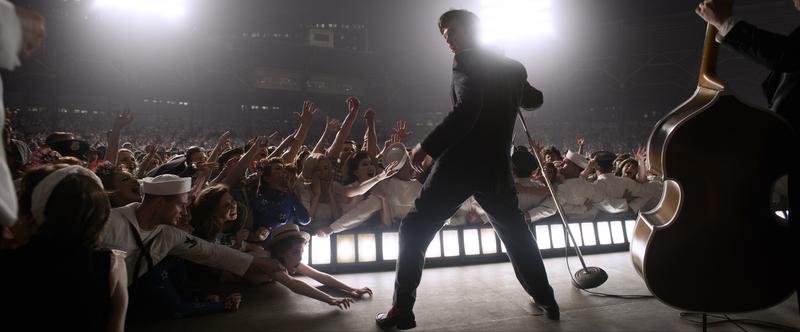
The thing about working with Austin doing a concert movie is I was there for Austin's, a lot of his rehearsals, and then I brought my camera team in and my grip team and we rehearsed with him so that by the time we got on stage, we were so prepared and we knew we were dancing with him. That was really important for us and also for him because it meant that he felt comfortable being on stage with us during these performances and made everything go so much smoother. No one was ever bumping into each other.
There was a crane flying across the audience right into Austin's face and he knew that that was coming and that we practiced it and we knew exactly where he was going to be in terms of the choreography. I think that kind of thing for this movie made a huge difference. It meant that what we did was-- because we had to reproduce all the concerts exactly. All the concerts, the Elvis, that you can see online, that's the way it is. The Vegas concert, the Russ Wood was documented by a stills photographer. That's the trouble sequence, and also some of these early, even the hayride, there was stills photography there and the '68 special at NBC.
What Baz wanted to do was have us replicate that exactly. I had to study the lighting, the camera angles, the lensing, but then there's also the drama of the film, and I had to integrate that into a concert footage. There was kind of a dance that I was doing with the visual language as well between the drama and the music sequences.
Alison Stewart: It's interesting you talked about the different periods. What was something you noticed that is different about the way artists were filmed across the decades?
Mandy Walker: Very interesting. They didn't have the equipment that we had, and a lot of the time, you see actually in the Vegas show, it was just after the zoom lens had been invented, so they're going all crazy with the zooms. They're doing a lot of zooms with the music, which is something that we don't do that often these days unless you're doing something to make a point, or for me, it was like replicating that style. Yes, things like that.
Also, I had two sets of lenses built. I had a set of lenses built that took us up to the '60s that were flatter and not distorted and they were a little bit sort of vintage. They were based on vintage lenses, so they had a more of an old-fashioned less clinical modern style to them. We went anamorphic when we got to Las Vegas, so that, for me, represented that period of time, and I had them detuned to look like the lenses that were made at that time. I went through three iterations of our lenses to get them to the right place.
Alison Stewart: My guest is Mandy Walker. She is nominated for best cinematography for Elvis. What was a pro and what was a con of working on a project with someone whose image is iconic? And that word is overused, but the image of Elvis truly is part of our cultural wallpaper.
Mandy Walker: Yes, it was a great honor and a challenge. The thing that we wanted to be true to was to make sure the audience felt that the cultural impact of Elvis on society and the era and the cultural situation that he grew up in and how that affected him. We did a lot of research into this and to make sure that-- there's three audiences for this movie, I feel.
There's the older people like my parents who grew up with Elvis and are very familiar with him and his music, then there's people my age that remember but I was really young when he died, and I remember the movies maybe and some of the Vegas stuff. Then there's new teenagers and, in fact, the teenagers are the ones that are the biggest audience of seeing the movie.
What we were doing is try to be true to the history for the people who remember it but also to introduce him to a new audience and make that exciting. It's like what Baz does a lot on his movies is that crossover between new music and old music, and therefore, he does that with the sound and the songs and the collaborations on the songs.
I also tried to be conscious of that with the photography so that we were paying homage to the older style of cinema, but also, I wanted to amp it up and integrate a more modern sensibility. There was a fine line. I was always juggling especially during the performances of doing both those things so that it would be coherent and not ever jump out at you.
Alison Stewart: What is something that you always wanted to try, something wild that you got to do on Elvis?
Mandy Walker: You know what? I think it was that big Vegas showroom. We never shot anything in a theater or in a location. We built everything from scratch. We made that big Hilton showroom from the stage to my lighting rigs, the backstage area, the audience, and it took months to build.For me, it was something I've always wanted to do. I remember when we first started and my gaffer said to me, "Oh, do you think we need to get theatrical lighting people in?" Then we both looked at each other and went, "No, we can do this." I knew that I could do it because it's lighting, and that's what I do.
It was a challenge to reproduce something that big, but I'm really proud of it. We did actually shoot often for that first performance. We shot it in one shot, so we did it multiple times and with different angles, but he walks from backstage side of stage, tunes his guitar to on stage and does four songs in 20-minute take, and we just did it all in one go. That was one of the most exciting things, I think, for everybody. All my grips were bopping away and wiggling their bottoms and dancing up to the side. We really felt like we were in the moment, I think, because we did it like that.
Alison Stewart: Hearing you describe all the different people who work with you, what part of your job is leadership? We've talked about the creative part, but what part of it is leadership?
Mandy Walker: That's a good question. I remember when I first started as a cinematographer, and I thought, "Well, my job's just making pretty pictures and creating an atmosphere and helping the director tell a story." I remember when-- Baz, actually, when he gave me the job on Australia, it was the first time a woman had shot a film of that scale.
I remember him sitting down with me because I think the movie before I'd done was like $12 million. That was the biggest film I'd ever done. This was 130. I remember him sitting down and saying, "Mandy or Mand," he calls me Mand, "Now, you're an artist and a technician, and now, you have to be a general." That was a really important thing for me and it stuck with me because I had to be in charge of over a hundred people on my crew with second units and lighting, grip, electric, camera.
I feel that then I had to learn about collaboration and communication and being a politician, really, because you have to manage all these people as well as get them to be creative and on the same page as you. It's something that I picked up pretty quickly, and I actually love that part of my job now, because I started as an assistant, I didn't go to film school.
I worked my way up the camera department and I saw how other people ran their teams, and sometimes it was bad and sometimes it was good and sometimes it was disrespectful and other times it was very inclusive, and I decided that I wanted to be respectful and inclusive and I want my team to feel part of the movie-making. I never want to feel like I'm just giving them a task to do. I want them to feel they have an opinion, and I respect people's professionalism and what they're good at and I want them to contribute to the movie.
Also, I want my crew to be diverse. I want there to be a lot of women on my crew, which has, over the years, been easier and easier but very, very difficult at first because when I first started, I think I was the only woman in my department on set for years.
Alison Stewart: Mandy Walker is up for an Academy Award for best cinematography. If she wins, she'll make history. Mandy, thank you so much for making time for us today.
Mandy Walker: Thank you, Alison. My pleasure. Thank you.
Copyright © 2023 New York Public Radio. All rights reserved. Visit our website terms of use at www.wnyc.org for further information.
New York Public Radio transcripts are created on a rush deadline, often by contractors. This text may not be in its final form and may be updated or revised in the future. Accuracy and availability may vary. The authoritative record of New York Public Radio’s programming is the audio record.