The Red-Eyed Mascot: Loon Resilience in Minnesota
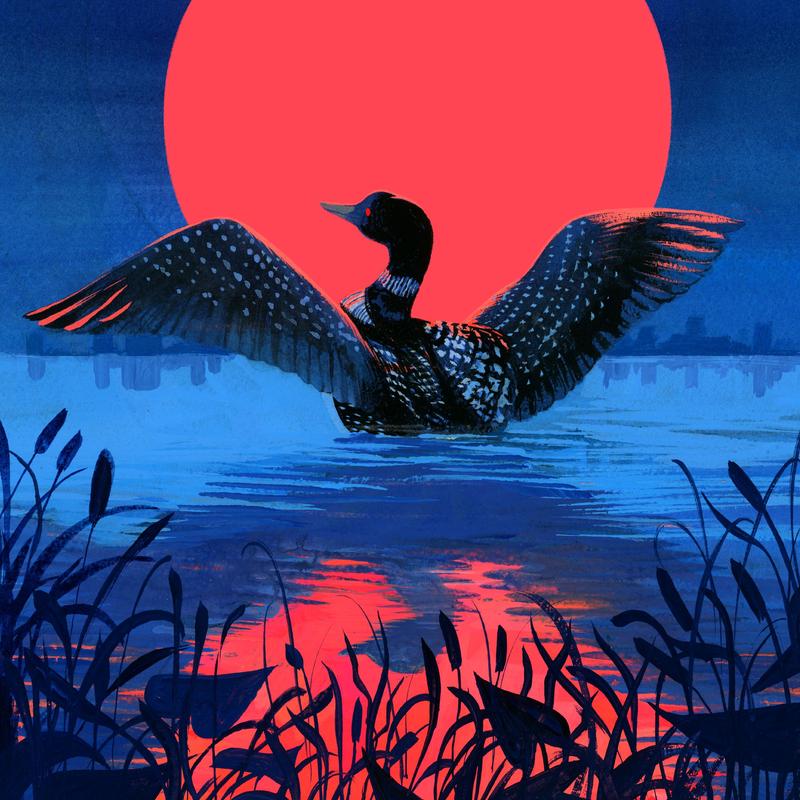
LULU: 3, 2, 1. Imagine you grow black and white feathers
LULU: and your eyes turn bright....
JUDE AND MO: Red.
LULU: you look peaceful as you
JUDE AND MO: float on the water.
SFX: nice peaceful floating, maybe even a cricket or bird]
LULU: Till u dive down, furiously kicking your black webbed feet, to HUNT
JUDE AND MO: fish,
LULU: stabbing them with your looong sharp beak. Fwoo.
LULU: And then you swim up to the surface again,
SFX: mmm, peaceful dusky placid again
LULU: and as the lake around you grows dark… in the night...
JUDE: you howl.
JUDE+MO HOWLS
LULU: You have become.
Jude/Mo: A loon!
LULU: A LOON.
LULU: Now's the part where I make you sing the theme song with me. Terrestrials Terrestrials. We are not the worst, we're the...
Jude/Mo: Bestrials!
LULU: Haha! You got it.
LULU: Terrestrials is a show where we uncover the strangeness waiting right here on earth,
LULU: I'm your host, Lulu Miller, joined as always by my songbud
ALAN: LOOOONS MAKE TOONS
LULU: Alan!
ALAN: DOES THAT MAKE THEM LOONY TUNES?
LULU: Ha ha. And today we are talking about the water bird… the diving bird, known as the loon!
[SFX LAKE CHIRPING BIRDS / DIVING SPLASH]
LUULU: Now if you’ve never seen a loon it looks like a really big duck, [QUACK] but it doesn’t sound like a duck.
SFX LOON CALL
MUSIC
MO: It’s like a whistle howl its like - you feel kind scared, but then you’re like not scared
LOON TREMELO
MO: it’s like.. creepy but you don’t wanna run away.
LULU: Why don’t you wanna run away?
MO: Because It’s like a different language we don’t understand.
LOON TREMELO
MO: You wanna keep listening…
LOON CALL
LULU Hmmm… And we decided to listen in on the world of loons today Because of a...
ALAN: LLLISTERNER REQUEST!
LULU: that came to us from…
MO: Minnesota!
JUDE: Minnesota, St Paul.
LULU one of ‘the twin cities’ of Minneapolis and St Paul. a vibrant midweestern metropilis home to people from all over the world, like mexico, somalia,, cambodia and laos... AND these two sisters:
JUDE I’m Jude.
LULU: (she’s 9)
JUDE: this is my little sister Momo
MOMO: I AM FIVE!
LULU: So you and your mom wrote us the other day that you wanted to learn more about loons...
JUDE yeah we have a whole lot of questions..
LULU: Because see, loons have all of a sudden started appearing everywhere in Jude and Mo’s life - which is the Minnesota state bird
JUDE: the soccer team is a loon
LULU: but recently the loon has also become a sort of MASCOT of the community’s response to something kinda scary that’s been happening where Jude and Mo live.
LULU: So I guess I just want to talk for a quick second about what things have been like these past few months And I wonder, Jude, if you could just describe, like, a little bit about what's going on?
JUDE: Um… we have two kids in my class who are going virtual.
LULU: Meaning those two classmates are joining through video chat (because)
JUDE: Because… certain people can’t leave the house… or something bad might happen to them.
RECORDING: And what might happen to them, is that they could be taken away by immigration officers, also known as Ice Agents, sent by the federal government to go after people that they claim don’t have proper permission to be living in the US, although they’ve also been going after some people who DO have all the proper permissions, and so all kinds of kids, especially those with family born in another country...
JUDE: they don't feel, feel safe to go to school.
LULU At the height of things, in some schools, up to 50 % of the students - according to some reports - were staying home.
JUDE: And I think that's kind of sad.
LULU: To try to help, Jude and her family have started driving a classmate to school
JUDE: we’re picking them up from the house to bring them to school cause their mom can’t leave the house to do it.
LULU And while Jude and Mo haven't felt scared of being taken, (because they’re white and the ICE officers have been mostly going after people of color),...
BUSIER MUSIC FADING IN
LULU...their city has been loud with screams and sirens as the ICE officers have been getting in fights with anyone trying to stop them from taking people away.
MUSIC REVERBS OUT
LULU: Mo and Jude, this sounds, this sounds scary. How are you guys staying... Okay?
JUDE: How I usually deal with problems is I take time by myself and I like to imagine....
MUSIC FADING IN
JUDE: like make a story, pretend that I am something else entirely.
Lulu: Like what?
Jude: Usually like an animal like a wild cat, like a bobcat, or a lynx, or a tiger…
Lulu: Huh.
Jude: Even like a species like winged wolves, with eagle wings…
MUSIC
LULU: And speaking of winged creatures, the whole reason Jude wanted us to do an episode about LOONS, is because one day a few weeks ago she was in the car with her mom, Natalie, who says,
NATALIE: we drove by the soccer stadium and we saw the big loon sculpture..
LULU: It’s this massive statue, made of all these metal pieces that sparkle in the light. And its wings are spread wide, its face pointed up to the sun.
JUDE AND MO: It looks like not worried. Like just calm. It does this every day.
LULU: hm.
MOM: and Jude and I just started talking about how beautiful it is and it's beautiful even at a time where there's so much darkness and fear in the city. And then we were able to sort of talk about how it's become like a symbol of the resistance.
LULU: The resistance, the people standing up to the immigration officers, the people who LOVE having immigrants in their city, who believe they belong. The LOON! Has become their mascot. There are loons on protest posters, and loon stickers on local businesses that won’t let ICE officers in. People are even getting tattoos of loons!
LULU: And why a LOON? Is there anything about the loon that would make it a good symbol of resistance?…
NATALIE: so We look to the loon as something that comes back, you know, every spring.
JUDE: They'll come back even no matter what, they always come back.
LULU: HM
NATALIE: Yeah. And the people, right? Like we're showing up for each other. Even in this dark time.
LULU: Woah - so they're a, they’re a symbol of resilience.
NATALIE: YEAH. A nd the girls and I talked a lot about how the call of the loon, like how they call each other, it’s what Juded calls a whistle-howl
NATALIE:...it's similar to the whistles that, that a lot of people here are carrying to alert each other of danger.
LULU: So if someone less at risk, like Jude’s mom, sees ICE officers coming - she can blow the whistle to alert her neighbors...
NATALIE: Just to say like, we're here and we're gonna do what we can to protect you.
LULU: Huh...just like ‘here I am’.
Natalie: Yeah.
LULU: I wonder if that’s what the loon calls actually mean too?
MO: I don’t know
LULU: Haha fair. And that’s why we are here in the first place.
LULU: Because jude and her family want to find out, they want to get to know the real creature… behind the mascot.
LULU so that is what we are gonna do today, Who are loons… really? And what super powers might they have that might inspire people to stand up against forces trying to knock them down.
CLAPPING So we gathered up a bunch of loon experts -
WALTER Hi
LULU: Starting with - scientist Walter Piper
WALTER I’ve spent 33 years studying loons.
LULU: Are you at a computer researching things, or what…
WALTER: No, I’m in a canoe, paddling towards loons
LULU: Do you have a favorite canoe snack?
WALTER: you know those horrible little honey buns that they sell in gas stations?
LULU: Yeah!
WALTER: i’m infamous for firing down 2 or 3 of those down.
ALAN: SFX in rapid fire GULPING DOWN THREE HONEYBUNS
LULU: hahaha
LULU: Well I hope you packed your honeybuns for today, Dr. Piper because Mo and Jude..
JUDE: We have a whole bunch of questions.
LULU: laughing oh! Alright!
LULU you ready?
WALT: Yeah oh, absolutely
JUDE: ok. Do loons have different calls and what do they mean?
ALAN MINI MUSIC
STING: It’s time for 3 loon language lessonssss! Do you speak my loon-guage?
LULU First up,
ALAN: the TREMOLO
WALTER: The tremolo is the famous one.
LULU: sounds almost like laughter LOON TREMOLO SFX
WALTER: the laughter like call is, is an alarm call people. That's the one most often heard by humans.
LULU: Yeah.
WALTER; Why do you think humans hear the tremolo call most often?
LULU Ohhhh, because they're, they're alarmed about us.
WALTER: right.
LULU: Next up
ALAN - the HOOT
LULU: That’s sorta like a little babytalk or chatter that loons when they’re up close with their chicks or other family members.
ALAN: HOOT HOOT how’s my little baby loooon.
LULU And finally - that famous - whistle howl - which, Walter says scientists call
ALAN: The WAIL / SFX WAIL CALL
WALTER: It’s the mournful call or the one that sounds lonely..
WALTER: And It’s sort of ironic
LULU: Because loons usually wail when they are NOT lonely, when they have a mate!
WALTER: It's a contact call to inform your mate that I'm over here…
LULU: Huh, A CONTACT call... is that at all similar to what Jude's mom said the human whistles are saying?
NATALIE: “we're here” and “we're gonna do what we can to protect you.”
WALTER: Yeah, that's a good parallel! they're telling each other: here I am.
LULU: Here i am.
WHISTLE + WHISTLE HOWL TOGETHER
LULU wow... walter said they’ll also use whistle - in a very different way though - as an alarm call.
WALTER: given to bald eagles because bald eagles are like the number one enemy of loons.
LULU: Oh, it's saying Watch out friends theres an eagle?
WALTER: Watch out. There's that bald eagle coming over. but also I know you're up there, uh, you know “Mr. Eagle, I see you, the game's up. There's no point in attacking me.”
LULU: whoa, that’s brave!
WALTER OH YEAH
LULU And speaking of … the loons, um, calls...
MO: Do loons fart?
LULU: Hahahaa
LULU: Thank you Mo. Do loons fart?
JUDE: and does it like, make bubbles in the water?
LULU: Hahahaa
WALTER: Um, I don't, I don't know that I've, I don't think I've ever, I've never seen it. you know, loons poop in the water. And so it's, it's easy to see them poop. And when they poop, their poop is white. And so it's like this cloud of that explodes behind them. And so the entire lake is like their bathroom. It sounds disgusting, but they, uh, you know. But I don't know about, I don't know about farting. I, I've, I've never been able to record that. Never tried, I suppose.
LULU: Walter wrote us back later to say he researched it and found that indeed loons do NOT make flatulent tunes.
ALAN: Thanks for that breaking wind, I mean news, LoonLoon, I mean Lulu.
LULU haha / groan.
ALAN: NEXT QUESTION!
JUDE: Can they breathe under water?
WALTER: No, they cannot.
LULU: But Walter says he can understand why it looks like they might be able to because...
WALTER: They can stay down allegedly as long as five minutes.
LULU: Wow. Which is thanks in part to their
WALTER: Super, super strong powerful legs when we capture them and mark them with leg bands, um, you know, one thing we have to do is grab the legs. because they're very good at pushing against the water.
LULU: OH, cause their jacked muscley legs could like kick you?
WALTER: Well it's just like slapping.
LULU: And Walter said that unlike most birds with light hollow bones, loons…
WALTER: They have mostly solid bones. They're relatively heavy.
LULU: Almost like diving weight, which let them go suuuper deeep (SFX BUBBLES)
WALTER: Their bodies are better adapted for swimming and diving than, than for flight.
LULU: How are they on land?
WALTER: Uh, terrible. They're, they're, they're ter -
LULU: How so?
WALTER: You can't have it all. You can't have it all, you know, I they can't turn fast. They flap like crazy to keep aloft. It takes forever for, for them to take off.
LULU: Now I'm picturing, are
WALTER: They can’t soar
LULU: huffing and puffing? Are they
WALTER: They're huffing and puffing.
HOPE: Even if you're not looking up, you can hear a loon fly over you and you'll know it's a loon.
LULU: Why?
HOPE You can hear the, because they're working so hard.
LULU: This is our second expert,
HOPE: Hello.
LULU Hope Flanagan. She's Seneca, originally from New York. But now lives in a community of Ojibwe people, who have made their home on the land we now call Minnesota for hundreds of years, maybe even longer
HOPE: Maanng is how you say loon in Ojibwe.
LULU Maan?
HOPE: Maang.
LULU: and as a bird lover and storyteller - she’s spent a lot of time studying loons - in the wild, And Hope is so in awe of how FAR these not-so-great-flyers can fly? that she will.. follow them!
HOPE: the loon migrates from, you know, this area down to Florida. So, I always go down there to see how are they doing, because sometimes that is a really difficult migration.
LULU: Nearly 2000 miles of huffing and puffing.
HOPE: So when you see 'em in Florida, they're mostly gray.
LULU: They’ve lost feathers...
HOPE: They changed their form.
LULU: But Hope knows this is not their end, because as Ojibwe stories put it, after a few months down south migrating birds like the loon.
HOPE: fly through the hole in the sky and bring the seasons back.
SFX SPRING WOOSHES IN / NEW SONG / BIRDSONG / LOON CALL
LULU: SPRING - in particular, which of course comes with the birds as they land back in Minnesota.
HOPE: the birds carry the seasons in their wings.
LOON SFX
LULU: OK Before we SPRING forward into a quick break, uh Jude, should we do one more question?
JUDE yeah. Why are loon's eyes red?
WALTER: Why are they red? You know, during the winter, um, loon's eyes are brown,
LULU Huh!
WALTER: So the change in eye color is one of many signals in addition to their feathers, that change into bright contrasty patterns, that, that signals a potential mate that, Hey, this is an adult who's in breeding condition.
LULU: Ahhh I’m thinking of it like Valentine eyes. I'm almost picturing red hearts in their eyes, It's like, I'm ready. Ready for love!
WALTER: Yeah.
JUDE : And does it make everything they see look red……!?
LULU: Ohhh!
WALTER: No, it doesn't
LULU: womp womp
HOPE: There's one story I've been telling a lot of lately.
LULU This is HOPE Again who says the Ojibwe tradition has another explanation for why the loons eyes are red.
HOPE: in this particular story, maang is.....(fading down)
LULU: it begins in a land where many birds were living peacefully.
LULU: until one day, this half-human sort of sneaky spirit shows up, called the Trickster.
HOPE: So he's trying to trick these birds 'cause he's hungry. He's always hungry.
LULU oh oh
HOPE So the trickster is calling on these birds to dance in a circle,
DANCING SOUND DESIGN BEGINS
HOPE: It’s called a Shuteye Dance,
LULU: the birds are supposed to keep their eyes SHUT - totally closed, as they dance.
HOPE: and he says I want you to sing your song as you dance and if you open your eyes, your eyes will turn red. And they'll be red for the rest of eternity. People will know that you're somebody who doesn't do what they're supposed to do cause you'll have red eyes.
LULU: Oh you’ll be marked!
HOPE: Yep. So during the story, you know there's geese and ducks and all kind of water birds, and they're doing their calls and Loon's doing his call.
HOPE: And it gets quieter and quieter in there. So loon gets suspicious 'cause it's getting quieter, right?
LULU yeah!
HOPE So Loon peaks, and the trickster is breaking everybody's necks to eat! So loon rats out the trickster. He goes, “He's killing us. He's killing us. Fly away. Fly away!”*
LULU: As punishment for breaking his rule, the trickster turns the loon’s eyes red.
LULU: And that’s why, according to the Ojibwe legend:
HOPE: you can still see the redness of his eyes when you look at the loon today.
LULU: And so to you, is that... It's like it's marked by breaking the rule, but it's by, it's by challenging a dangerous authority. It's by being skeptical and brave, sort of? Is that what you see in the red eye?
HOPE: you know, I'm a storyteller, right? My job is to tell the story and then you give the message that you need.
LULU: huhhh
HOPE I can't tell you what you’’re supposed to get
LULU: You can't?
HOPE: No, no, no, no, no. It's for you.
LULU: I asked Jude what she makes of this story about the loon.
JUDE: as the other birds are focusing on other things, He peeks right? He peeks. And warns all the other birds. To protect them. Maybe like those birds were his friends or something…
LULU: like his flock, like different birds but he’s still a part of them like it’s his–
JUDE: Like a community?
LULU: Yeah. And - whether or not people in Minnesota know that Ojibwe legend, it does seem like a LOT of them in recent months have been acting like that community- minded (red eyed) loon
NATALIE: if you drive down the streets during the week, you'll see parents basically at every daycare, every school in yellow vest doing parent patrols.
LULU: That’s Jude’s mom Natalie again.
NATALIE : churches are packing up groceries…
LULU: who started listing off all the ways she’s seen her community rising up
LULU: From marching (and singing) in the street in protest
LULU: To providing shelter, and food and medicine to people who need it.
MO: Yep!
LULU Even kids are trying to help. There are some writing letters to ICE agents -
LULU: asking them to consider how they are hurting people.
FOLDING PAPER SFX
And other kids are folding origami bunnies, hundreds of them, as a wish to keep their bunny-hat-wearing classmate Liam SAFE in the country..
even though it’s uncertain if he’ll be allowed to stay.
NATALIE : Like I don’t know of any other creatures that have that kind of… red eye… and… they seem like a powerful reminder that we can Mobilize and take care of each other, watch out for each other
LULU When we return from break…. Hope will bring us a pretty cool secret loons have to teach us… about the very idea of home.
[BREAK]
LULU: Terrestrials is back with the loon, a bird that's sleek and black like the night. with speckles of white on its feathers, almost like stars. Which is why for the Ojibwe people, the loon looms large in the universe itself
HOPE: is in our star stories, you'll see this.
LULU: Okay. You're holding up a, a, a chart?
HOPE: So the maang is always in the sky.
LULU: wait, so there's a constellation that's a loon?
HOPE: Yes. The loon constellation is right there.
LULU: Whoa.
HOPE: see that?
LULU: Hope shows a map of the night sky with all of these shapes that we know as Orion and the big dipper, but in Ojibwe tradition, so many of them are spirits and animals. And the one cluster of stars shaped like a loon?
HOPE: That's the, the little dipper.
LULU: Oh!
HOPE: yeah the little dipper!
LULU: Is a loon!
LULU: The little dipper is a constellation that has 4 stars in the shape of a pot and 3 little stars that look like a handle. And the end of the handle is the brightest star, which is also known as the North star, [SFX SHIMMER] And that sits, for the Ojibwe, at the end of the loon's tail.
HOPE: The specific North star is called agiwaydanung, the going home star. [SFX SHIMMER] 'cause once you can find that star and you can find the loon constellation, you can find your way home. 'cause now you know where North is.
LULU awww
SOUND DESIGN - WIND AND MUSIC
LULU: Speaking of home - Jude and a lot of her classmates wondered:
JUDE: Where is home for loons during the winter? like when they fly away from Minnesota, where do they go?
LULU And as we heard before break, some go to Florida…And it turns out some go to Louisiana, Some to Texas, And some to….
LEONARDO: Hello, Right now I am standing in front of a lake in Mexico.
LULU: Mexico! This is biologist Leonardo Chapa who is based in central Mexico.
LEONARDO: I am looking at birds. There are many different species of water birds, including duck, egrets, plovers...
LULU: And, though he doesn’t see any loons at the moment... He has seen them over the years.
Leonardo: Yeah, like in the Gulf of Mexico, we have seen them here in San Luis Potosi.
LULU: It’s just part of their life cycle – they go back and forth. Home is Mexico. Home is the United States.
LEONARDO: And actually on my balcony, there's a migratory bird that visits me every day.
LEONARDO: It's very cool because US was my home for 10 years.
LULU: For a season of his life, Leonardo lived in Illinois
LEONARDO: So it's, it's like, oh. There come my visitors from my former home. Right?
LULU LAUGH ha ah
LEONARDO: Ha ha
LULU To the loons, the borders between countries - mean nothing. And migrating from one place to another… does not mean they do not belong.
LEONARDO: They have another home down here I guess. to get the best of both worlds. they just have to survive, right? How can I say? It is like generalist strategy.
LULU: AH! Generalist strategy! Like we learned about in our coyote episode: instead of being VERY GOOD AT ONLY ONE SPECIFIC THING, generalists have this incredible flexibility and creativity, like how Coyotes can survive in mountains hunting prey or live in the city like navigating busy streets and eating pizza
It’s the same with loons, sure they love their fish but they’re also down to eat
WALTER: things like crayfish, crabs, lobsters.
LULU: Walter again
WALTER: insect larvae, leeche.,
LULU: yuck but FLEXIBLE!
LULU: ANd loons can survive in freshwater or saltwater, minnesota, parts of mexico, greenland, alaska! They're scrappy! And resilient. And that brings me back to the whole point of this episode: are loons actually a good mascot for people trying to resist?
WALTER: Well, I mean, loons have long lives and they have lots of ups and downs in their lives. Most of our lives are rollercoasters, right? We have times when we don't, we're not doing so well. And other times when we're doing great and other times when we're somewhere in the middle, and loons are the same way.
They, have, um, good times and bad times, and, the fact that they just keep picking themselves up and dusting themselves off and going back out there even if somebody's just beating them up.
And if their feathers are all torn up and, and their wing’s a little injured, you know, they just, they just kind of hang in. They figure out how to survive, make it to the next day, jump to the next pond and, you know, that they know, they know that, that any one setback is temporary and that they're going to be able to come back strong the next year and the world will look very different.
LULU: What I love about what walter is saying about loons - is that they ARE resilient. But in this scrappy way. There’s something almost inelegant about loons. They fall down, they lose their feathers, they turn gray. They can’t fly all that well. But they do return. This mascot doesn’t have superpowers - So much as something maybe more useful. Which is the earthly power of trying however you can. Awkwardly, tiredly, clumsily flapping against headwinds. And when you run out of steam, listening… for the call of your neighbor…
SONGY SONG SONG HERE
LULU: Allllloooon Goffinski, with harmonies from Natalia Ramirez. And incredible loon howls… from Jude and her classmates.
And that is where we are gonna leave it today.
Huge thanks to Jude, Mo, and mom Natalie for writing in. don’t forget you too can write in to request that we cover an animal, a plant, a sound - i dunno anything that happens here on earth.
And if you need any resources relating to immigration and your rights and how to get or give support, we have linked a bunch of great orgs RIGHT here in our show notes. You just can go click on ‘em
And another thing you could check out is hope flannigan’s very cool organization - its called dream of wild health - and they serve the indigenous community in the twin cities by mending the world through farming, gardening, cooking and storytelling, again they are called DREAM OF WILD HEALTH
Terrestrials was created by me, loon loon miller uh with wnyc studios
The people who told me to make that joke and who produced this episode are Ana G with sound designed by Mira Burt-Wintonick. [And if you listen closerly you can hear piano! Played by JUDE! Thank you jude!] Sarah Sandbach is our EP. Our team also includes Alan Goffinski, Tanya Chawla, joe plourde, and natalia ramirez. Fact checking by Angely Mercado.
Special thanks to Shannon Heffernan - for top notch investigative reporting on how kids (and adults) are being effected by ICE, over at the Marshall Project. Um and also huge thanks to Erica Heilman at the podcast Rumble Strip - they have a new episode out about one of the songs being sung in Minnesota
LULU We played it in our episode, it’s called hold on, and the rumble strip episode tells you where it came from, how it’s traveled, that episode is called HOLD ON.
LULU: That sound means we’ve got some BIRTHDAYS TO SHOUT, some belated january birthdays uh and then also some march birthdays For our Explorers Club members… so
LULU / ALAN HERE WE GO!
January
Allison
Ariel
Clara
Cody
Ella
Eli
Emily
Harvey Rosalyn
Henry, 6
Henry, 8
Hildy
Lucy
Molly
Prometheus
Santiago
Tallulah
HAPPY BIRTHDAY! Now that march oness which also includes me, happy birthday
Ok we got
Adelaide
Anna
Avni
Calvin
Casmir
Cooper
Desmond
Diana (say "Deana")
Emil
Evelyn
Everett
Finn
Frans
Hattie
Henri or is it Henri?
Isa
Kintu
Lea
Leo
Lucien
Luna
Maeve
Meadow
Mo
Olive
Otis
River
Sammy
And Stanley
If you'd like to join the Explorers Club (and experience off key singing from me, along with ad-free listening and stuff, go to Terrestrialspodcast.org/join and see if its for you.
Alright yall, spring is returning at last and should you ever find yourself lost in the dark, if you look up for seven stars - that may be pointing you a way home
HOPE, the fact that the loon is posted up in the sk,it's a responsibility that the loon has to carry. you're going to be helping the people, the planets, you know, you've got a responsibility you have to carry. But it's also like an honor.
See you in a couple spins of this dirty old planet of ours. Bye!